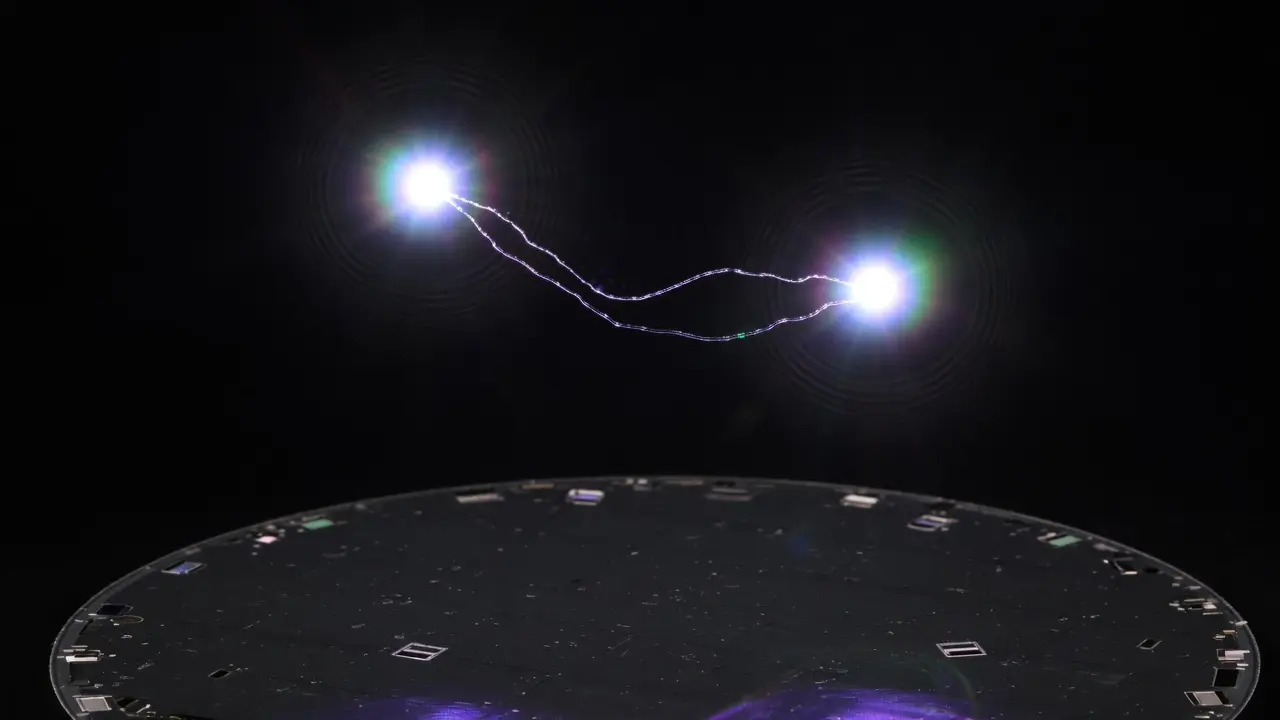
After fifteen years of experimental work, researchers at QuTech have demonstrated coherent control of a qubit built from elusive Majorana quasiparticles, publishing their results in Nature, the company says. The achievement marks a step toward realizing a vision physicist Alexei Kitaev first proposed twenty-five years ago: using these quasiparticles to create more robust qubits by encoding information non-locally.
“There are broadly speaking two routes towards a Majorana-based qubit,” explains Francesco Zatelli, “One is to first establish topologically protected Majorana states and then use them to build a qubit.” This new approach offers a different path to building quantum computers less susceptible to environmental disturbances.
Kitaev Chains Enable Creation of Majorana Qubit Devices
Researchers at QuTech have, for the first time, coherently controlled a qubit based on Majorana modes hosted within short, two-site Kitaev chains. This demonstration uses what the team refers to as “poor man’s Majoranas,” acknowledging the limited topological protection offered by these minimal chains, yet establishing a functional qubit for further study.
Each chain, comprising only two quantum dots, hosts two Majorana modes, collectively forming the qubit’s foundation; the arrangement mirrors the coupled Kitaev chains central to the design. This achievement builds on over a decade of work focused on establishing the necessary conditions for manipulating these exotic quasiparticles.
The controlled qubit is a significant step toward both improved qubit designs and a deeper understanding of Majorana physics itself. “This qubit forms a solid starting point for both better qubits as well as a more detailed study of Majorana physics. There are some very fundamental outstanding challenges such as non-Abelian exchange statistics that now become in reach for experiments,” explained a researcher involved in the project.
The team’s approach differs from earlier efforts that prioritized establishing fully topologically protected Majorana states before attempting qubit construction. Instead, they focused on demonstrating qubit operations with less-protected modes, with plans to enhance protection in future iterations, according to QuTech. Michael Wimmer’s group provided theoretical insights underpinning these systems, while Srijit Goswami’s group previously demonstrated longer Kitaev chains in two-dimensional devices, contributing to this latest advance.
The ability to observe how coherence changes with chain length is now a primary focus, offering a practical method for testing the degree of topological protection. The qubit’s state is visualized on a Bloch sphere, where coupling the Majorana modes allows for rotations around the X and Z axes, enabling quantum operations. The basis states correspond to even or odd electron parity within the two Kitaev chains. This controlled manipulation represents an advancement in the pursuit of robust quantum computation, using the unique properties of Majorana quasiparticles.
This qubit forms a solid starting point for both better qubits as well as a more detailed study of Majorana physics. There are some very fundamental outstanding challenges such as non-Abelian exchange statistics that now become in reach for experiments.
Leo P. Kouwenhoven
Demonstrating Coherent Control via Parity Oscillations
Researchers now measure regular patterns in the qubit’s behavior, observing coherent oscillations in the probability of finding the qubit in its initial state by varying the interaction time between the chains. The observed coherence currently decays within tens of nanoseconds, prompting the team to investigate if longer chains can enhance quantum information protection against disturbances. “Observing if coherence improves with chain length is probably the best practical way to test topological protection,” says Bart Roovers, who is already experimenting with qubits constructed from two sets of three quantum dots.
This focus on chain length offers a practical method for verifying the anticipated benefits of topological protection, a core principle behind Majorana-based qubits. The achievement unlocks new experimental avenues, bringing previously inaccessible challenges within reach, such as investigating non-Abelian exchange statistics. Following years of scientific hurdles and a distinct experimental approach, this result signals a new phase in Majorana research, impacting both quantum computing and fundamental physics.
Observing if coherence improves with chain length is probably the best practical way to test topological protection.
Bart Roovers, who is already experimenting with qubits consisting of two times three quantum dots
Two-Site Chains: Initial Qubit Operations with “Poor Man’s Majoranas”
The demonstrated qubit relies on a system of just two quantum dots per chain, a deliberate simplification allowing researchers to focus on establishing control rather than immediate topological protection. Bart Roovers, a first author on the study, explained that this approach allows for demonstrating essential qubit operations before tackling the complexities of robust protection. The team verified coherent control by manipulating the qubit with brief interactions between the two chains, then measuring the resulting quantum state.
Initial state measurements were followed by a controlled evolution period before a second measurement, and repeating this process with varying interaction times revealed regular patterns in the results. These patterns manifested as coherent oscillations, predictable rises and falls in the probability of the qubit returning to its initial state, confirming deliberate manipulation of the qubit’s quantum state.
The choice to prioritize chain length as a key variable stems from the theoretical expectation that topological protection strengthens with increased chain size. While the current two-site chains offer limited protection, the team believes that extending the chains provides a practical means of verifying this anticipated benefit.
There are broadly speaking two routes towards a Majorana-based qubit.
Francesco Zatelli
Extending Chain Length to Improve Topological Protection
Increasing the length of the superconducting chains used to host Majorana modes is now a primary focus at QuTech, following initial demonstrations of qubit control with minimal two-dot systems. Researchers are building upon the established ability to manipulate qubits formed from these “poor man’s Majoranas” to explore whether extending chain length demonstrably improves topological protection against environmental disturbances.
This shift in emphasis represents a move toward validating theoretical expectations regarding the robustness of quantum information encoded in longer chains. The team’s current qubit design uses two minimal Kitaev chains, each comprising just two quantum dots, and is limited by coherence times that decay within tens of nanoseconds.
Francesco Zatelli explains that the current work represents a deliberate choice of approach to Majorana qubit development, the company says. Another is to create and control Majorana states without full topological protection, use them to demonstrate qubit operations and then work towards improving their protection.” For over a decade, the field largely concentrated on the first route, but this team’s success with the latter has spurred a wider research effort within QuTech, encompassing improvements in chain stability and readout methods, the company states. The goal is to move beyond demonstrating basic qubit operations and towards realizing the full potential of topologically protected quantum computation.
For the first time, we can coherently control a qubit based on Majorana modes. This is something we have been working towards for several years.
Bart Roovers



See today’s quantum computing news on Quantum Zeitgeist for the latest breakthroughs in qubits, hardware, algorithms, and industry deals.