Levent Alpöge, a number theorist on Anthropic’s staff, published a four-page note on his personal website on Friday, 20 November. In it he claims that he and the company’s Claude model have proved the Riemann Hypothesis, the 167-year-old conjecture widely regarded as the most important open problem in mathematics. The note leaves little room for doubt about what is being claimed.
The note goes on to say that the same method settles a far broader family of related conjectures. Nobody outside the project has yet confirmed the argument, which has so far been released as computer code with no conventional paper alongside it. Our earlier coverage of Lean and AI in mathematics is listed at the end.
What the Riemann Hypothesis says
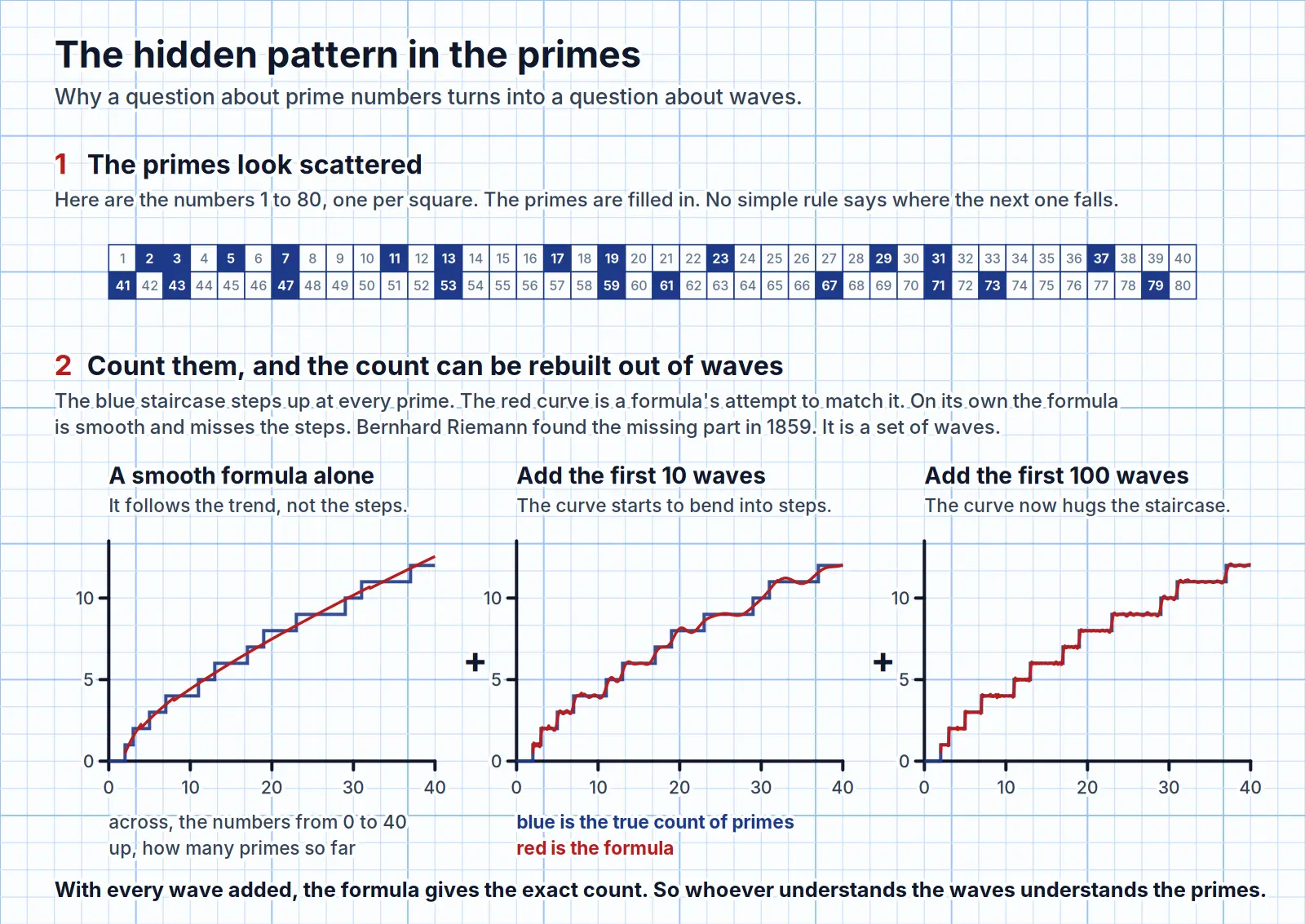
Prime numbers are the whole numbers that divide only by themselves and 1, such as 2, 3, 5, 7 and 11. Every other whole number is made by multiplying primes together, which makes them the building blocks of arithmetic. They thin out as numbers grow, but nobody can predict exactly where the next one will fall.
What mathematicians can do is count them. There are 78,498 primes below one million, and a smooth formula that goes back to Carl Friedrich Gauss estimates 78,628, which is too high by only 130. The formula stays that good however far anyone has checked, but it is never exactly right.
Bernhard Riemann showed in 1859 what the formula was missing. He found that the gap between the estimate and the true count is made of waves, in the way a musical chord is made of pure notes. Add every wave to the smooth formula and the result is the exact count of primes, steps and all.
Each wave comes from one special number, called a zero of the Riemann zeta function. The zeta function is a formula built from all the whole numbers, and its zeros are the inputs that make it come out as exactly zero. These inputs are numbers with two parts, so they are plotted as dots on a flat map and not as points along a line.
A few easy zeros sit at −2, −4, −6 and so on, and they barely affect the count. The hypothesis concerns all the others, which are known as the nontrivial zeros.
Where a dot sits on the map decides what its wave does. Its height sets the pitch, meaning how fast the wave wiggles. Its position from left to right sets the volume, meaning how quickly the wave swells as the numbers being counted get larger.
The Riemann Hypothesis states that every nontrivial zero sits on a single vertical line, called the critical line, where the first part of the number equals one half. The middle matters because the zeros come in mirror pairs across that line. A single zero off the line would have a twin on the right-hand side, and that twin would make a wave louder than any wave from the line.
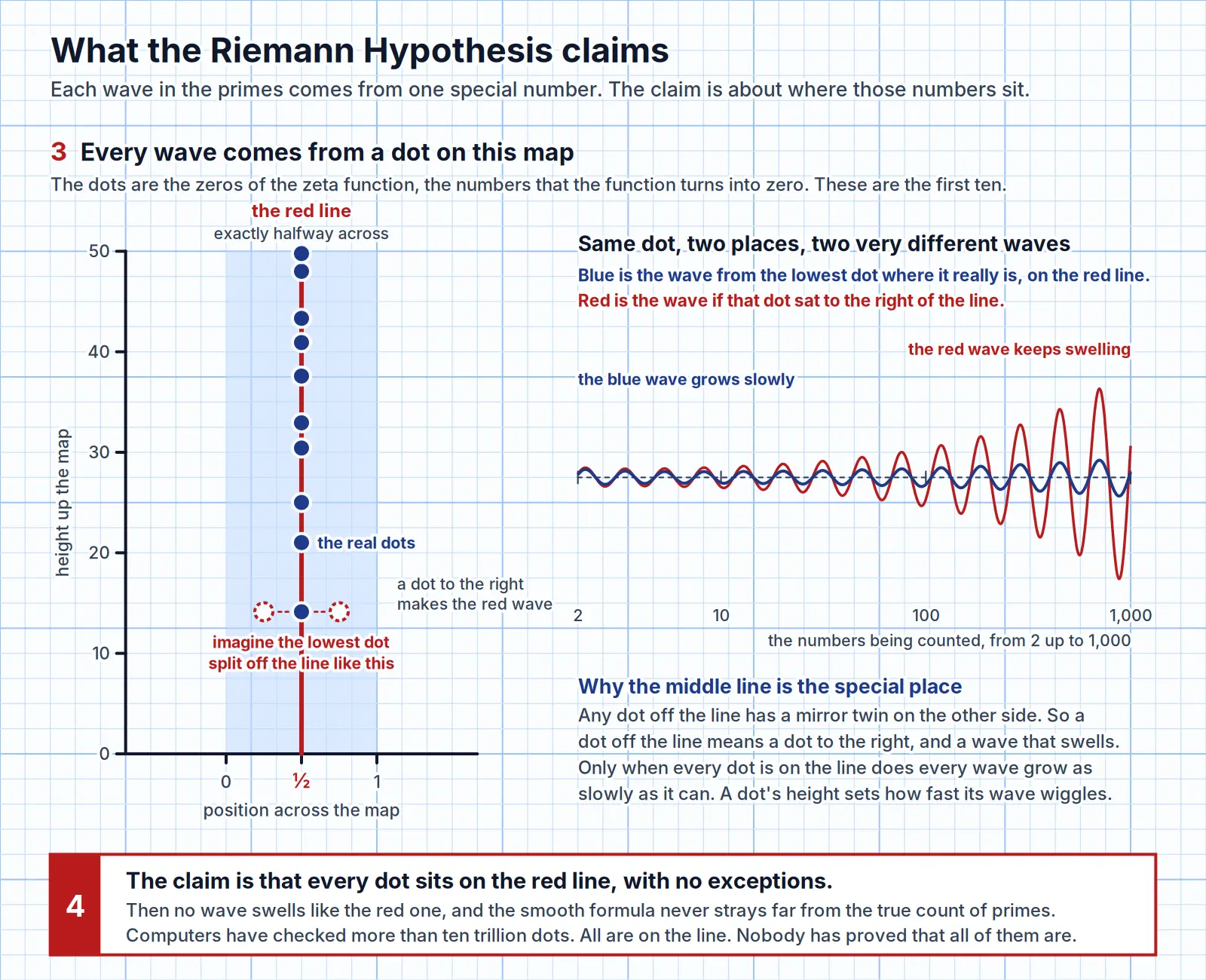
If the hypothesis is true, every wave stays as quiet as it can, and the smooth formula never strays far from the true count. Its miss grows no faster than roughly the square root of the number being counted up to, about the scatter seen when a fair coin is tossed that many times. In that sense the primes would be as evenly spread as they could possibly be.
If it is false, at least one wave grows faster than that, and somewhere far along the number line the primes bunch up and thin out more than expected. Computers have checked more than ten trillion zeros and found every one on the line, but no amount of checking can cover infinitely many.
A great many published theorems begin with the words “assuming the Riemann Hypothesis”. The Clay Mathematics Institute lists it among its seven Millennium Prize Problems, with a reward of one million dollars.
Alpöge says his method also proves the Generalized Riemann Hypothesis, which makes the same claim about Dirichlet L-functions. These are relatives of the zeta function that track how primes fall into arithmetic progressions, such as the numbers leaving a remainder of 1 when divided by 4. He expects it to reach further still with more work.
“I believe I have, working with Claude, discovered a proof of the Riemann Hypothesis.”
Levent Alpöge, Anthropic, 20 November 2026
A Riemann Hypothesis proof delivered as code
The unusual part of the announcement is its form. The note says the entire argument has been formalised in Lean, a proof assistant in which every logical step is written in a formal language and checked mechanically by a computer. It adds that the formalisation leaves no unproven assumptions in place.
The Lean project has been posted on his site as a 14-part archive, and a readable account of the mathematics is promised for later. Alpöge concedes that the argument as it stands is extremely long and will probably be simplified a great deal.
Lean already referees work closer to quantum computing. Recent projects have used it to check quantum error-correction claims and to set 76 quantum theorems as a benchmark for AI provers.
The two checks a Lean proof still has to pass
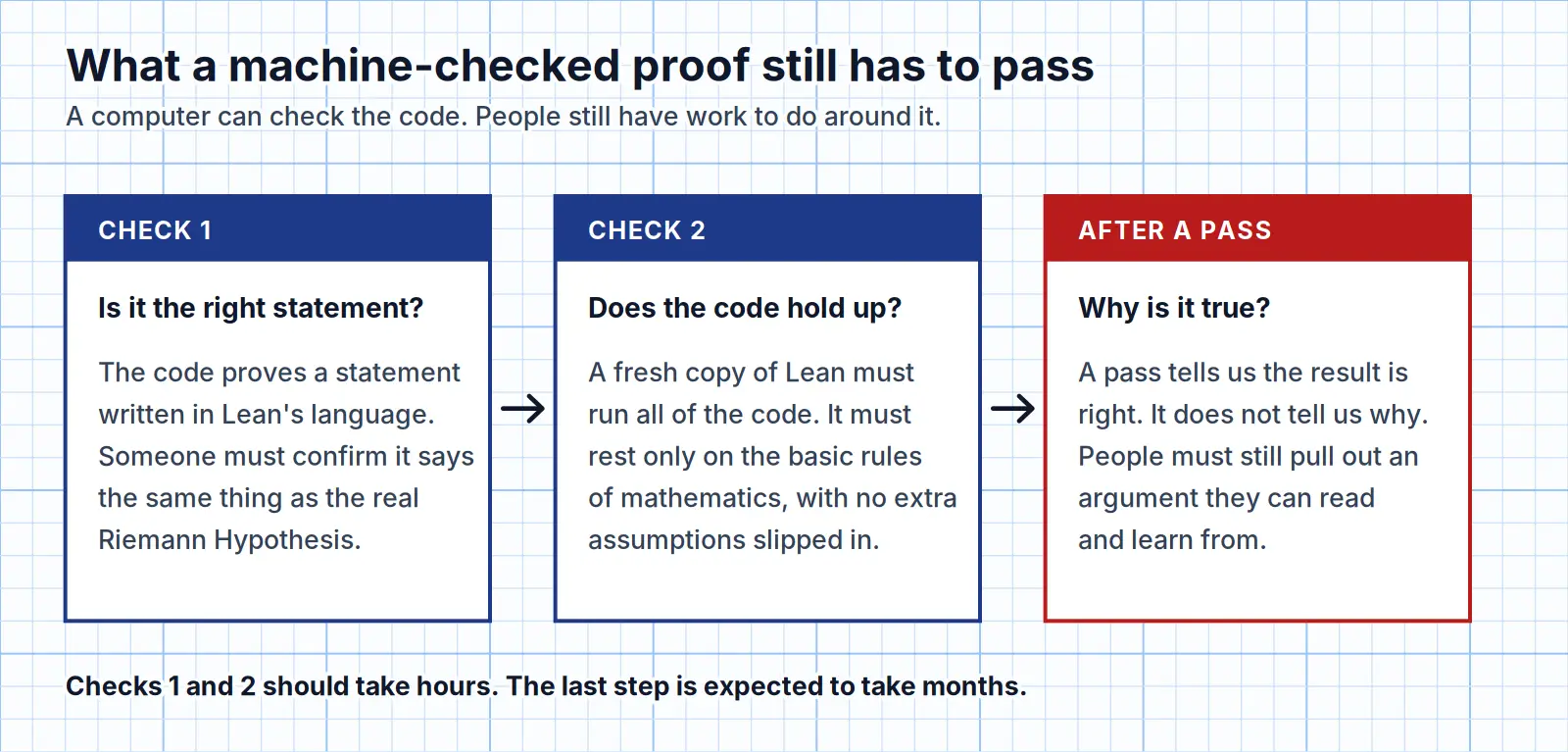
A formal proof moves the burden of checking from the reasoning to two narrower questions. The first is whether the statement written in Lean is a faithful translation of the real hypothesis. The second is whether the code compiles against a trusted version of Lean without smuggled axioms or other tricks.
Our view is that the first question is the easier of the two. It comes down to reading a short top-level statement against the definitions of the zeta function already held in Mathlib, the community-maintained library of formalised mathematics that Lean projects build on. An independent mirror of the code reports that the top-level theorem uses Mathlib’s own statement of the hypothesis, with separate statements for Dirichlet L-functions. Its full check had not finished at the time of writing.
The second question will take longer, and it is where we would watch most closely. A project of this size needs hours of computing time simply to compile. A clean compile only counts once the checkers have listed every axiom the final theorem depends on and found nothing beyond the standard foundations, and Lean can report that list with a single command.
A machine-checked proof also says nothing about why the result is true. Even a pass would leave number theorists with months of work to extract an argument that people can read and learn from. Scientific American reported that specialists expect the basic checks to go quickly, which fits with how fast the Lean community mobilised on Friday.
How the argument is said to work
The note sketches a route that starts from Stepanov’s method, a technique devised by Sergei Stepanov in the 1960s. It led to an elementary proof of the Riemann Hypothesis for function fields, a parallel setting in which polynomials play the part of whole numbers. André Weil had first proved the result there in the 1940s.
Stepanov’s approach builds an auxiliary function that vanishes many times over at each of a large set of points, a property called multiplicity. The sheer amount of vanishing forces the bound that is wanted. The note says that multiplicity is hard to find over the ordinary integers, and that this gap stood between the function field proof and the real thing.
Theta lifts and the square root of X
Alpöge says the counterpart comes from long chains of theta lifts. A theta lift is a procedure for carrying automorphic forms, the highly symmetric functions at the centre of modern number theory, from one symmetry group to another. In his account each lift in the chain contributes a unit of multiplicity.
The sum in question runs over the prime powers up to a length X, weighted by the von Mangoldt function, which assigns each prime power the logarithm of its prime. For that sum the chain has to be roughly the square root of X lifts long. He credits Claude with suggesting that length and writes that the model was well ahead of him by the end.
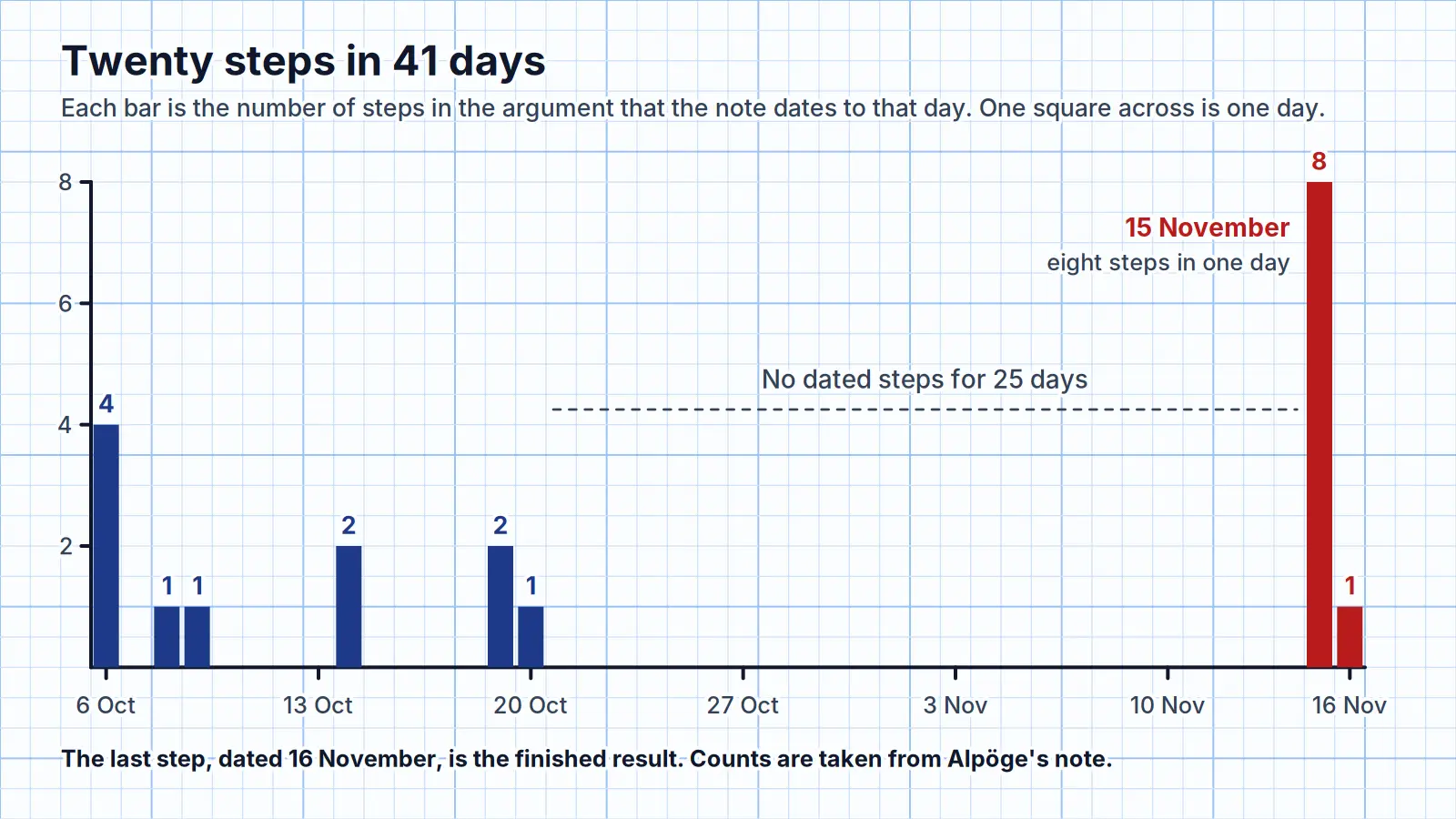
The note closes with a 20-step timeline, which Alpöge says Claude assembled, running from 6 October to 16 November. That puts the whole effort at 41 days. In a footnote he says a machine-written version of the argument, which he chose not to post, ran past 250,000 pages.
Reasons for caution
Claimed proofs of the Riemann Hypothesis arrive regularly and have always failed, including a widely publicised attempt by the late Sir Michael Atiyah in 2018. Alpöge’s note is candid about its own state, warning that parts of the sketch are paraphrased from Claude’s summaries and may be hard to follow.
It thanks a number of prominent mathematicians, among them the Fields medallist Manjul Bhargava and Princeton’s Peter Sarnak. An acknowledgement is no endorsement, though, and none of them appears to have publicly vouched for the result so far.
What separates this claim from its predecessors is that it can be tested by machine. Alpöge is an established researcher who, according to reports, used Claude in July to produce a solution to another long-standing problem, the Jacobian conjecture. It would not be the first such result from an Anthropic model, since an AI system running one settled an almost 20-year-old conjecture on quantum speedup earlier this month.
Even a clean compile would leave the Clay prize some way off, since the institute’s rules call for publication and a two-year period of acceptance by the mathematical community. The bar is high, and OpenAI’s claim on the Navier-Stokes problem, another of the seven, has yet to clear it.
Why the Riemann Hypothesis matters to quantum physics
Physicists have had a stake in the Riemann Hypothesis since the 1970s. Hugh Montgomery and Freeman Dyson noticed then that the spacing between zeta zeros appears to follow the same statistics as random matrices, which physicists use to model the energy levels of heavy nuclei.
That observation revived the Hilbert-Pólya conjecture, the idea that the zeros are the energy levels of some undiscovered quantum system. A proof by purely number-theoretic means would put the zeros on the line, but it would leave both the spacing pattern unproved and that system unidentified.
For cryptography the practical effect would be small. A proof would firm up the guarantees behind some primality tests and running-time estimates that currently assume the generalised hypothesis. It would hand attackers no new way to factor large numbers, and the threat to RSA encryption remains Shor’s algorithm running on a large fault-tolerant quantum computer.
The larger consequence would fall on mathematics itself. The only Millennium problem the Clay institute counts as solved is the Poincaré conjecture, which took Grigori Perelman years of solitary work. By the note’s own timeline, this one would have gone in six weeks of conversation with a language model. Scientific American reports that the first independent checks of the Lean code should not take long.
More on the Riemann Hypothesis, Lean and AI in mathematics
Lean and machine-checked proof
- Google’s AI agents write quantum algorithms in Lean and prove them correct
- Google Quantum AI designs quantum programs with AI and verifies them by proof
- New Lean framework formally checks quantum error-correction claims
- Lean library links quantum codes to their error-correction criteria
- QudeLeap and HKUST build Lean-QIT for formalising quantum theory
- Researchers build trust in AI-designed quantum algorithms with Lean 4
- Ethereum’s leanVM is now formally verified for quantum resistance
Theorem provers and AI
- AI verifies mathematical proofs step by step
- Ax-Prover solves theorems in mathematics and quantum physics
- DeepSeek-Prover V2, a model aimed at formal mathematical reasoning
- Simple structural guidance lifts AI theorem proving
- Google DeepMind’s AI for maths research initiative
Anthropic and Claude in science
- Stanford team confirms an AI proof of quantum speedup limits
- Anthropic’s Claude improves quantum optimization designs
- Claude Opus 4.6 solves a Hamiltonian cycle problem
- AI solves high-energy physics problems with Anthropic’s Claude
- Anthropic predicts four ways AI will advance scientific discovery
Maths prizes and famous problems
- OpenAI’s AI solves Navier-Stokes, a million-dollar maths problem
- AI companies solve maths problems decades old, warns Fields medallist
- OpenAI shares raw research data with academics
- A human-assisted proof finds a counterexample to an Erdős prize conjecture
- How a mathematician bridged quantum physics and number theory
- David Hilbert and Paul Erdős, two of our profiles of mathematicians



See today’s quantum computing news on Quantum Zeitgeist for the latest breakthroughs in qubits, hardware, algorithms, and industry deals.