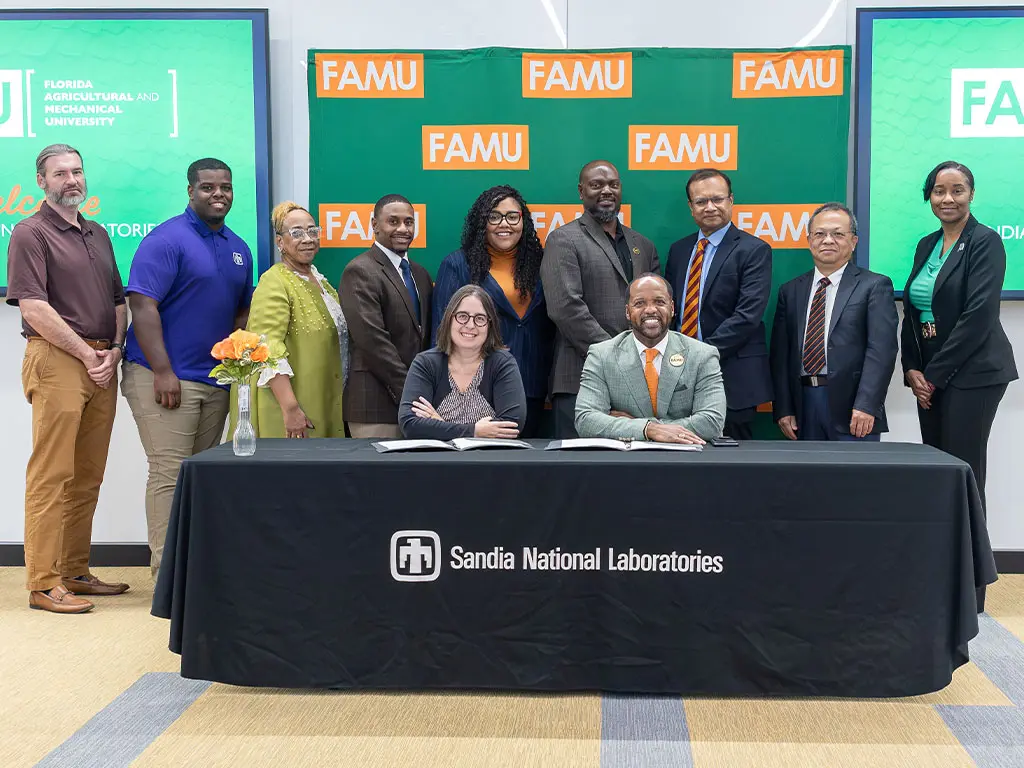
Luxquanta and partners report demonstrating an 8,000-kilometer Quantum-Safe Network, a distance signaling substantial progress in the feasibility of long-range quantum communication. This achievement, unveiled at a recent high-performance computing conference, emphasises growing momentum in securing data transmission against future quantum computing threats. The demonstration involved connecting nodes across a vast distance. This advance arrives as Florida A&M University and Sandia National Laboratories extended their five-year research partnership focused on artificial intelligence and quantum computing.
Five-Year Agreement Facilitates Faculty and Student Exchange Programs
This agreement builds upon a prior partnership established in 2020, amplifying joint research initiatives, student internships and faculty exchanges while providing access to specialized research facilities at the national laboratory. The extended collaboration directly supports FAMU’s ongoing efforts to achieve Carnegie R1 research status, a designation recognizing the highest level of research activity for universities. Robert E. Nobles II, FAMU’s senior vice president for Health Science Enterprise and Research Innovation, explained that the partnership is strategically designed to attract and retain high-caliber students by offering experiences that align with their career aspirations, Sandia says.
“To recruit high-caliber students, you have to have something that they want,” Nobles said. Providing students with access to real-world research challenges and potential career pathways within a national laboratory setting is valuable.
This focus extends beyond traditional engineering disciplines, with FAMU aiming to broaden its research scope and hands-on learning opportunities across multiple fields to address complex national challenges. The university intends to expand its research footprint beyond Tallahassee and forge stronger connections with leading national laboratories.
Jennifer Gaudioso, director of Sandia’s Center for Computing Research, highlighted the strength of the existing relationship between the two institutions, noting the development of robust connections between faculty and researchers. “What has impressed me most about this partnership is the strength of the relationships that have developed between FAMU and Sandia,” Gaudioso said.
The renewed agreement specifically identifies shared research interests encompassing artificial intelligence and machine learning, quantum science and computing, advanced materials, pulsed power, high-energy-density science and numerical approaches to complex systems, signaling a focused approach to collaborative innovation. The partnership’s scope extends beyond research to encompass faculty development and workforce preparation, with the agreement outlining potential opportunities for faculty sabbaticals, summer research assignments and personnel exchanges.
Sandia researchers will also contribute to university instruction, graduate mentorship and academic advisory activities, supporting a reciprocal exchange of expertise. Donald Palm, FAMU’s executive vice president for Health Sciences Enterprise and Research Innovation, described the renewed agreement as a more intentional approach to the longstanding relationship with Sandia, noting a recent FAMU delegation visit to explore further engagement opportunities. Palm emphasized the value of conducting research and subsequently integrating that knowledge into their teaching, enhancing the learning experiences for students.
Specific student opportunities detailed in the agreement include undergraduate and graduate internships, mentorship programs, capstone and senior design projects and research experiences alongside Sandia scientists and engineers. While the agreement outlines these potential activities, actual implementation will depend on mutual agreement and the availability of funding, as the agreement does not independently commit financial resources. Suvranu De, dean of the FAMU-FSU College of Engineering, emphasised the renewed agreement’s potential to build upon existing research and workforce development efforts, highlighting the value of Sandia-supported faculty research and hands-on learning experiences for students working alongside laboratory researchers.
“The purpose of leadership is to create opportunities,” De said. Sandia’s commitment to the partnership is further demonstrated by the role of Anthony Sanders, campus partnership manager at Sandia National Laboratories, who affirmed that renewing the agreement reflects the strength of the existing collaboration, according to the company. Sanders credited faculty and staff at both institutions with sustaining the relationship and developing new connections during recent gatherings.
The collaboration is also exploring systems engineering as a promising area for future joint research, indicating a proactive approach to identifying and pursuing emerging opportunities. Gaudioso further explained that FAMU students contribute valuable perspectives to Sandia’s work, the firm reports. “FAMU students bring curiosity, technical capability and fresh perspectives, and Sandia benefits from engaging with emerging scientists and engineers who are interested in mission-driven work,” Gaudioso said.
“I’m excited to see this collaboration continue to mature and create new pathways for students, faculty and researchers.” “This is exactly what we should be doing,” Nobles said, “And we will be doing a lot more of this.” The collaborative framework outlined in the memorandum of understanding is designed to facilitate a sustained exchange of knowledge, resources and expertise, ultimately benefiting both institutions and contributing to advancements in critical fields like artificial intelligence and quantum computing.
The agreement’s emphasis on faculty and student exchange programs is intended to cultivate a pipeline of skilled professionals prepared to address complex challenges in science, technology and national security, solidifying FAMU’s position as a leading research institution.
What has impressed me most about this partnership is the strength of the relationships that have developed between FAMU and Sandia.
Jennifer Gaudioso, director of Sandia’s Center for Computing Research
Source: https://ow.ly/gsYu5108f4F

See today’s quantum computing news on Quantum Zeitgeist for the latest breakthroughs in qubits, hardware, algorithms, and industry deals.