Google reports new innovations in information theory, formal verifications and molecular structure discoveries resulting from collaborations between human experts and its Antigravity /teamwork multiagent system. Using Gemini 4 Argon, Carbon and Hydrogen, these teams tackled open problems across multiple disciplines that had remained unsolved for years. Google is now extending access to these agentic tools, including /teamwork and /boost, to external researchers and developers.
Gemini 4 & Antigravity’s /teamwork Enable Collaborative Problem Solving
Researchers paired with Gemini 4 and Antigravity’s /teamwork system have successfully proven the 2013 Courtade-Kumar conjecture in information theory, a problem that had remained unsolved for years. The breakthrough involved using the /teamwork’s Long Proof pattern, implemented within the Stellar Colosseum in Antigravity, to establish the validity of the conjecture. This confirms that when random bit strings pass through noisy channels, compression to a single bit cannot preserve more information than a simple “dictator function” that copies a single input bit.
Gemini 4 initially identified counterexamples to a generalized conjecture proposed by a team from CUHK, prompting a refinement of the approach. Following the initial findings, the CUHK team proposed a new candidate function, reducing the problem to a 14-variable optimization challenge alongside an important analytical lower bound. This collaborative effort demonstrates the power of combining AI-driven analysis with human expertise to tackle complex mathematical problems.
Beyond mathematical proofs, the Antigravity /teamwork system has also yielded significant advancements in the field of molecular structure discovery, a notoriously difficult area of chemistry. Determining a molecule’s structure from nuclear magnetic resonance data is often hampered by the subtle differences that separate active drugs from inactive look-alikes. By organizing 30 specialized agents into a self-correcting loop with /teamwork and a physics-informed spectral simulator, the team achieved 95% top-1 exact match and 100% top-3 accuracy on complex benchmark molecules.
This nearly doubles the performance of single-agent approaches, suggesting a substantial improvement in the efficiency and reliability of molecular structure prediction. This success extends beyond simply teaching Gemini to reason about structure; it also establishes a foundation for future work on the dynamics of 3D proteins and complex structures.
Science problems in areas like nuclear fusion and quantum algorithms, as reported in a recent Gemini 4 blog post, also benefited from the integration of /teamwork and the Argon model. The impact of Antigravity’s /teamwork extends beyond fundamental scientific research, delivering tangible gains within Google’s own production infrastructure. The team used /teamwork and Argon to create custom TPU kernels for Graph Neural Networks, resulting in up to a 185x reduction in High Bandwidth Memory usage and an 8x to 15x speedup in both forward and backward passes.
This optimization demonstrates the system’s ability to enhance the performance of critical machine learning workloads. Further details regarding this kernel optimization are available in a recent Antigravity blog post, outlining the specific techniques employed to achieve these improvements. Autonomous optimization was also tested through hill-climbing teams on Argon, which trained a 9×9 Go engine from scratch, starting with a basic AlphaZero implementation.
The resulting champion won by 22.5 points, using area scoring with a komi of 7.5, in a single, decisive game. This shows the system’s capacity for long-horizon planning and autonomous learning in complex game environments. A new /teamwork rewrite pattern, soon to be available in Antigravity, addresses a common challenge in large code migrations: preventing failures caused by stubbed dependencies or altered tests. The pattern works by scheduling each module only after its dependencies compile, ensuring that every leaf module links against the original, unmodified test suite.
After granting /teamwork access to profiling tools and tasking it with maximizing speed on sample video clips, the resulting Rust port of the code became 20-30% faster than the original C++ and hand-optimized assembly code on both and ARM architectures. For routine coding tasks, the Antigravity /boost command packages /teamwork’s iterative coding pattern, streamlining the development process.
A long-running /teamwork campaign analyzed past run trajectories and determined that tightly coupled code is best handled through sequential implementation and revision stages, further improving /boost’s performance on coding tasks. The team also deployed the human-in-the-loop Memory Efficiency Monitoring Agent, achieving additional memory savings through techniques such as struct padding elimination, scalar narrowing, cliff jumping, outlining, and tagged pointers.
Borg’s agentic workflow for scheduling optimization, built on /teamwork and /boost, shipped two successful changes, resulting in a 24% reduction in TPU workload preemption on some hardware types while maintaining workload service level objectives and cluster use. “Tools of this kind can help produce cleaner and more precise research, faster,” according to the researchers involved.
This move will allow the broader scientific and engineering community to apply the system to their own work, encouraging further innovation and collaboration. External scientists and developers can begin using Gemini 4 models with /teamwork and /boost in Antigravity and Deep Review immediately.
/teamwork Architecture Scales Reasoning with Falsifiers & Context Partitioning
The /teamwork architecture within Antigravity addresses limitations inherent in current language models by pairing parallel exploration with automated verification, a strategy essential for tackling complex, long-horizon reasoning tasks. This system doesn’t simply generate potential solutions. It actively tests them using dedicated falsifiers, ranging from established proof checkers like Lean 4 to live software test suites and even hardware counters, ensuring only viable answers progress. This approach directly counters the tendency of AI models to lose important details over extended projects due to the constraints of attention spans within growing context windows.
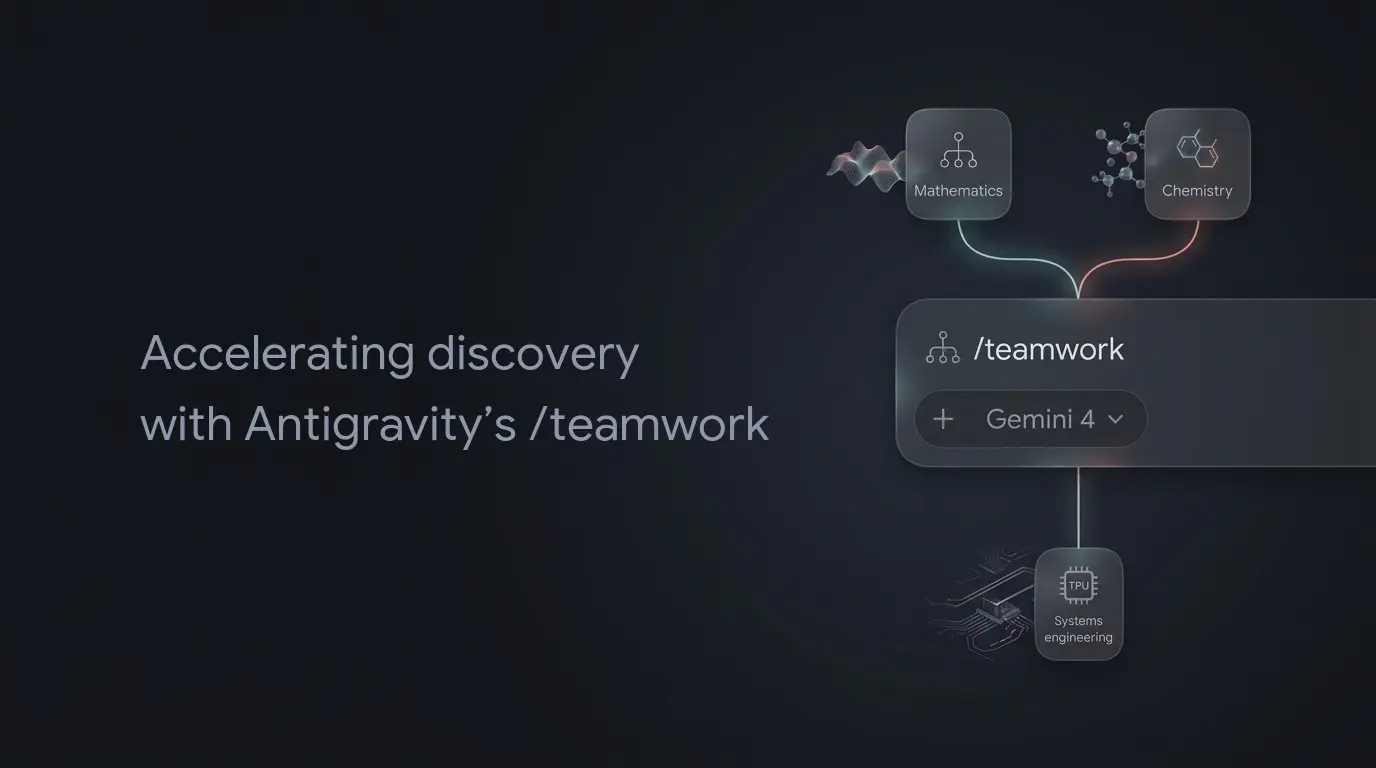
To further refine focus, /teamwork partitions context by design, granting each specialized agent access only to the files and tools necessary for its specific task. Coordinators manage the workflow, handing off assignments to new agents while critics and auditors independently verify results from isolated environments, free from the original reasoning chain.
This modularity is expressed through declarative, self-improving natural-language patterns, dynamically routing user prompts to the most appropriate workflow for the problem at hand. The system’s architecture isn’t merely about processing power, but about intelligently organizing and verifying information flow.
Beyond this, the LEAP framework, developed in collaboration with Cloud AI and using the Argon model, autonomously produced a machine-checked formalization of the Weil conjectures, a landmark achievement spanning 1.8 million lines of Lean code generated across 28,800 subagent invocations. A multi-round auditing workflow was also employed to create a new empirical benchmark for causal inference, with 29 agents running on Argon transforming 13 public tables into a 50-task benchmark over 11.5 hours.
This demonstrates the system’s ability to not only solve existing problems but also to generate the tools needed to explore new areas of research. The architecture’s impact on systems software is equally notable. Using /teamwork and Argon, the team constructed FarArray, a low-latency kernel-bypass Partitioned Global Address Space built on the SNAP microkernel. Similarly, InstantEmbedding, a personalized PageRank implementation, reduced peak DRAM usage by up to 14x and runtime by 11x to 27x over accelerated MapReduce implementations.
The system’s ability to optimize at the kernel level highlights its potential for accelerating machine learning workloads. Addressing the challenges of large-scale code migrations, /teamwork introduced a new rewrite pattern designed to prevent common pitfalls like stubbed dependencies and test failures.
This approach proved successful in rewriting the Zircon microkernel, adding approximately 800,000 lines of safe Rust code that passed all kernel unit tests and booted on arm64 hardware over a two-week campaign. The same pattern was then applied to AV1 video decoder, libgav1, converting around 170,000 lines of C++ into Rust while maintaining 100% bit-exact parity across a comprehensive conformance test suite.
Courtade-Kumar Conjecture Proven Using /teamwork’s Long Proof Pattern
This pattern, implemented with Stellar Colosseum, facilitated a full and complete proof of the longstanding conjecture, demonstrating a new approach to tackling complex mathematical problems. This architecture extends beyond a single proof. /teamwork’s capabilities were also applied to formalizing several other significant mathematical challenges. The resulting formalization spans 1.
The team also independently reproduced a formalization of a recent proof of finite-time blowup for the 3D Navier-Stokes equations, a Millennium Prize Problem that has remained open for approximately 90 years, and generated the first formalization of the Birkhoff conjecture, a dynamical-systems problem open since 1927. The resulting champion engine ultimately won a decisive game by 22.5 points, demonstrating the system’s ability to refine complex algorithms through iterative self-improvement.
This success extends to code migration, a traditionally challenging task prone to errors when dependencies are stubbed or tests are altered to mask incomplete ports. Upcoming updates will integrate the formal proof pattern and additional specialized workflows into Antigravity, accompanied by detailed tutorials on the Antigravity blog to assist developers and researchers in generating, inspecting, and refining custom multi-agent teams. The team states, signaling a broader commitment to democratizing access to advanced AI-assisted research and development.
Antigravity’s /teamwork Achieves Breakthroughs in Matrix & Graph Processing
These improvements, detailed in a recent Antigravity blog post, demonstrate the system’s capacity to optimize code for specialized hardware, exceeding expectations in memory efficiency and processing speed. The team’s approach extends beyond simple acceleration, focusing on minimizing resource consumption alongside maximizing computational throughput. The challenges of large-scale code migration, traditionally plagued by dependency issues and test failures, were addressed through a novel rewrite pattern implemented within /teamwork.

This pattern schedules module compilation only after dependencies are resolved, ensuring that each component is built upon a stable foundation. Critically, every module is linked against the original, unmodified test suite, preventing the introduction of errors during the porting process. This result highlights the potential for automated code refinement to achieve performance levels previously considered unattainable. Beyond individual codebases, /teamwork has enabled breakthroughs in mathematical and theoretical computer science.
In randomized linear algebra, a stacked sparse sketch technique resolved a 2025 open question by surpassing the classical sparsity barrier for matrix compression, achieving a quadratic reduction in the number of nonzeros required to preserve data integrity. Similarly, Stellar Colosseum tackled an open problem originating from the 2022 FOCS conference, developing the first single-pass streaming algorithm for cut sparsification that simultaneously optimizes memory usage, update time and reconstruction time.
Starting from a basic AlphaZero implementation, Argon-trained teams evolved the engine from scratch, culminating in a champion that won by 22.5, in a single, decisive game. This demonstrates /teamwork’s ability to guide complex optimization processes over extended timelines, achieving significant improvements in performance through iterative refinement.
Fleet-wide memory optimization efforts, building on initial Argon work, have identified opportunities to save over 1 PiB of memory across Google’s infrastructure. This was achieved through reusable /teamwork workflows that analyzed fleet-wide metrics and used past successes in memory reduction. DuoDiscover, another product of this collaboration, achieved a 4.09x geometric-mean speedup across 17 JAXBench kernels and a 2.99x geometric-mean speedup across 7 hand-optimized vLLM TPU-Inference Pallas kernels for frontier open-weight models.
Vahab Mirrokni, Google Fellow and VP of Google Research, emphasizes the collaborative nature of these advancements, stating, “We share recent results from Antigravity’s /teamwork multiagent systems, which enhance human-AI collaborations to solve open problems across mathematics, chemistry, systems software, and ML engineering.” The team acknowledges contributions from Carla Bromberg and Lauren Fraser for program management, as well as Francis Duan, Pan-Pan Jiang, Xiyan Shao, Jane Shapiro, Weilun Shi and Xinyu Ye for their technical contributions.
Support from Sergey Brin, Demis Hassabis, Koray Kavukcuoglu, Pushmeet Kohli, James Manyika, Yossi Matias, Varun Mohan, and Amin Vahdat was also instrumental to the project’s success, along with contributions from academic collaborators at institutions including CUHK, Columbia University, UCSD, IBM Cambridge, BYU, MIT, UC Berkeley, CMU, Princeton University and ETH-ITS.
Source: https://research.google/blog/advancing-science-engineering-with-antigravitys-teamwork-feature/

See today’s quantum computing news on Quantum Zeitgeist for the latest breakthroughs in qubits, hardware, algorithms, and industry deals.