Valeria Repetto of the National Research Council of Italy and University of Turin, along with Romina D’Aurizio and Piero Fariselli, have developed Soft-MoQE, a new quantum machine learning architecture that bypasses the need to train quantum circuits directly. Instead of optimization, Soft-MoQE selects from a pool of fixed quantum feature maps, combining them based on input data to achieve performance comparable to trainable quantum neural networks. Benchmarked on the MNIST parity, MNIST 10-class and FashionMNIST datasets, the model demonstrates a quantum training cost reduced by orders of magnitude, supporting learned routing as a key design principle for hybrid quantum-classical learning.
Soft-MoQE Architecture: Fixed Quantum Feature Maps & Classical Gating
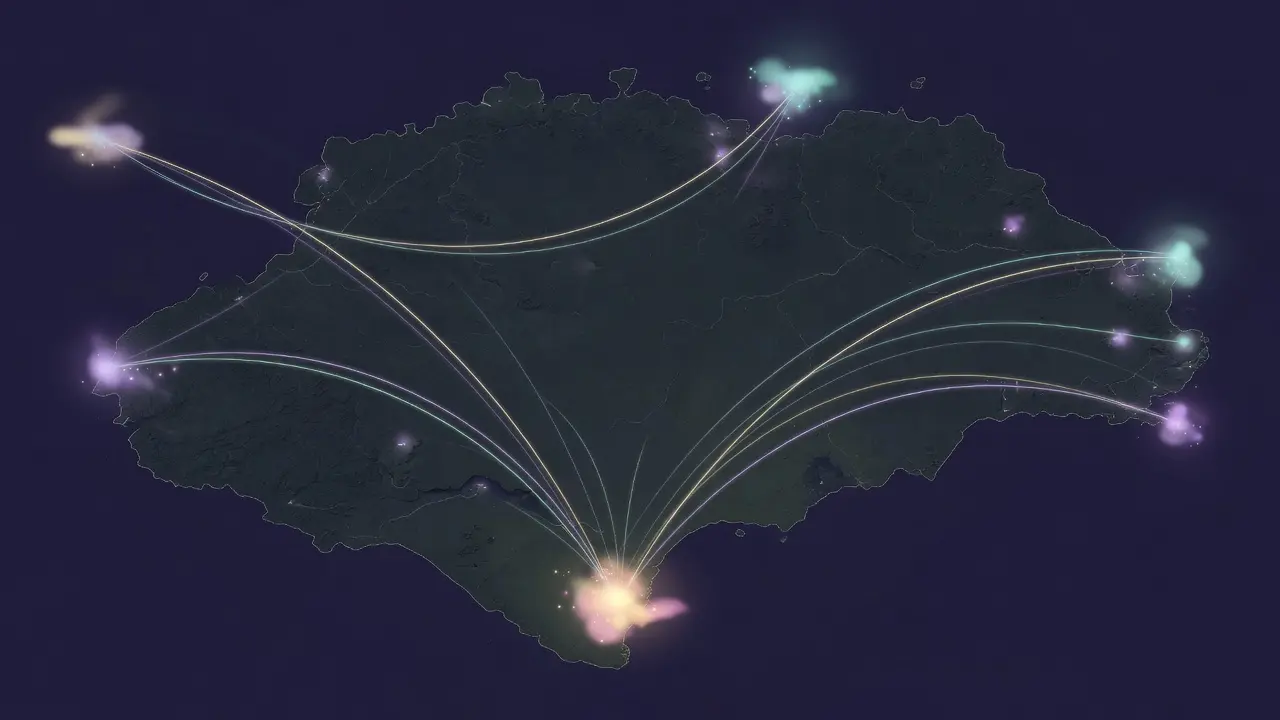
Soft-MoQE distinguishes itself from other quantum machine learning approaches by using a heterogeneous pool of non-trainable quantum circuits, each designed to create a unique data embedding. This architecture bypasses the need to optimize quantum parameters, a process often hampered by limitations in near-term quantum hardware and the presence of barren plateaus. Instead, a classical gating network learns to assign weights to the outputs of these fixed quantum feature maps, tailoring the representation for each individual data point.
The model’s design prioritizes classical computation for combining quantum embeddings, sidestepping the difficulties of directly training quantum circuits. Each quantum expert within Soft-MoQE implements a distinct encoding method, ranging from simple single-qubit rotations to more complex entangling circuits based on Instantaneous Quantum Polynomials.
This diversity in encoding complexity aims to provide the model with a wider range of representational capabilities, allowing it to capture subtle features within the input data. The outputs from these experts are then combined using a temperature-scaled softmax function, where the gating network determines the contribution of each expert based on the specific input. This adaptive weighting scheme allows the model to dynamically select the most relevant quantum features for each data instance.
The architecture’s reliance on classical computation extends to the final prediction layer, which consists of a single linear layer followed by a softmax function. The only trainable components of Soft-MoQE are the classical gating network and this output layer, significantly reducing the computational overhead associated with training. The quantum circuits receive the pre-processed input directly, ensuring that the final representation is solely derived from the outputs of the fixed quantum experts.
This approach allows the model to use the expressive power of quantum embeddings without the complexities of quantum optimization. The results show that Soft-MoQE consistently outperforms both the individual quantum experts and a uniform averaging of their outputs, as well as a linear baseline model. Analysis of the class-conditioned expert usage reveals that the learned routing mechanism combines only a few experts for each input, with the specific selection dependent on the class of the input data.
This suggests that the gating network is effectively learning to identify which quantum features are most relevant for distinguishing between different classes. This targeted selection of experts further emphasises the trainability-aware design principle behind Soft-MoQE, demonstrating that fixed quantum circuits can be effectively used in hybrid quantum-classical learning systems.
NISQ Era Motivation: Avoiding Barren Plateaus in QML
This approach tackles a significant hurdle in near-term quantum machine learning, where optimization difficulties often limit the scalability of variational models. The researchers evaluated Soft-MoQE on three datasets, MNIST parity, MNIST 10-class and FashionMNIST, all reduced in dimensionality using Principal Component Analysis. “These results support the learned routing among fixed quantum circuits as a trainability-aware design principle for hybrid QML,” the authors write, highlighting the potential of this modular approach.
Benchmarking Soft-MoQE: MNIST & FashionMNIST Performance
Soft-MoQE achieved performance comparable to fully trainable quantum neural networks on the MNIST 10-class and FashionMNIST datasets, despite bypassing quantum parameter optimization entirely. This benchmark used Principal Component Analysis (PCA) to reduce the dimensionality of the image data before processing, a step demonstrating the model’s adaptability to pre-processed inputs. The team evaluated Soft-MoQE’s performance against a linear baseline, a uniform average of all quantum experts, and the single best performing expert within the system, consistently exceeding their capabilities.
The analysis of how the gating network uses these experts revealed a selective process, with only a few experts activated for each input, and that selection varied depending on the image’s class. This class-dependent routing indicates the model learns to identify which quantum feature maps are most relevant for specific image categories.
This selective combination of quantum representations, rather than relying on a single expert or averaging all outputs, is a key feature of the Soft-MoQE architecture. Compared to a variational Quantum Neural Network (QNN) operating on the same reduced inputs, Soft-MoQE reached comparable task-dependent performance without any quantum parameter training. This is significant because it sidesteps the challenges of barren plateaus, a common obstacle in training quantum circuits. The model’s architecture implements quantum experts as fixed circuits, each defining a distinct embedding and a classical gating network learns to weight these embeddings for each data point.
Class-Dependent Routing Reveals Selective Expert Usage
This approach avoids the computational overhead and trainability issues associated with simultaneously optimizing multiple quantum experts and a quantum gating network. The model consistently outperformed both the best individual expert and a uniform average of all experts, demonstrating the effectiveness of the learned routing mechanism. Formally, a Mixture of Experts (MoE) consists of a set of n experts, each receiving the same input and a gating network that maps the input to a vector of non-negative weights summing to one.
The output of the MoE is then a weighted combination of the expert outputs, calculated as f(x) = sum_(i = 1)^n . The paper explains, detailing the foundation of the quantum component. This selective combination of quantum representations, guided by the classical gating network, offers a viable path toward building more efficient and trainable hybrid quantum-classical machine learning models.
👉 More information
🗞 Soft Mixture of Quantum Experts for Hybrid Quantum-Classical Learning
✍️ Valeria Repetto (National Research Council of Italy (CNR), Institute of Informatics and Telematics (IIT), via Giuseppe Moruzzi 1, Pisa, Italy); Romina D'Aurizio and Piero Farinelli
🧠 ArXiv: https://arxiv.org/abs/2611.24798v1



See today’s quantum computing news on Quantum Zeitgeist for the latest breakthroughs in qubits, hardware, algorithms, and industry deals.