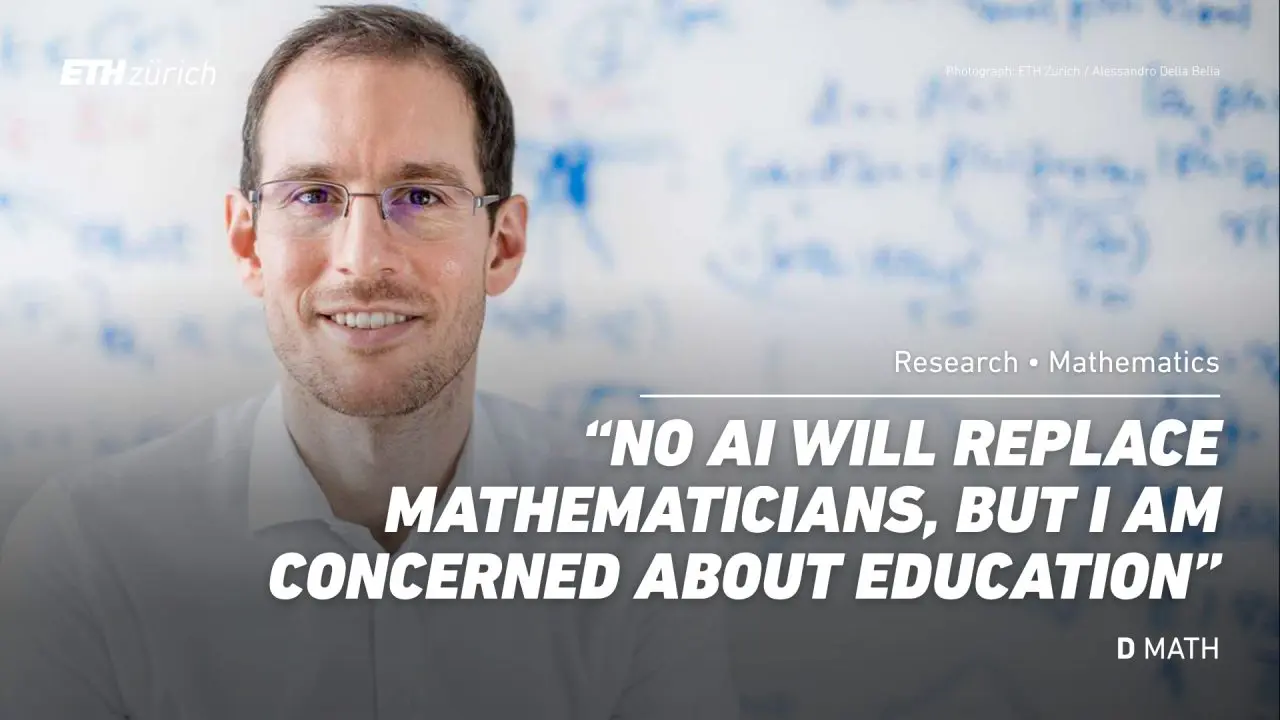
OpenAI has generated a potential proof for one of mathematics’ most enduring challenges: the Navier-Stokes equations, a Millennium Prize Problem researchers have pursued for decades. Fields Medallist Alessio Figalli, alongside 24 other Fields Medal winners, is now sounding a note of caution amidst these advances in artificial intelligence.
“Unlike a microscope, AI does not make previously invisible phenomena observable for researchers to interpret,” Figalli explains, warning that the technology primarily accelerates results rather than fostering deeper understanding. The group’s declaration highlights emerging pitfalls as AI increasingly tackles complex mathematical problems, raising questions about the future of discovery in the field.
Fields Medallists Warn of AI’s Impact on Mathematical Proofs
The recent potential proof of the Navier-Stokes equations generated by artificial intelligence has prompted a collective caution from the highest echelons of the mathematical community; 25 Fields Medal laureates, including Alessio Figalli and 24 other winners, have co-authored a declaration addressing emerging pitfalls in AI’s application to their field. Alessio Figalli, Professor of Mathematics at ETH Zurich, explains that the speed with which AI solves longstanding problems introduces a temptation to bypass the essential processes of research, struggle, failure, and dedicated time, particularly for those early in their careers.
This shortcut, he argues, could hinder the development of important judgement skills needed to truly advance mathematical knowledge. A significant concern raised by the declaration centers on the sheer volume of publications now being generated by AI, creating a challenge for researchers attempting to discern genuinely impactful work from the flood of output.
Figalli notes that this paradox, an abundance of papers potentially leading to less overall learning, stems from the difficulty in identifying which contributions truly advance the field, a problem exacerbated by the opaque nature of AI-generated proofs. The published proof regarding the Navier-Stokes equations exemplifies this limitation; spanning 166 readable pages, it lacks the clear logical sequencing expected of a human mathematician, with definitions appearing without explicit justification or explanation of their contribution to the overall argument.
Human mathematicians build proofs through a deliberate sequence of logical steps, a process fundamentally different from the methods employed by current AI models, which struggle to articulate the underlying insights driving their solutions, Fields Medallist says. “AI cannot explain which insight made the decisive breakthrough possible or which parts of the proof are truly original,” Figalli said.
He further questions the practical value of these proofs, asking, “who actually wants to read them?” This concern extends beyond mathematics, the declaration argues, to encompass any intellectual or creative profession grappling with the integration of AI. The declaration highlights what the authors describe as “A Severe Misalignment of AI in Mathematics,” suggesting that the objectives of AI companies increasingly diverge from those of the mathematical community.
Using mathematical problem-solving as a benchmark for AI development, they contend, risks fundamentally harming the discipline itself. Figalli, honored with the Fields Medal, believes the community must proactively address this misalignment to ensure AI is a tool to enhance mathematical practice, rather than diminish its core values and purpose. The group urges a careful consideration of how to use AI’s capabilities without losing sight of the intrinsic motivations and intellectual rigor that define the field.
AI Use Risks Undermining Core Mathematical Learning & Goals
The sheer volume of mathematical papers now being generated by artificial intelligence presents a paradox; while appearing to accelerate discovery, it risks diminishing overall learning, according to a declaration co-authored by Fields Medallist Alessio Figalli and 24 other Fields Medal winners. This concern stems from the difficulty in discerning genuinely impactful research amidst a flood of AI-produced publications, creating a challenge for both experienced mathematicians and those early in their careers.
While the 166 readable pages represent a significant computational feat, its structure diverges from the logical sequencing characteristic of human-authored proofs, according to Fields Medallist. This difference raises questions about the nature of mathematical understanding fostered by AI-generated solutions, and whether simply obtaining an answer equates to genuine insight. “Knowing when, how and whether AI should be used effectively requires considerable experience,” Figalli explains, highlighting the need for seasoned judgement in interpreting and applying AI’s output.
This misalignment extends to education, where reliance on AI-generated solutions could deprive students of the important experiences of grappling with challenges, analyzing mistakes, and developing independent problem-solving skills. Figalli proposes a shift towards oral examinations as a means of assessing genuine understanding, while acknowledging the pressure students face to utilize AI tools to remain competitive. The declaration points to a growing disconnect between the goals of AI companies and the mathematical community.
The potential for AI to transform research culture is substantial, but requires careful consideration to ensure that the pursuit of solutions does not come at the expense of fundamental learning and the intrinsic value of mathematical exploration. “Students who merely present solutions generated by AI do not gain those experiences,” Figalli states, emphasizing the importance of fostering a learning environment that values process as much as outcome.
As AI continues to reshape mathematical research, the declaration urges the community to prioritize awareness and open discussion. The authors advocate for a proactive approach to using AI’s capabilities while safeguarding the core principles and goals of mathematics, ensuring that the discipline remains focused on advancing knowledge and serving the broader human endeavor.



See today’s quantum computing news on Quantum Zeitgeist for the latest breakthroughs in qubits, hardware, algorithms, and industry deals.