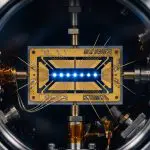
Two participants in the recent Quantum Circuit Challenge achieved a circuit depth of 95, exceeding internal expectations that predicted no submissions below 200. The challenge tasked 387 participants from 40 nations with encoding a 64×64 rasterized logo as a quantum phase oracle, a surprisingly creative application of a core quantum computing task. Classiq reports its initial baseline solution required 5,329 circuit steps, a deliberately unoptimized starting point that the winning solutions compressed by a factor of 56. “Understanding how participants achieved these improvements is as valuable as the scores themselves,” the company stated.
Classiq Challenge Attracts 387 Quantum Coders Globally
Classiq reports that 25 participants ultimately submitted circuits with depths below the 200-step threshold, demonstrating a competitive field and a high level of engagement with the problem. Successful circuits not only had to accurately represent the image but also preserve coordinate information and reset auxiliary qubits to zero, adding layers of complexity to the task.
Participants synthesized a total of 6,091 unique circuits during the month-long competition, which ran from August 28 to September 30, and 101 individuals submitted valid solutions. The five countries with the highest participation rates were India, the United States, Israel, Canada and the United Kingdom, indicating a broad international interest in quantum circuit design.
The winning solutions demonstrated a 56-fold reduction in circuit depth compared to Classiq’s initial, deliberately unoptimized baseline, a figure that highlights the potential for improvement in quantum circuit construction, the company says. The tenth-place solution, achieving a depth of 124 with 318 CX gates, further distinguished itself by using a Clifford+T representation, a gate set commonly used in fault-tolerant quantum computing. All five winning submissions underwent rigorous numerical verification, confirming their accuracy in reproducing the correct phase pattern and preserving coordinate data for all 4,096 coordinate-basis inputs.
A common thread among the most effective solutions involved compressing the logo’s information before circuit synthesis, reducing the computational burden and streamlining the process. Participants also focused on optimizing both the representation of the problem and the implementation of the circuit simultaneously, exploiting geometric patterns and reversible encodings to simplify the Boolean function.
The integration of artificial intelligence tools played a significant role in this iterative process, with many participants using AI for mathematical exploration, implementation and refinement. Classiq itself has integrated AI into its platform and documentation, recognizing its growing importance in quantum computing workflows and aiming to facilitate the transition from algorithmic understanding to efficient implementation and performance evaluation. The company intends to host similar competitions in the future, building upon the demonstrated quality of work and community engagement, according to Classiq.
Strong submissions have bolstered confidence in the ability of participants to tackle demanding quantum computing problems, leading Classiq to consider a more application-focused challenge, potentially at a research-level difficulty, for its next competition. They anticipate continued innovation from this community and look forward to observing future developments in the field.
Raster Logo Encoding as Quantum Phase Oracle
The Classiq Quantum Circuit Challenge revealed a focus on optimization, where problem representation and circuit implementation were refined in tandem. Participants did not approach the task of encoding the 64×64 logo as a quantum phase oracle as a purely circuit-design problem; instead, they actively sought geometric simplifications and reversible encodings to minimize computational cost. This integrated approach proved important, as evidenced by the winning solutions that used repeated patterns within the logo to streamline the Boolean function.
The fourth-place solution, developed by Andrei Diaconu of Romania, employed quantum interference to convert phase patterns into Boolean labels, organizing these encoders in a cascade to reduce their overall cost, the company says. This design coordinated the encoding and phase calculation, achieving a depth of 108 with 500 CX gates and a documented interface with 195 reachable code pairs. Sourabh Nirvani of India, securing fifth place, further refined this concept by combining coordinate-class compression with detailed scheduling optimization, highlighting the importance of both algorithmic and circuit-level improvements.
Beyond minimizing depth, some participants explored alternative gate sets to further enhance their solutions, Classiq reports. This choice adds a layer of practical relevance to the result, suggesting potential compatibility with future error-correction schemes. “This is essential for a phase oracle,” the source states, emphasizing that reproducing the correct Boolean pixel values alone would not validate the coherent quantum action required.
The row-column approach to encoding, exemplified by one optimized solution, involved reversibly recoding vertical bands into periodic, tent-shaped distance values, coupled with an encoded half-height and validity flag. A four-bit addition, with its carry determining phase application, formed a shared arithmetic structure refined through scheduling and local rewrites, ultimately reaching a depth of 106 with 360 CX gates, the company’s account states. This illustrates how seemingly disparate elements, geometry, arithmetic and circuit optimization, converged in the most effective solutions.
The final table, enlarged for readability, contains 121 entries and must be used in conjunction with the coordinate-to-class mappings to fully understand the encoding process. These results suggest that the community is not only capable of tackling demanding quantum computing tasks but is also adept at identifying and exploiting opportunities for improvement in circuit design and implementation.
Circuit Depth Reduction: Baseline vs. Top Solutions
Reports that the best valid circuit from each of those submissions demonstrated a marked improvement over their initial baseline. This compression of the logo’s information before circuit synthesis proved a common strategy among successful submissions, though the extent to which table size reduction translated directly into gate count or depth varied. PoJen Wang of the United States secured first place by recasting the geometric representation of the logo as comparisons between compact row-distance and column-radius codes, streamlining the encoding process.
The diversity of approaches taken by the top five participants, PoJen Wang, Daksh Shami, Jayachandiran U, Andrei Diaconu and Sourabh Nirvani, emphasises the breadth of potential solutions to complex quantum circuit optimization problems. Each winner will receive a $2,000 prize, and their principal ideas are being summarized for further analysis. The detailed circuit activity maps for the five winners provide a visual representation of their respective optimizations, offering insights into the strategies that led to their success.
Winning Strategies: Compression and Reversible Logic
The 64×64 rasterized logo, the visual input for the recent quantum circuit challenge, concealed a surprising degree of internal redundancy. Participants discovered that the image’s decision table could be significantly compressed by recognizing only 11 distinct column and 11 distinct row patterns, reducing the required data from 4,096 pixels to a table of 121 entries. This compression, achieved through grouping identical columns and rows, formed a core strategy for several winning submissions. Andrei Diaconu and Sourabh Nirvani explicitly used this repeated-pattern observation, while Daksh Shami developed a related joint encoding technique.
This approach allowed for parallel calculations of row and column values, resulting in a circuit achieving a depth of 95 with 272 CX gates, the lowest CX count among all submissions. Daksh Shami’s second-place solution used a seven-bit encoding scheme, dividing the phase decision into three features each for the column and row, plus one shared bit combining information from both. A reversible implementation computes suitable labels, applies the phase associated with their combination, and uncomputes the labels.
A central phase polynomial, a weighted sum of bit parities, combined the encoded information, while surrounding operations restored the workspace. This approach preserved the original order of operations on each wire, resulting in a depth of 109. The sixth-place solution matched Nirvani’s depth with only 13 additional CX gates, demonstrating the competitive landscape of the challenge.
This gate set, widely used in fault-tolerant quantum computing, added another layer of interest to the solution beyond its competition score, Classiq claims. These checks confirmed coordinate preservation, ancilla cleanup and the required phase pattern, up to a single global phase.


See today’s quantum computing news on Quantum Zeitgeist for the latest breakthroughs in qubits, hardware, algorithms, and industry deals.