Researchers are expanding the vision of the Quantum Internet beyond simply transporting quantum data, demonstrating that entanglement can function as a “stateful network resource” whose condition evolves and must be actively monitored. The work establishes that entanglement generation can occur during data propagation through coherent spatial-path superposition, a function happening within the network itself.
This moves beyond classical network models by showing operational connectivity can be induced by shared entanglement, allowing nodes to become relevant based on quantum coherence regardless of physical connections. The researchers broaden the Quantum Internet to exploit quantum phenomena in network functioning, opening a frontier spanning routing and control.
Entanglement as Stateful Network Resource
Entanglement’s operational condition is not static. It is a non-locally distributed property that evolves through manipulation, consumption and the inevitable effects of decoherence, demanding that network functionalities actively monitor its changing state. This requirement moves beyond simply using quantum mechanics for communication over a network, establishing a paradigm where entanglement is the network’s operational state, necessitating a new level of abstraction in network design.
Any representation of this resource within the network must remain meaningfully associated with the specific entanglement instance as it changes, preventing functionalities from acting on a resource that no longer exists in its original form. The implications extend to how network functions are realized, moving beyond conventional models where entanglement is first created and then distributed via a classically determined path.
Researchers demonstrate that quantumness can be lifted into the propagation process itself, meaning classical signaling remains necessary, but must coexist with abstractions capable of carrying the quantum semantics of the propagation alternatives. This fundamentally alters the relationship between resource creation and distribution, suggesting a network where entanglement generation can occur during data transmission, not solely at source or destination nodes. This is a departure from classical network models, which typically separate resource creation from distribution.
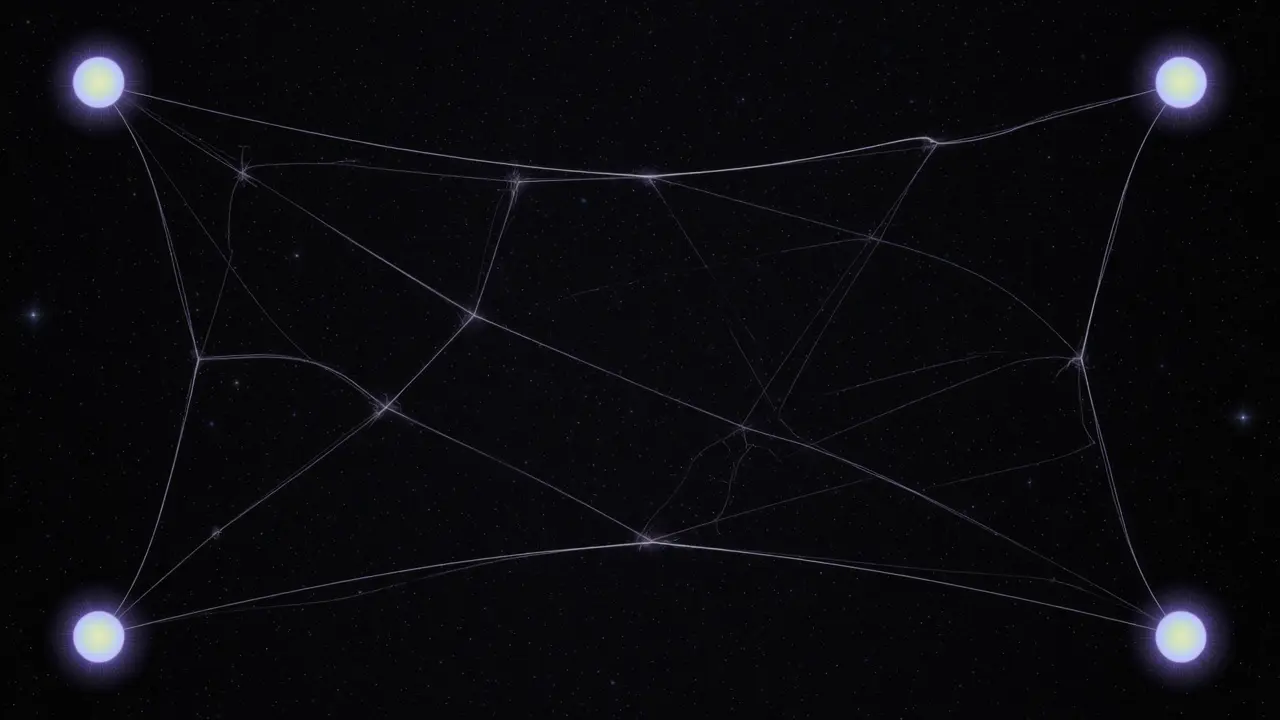
The physical layout of a quantum network, the physical graph, need not dictate operational connectivity. Entanglement can induce connections between nodes that are not directly linked by physical channels. The team denotes the time-dependent entanglement-defined operational graph as , which can differ from the physical network graph .
This means that nodes can become “operationally connected” based on shared entanglement and quantum coherence, regardless of their physical proximity or direct links. “Two nodes that are not directly connected in may share entanglement and thereby become operationally connected for a functionality that can exploit that resource,” the paper explains, highlighting a network topology defined by quantum states rather than physical infrastructure.
The ability to define connectivity through entanglement represents a shift toward what the researchers term a situation where quantum phenomena are not merely used for carrying messages or managing resources, but are integral to the mechanisms that perform networking functions. Superposition, quantum interference, entanglement, and coherent control become constitutive elements of how networking functions are executed. This contrasts with the traditional approach where the network’s control logic for routing, scheduling, or coordination remains predominantly classical, operating on quantum data rather than as quantum data.
The evolving state of entanglement as a network resource necessitates a new approach to network abstraction, one that acknowledges its dynamic nature and the need for functionalities to remain aware of its condition. This concept of entanglement as a stateful resource is not merely about visibility; it’s about integrating quantum properties directly into the network’s operational mechanisms.
The researchers illustrate this with two proof cases: entanglement generation during propagation and entanglement-defined connectivity. These examples demonstrate that quantum phenomena can actively shape how resources are created and how connections are established, moving beyond the limitations of classical network models. The ability to create entanglement during propagation, for example, allows the network to dynamically generate resources as data travels, potentially optimizing performance and reducing latency.
The implications of this work are significant for the development of future quantum networks, suggesting a move away from simply transporting quantum states towards a more integrated approach where quantum mechanics is deeply embedded in the network’s core functionalities. By exploiting entanglement not just as a resource, but as a fundamental building block of network operation, the researchers envision a new generation of networks capable of performing tasks that are impossible with classical technologies. This change requires a re-evaluation of existing network abstractions and the development of new tools and techniques for managing and controlling quantum resources.
Quantum-Native Network Functioning Defined
Entanglement’s condition is not static within a quantum network. It evolves through manipulation and naturally degrades due to decoherence, demanding active monitoring by network functionalities, a concept the authors term a “stateful network resource”. The researchers demonstrate that this evolving state necessitates abstractions capable of representing its non-local distribution across remote nodes, a departure from traditional network models that treat resources as fixed entities.
This process, detailed in the Perspective, challenges classical networking paradigms by showing that entanglement isn’t solely created at a source and distributed, but can emerge as a consequence of the network’s operation. This means a network’s effective structure isn’t limited by its physical layout, opening possibilities for routing and communication pathways unavailable in classical networks. The implications of this are significant for network design, as the researchers identify Quantum Addressing as a transversal abstraction capable of representing these quantum-defined relationships.
This abstraction complements, rather than replaces, classical addressing and signaling, suggesting a hybrid approach that uses the strengths of both classical and quantum technologies. The team emphasizes that this isn’t about replacing classical networking, but extending the functional design space through quantum abstractions where they offer an operational advantage. The network-scale frontier, according to the Perspective, lies in supporting route computation and forwarding across physical-graph, entanglement-defined and coherently superposed propagation regimes, and determining how these regimes should interact without prematurely reducing quantum-defined relations to a classical path.
This requires a compositional organization where primitives like propagation-enabled entanglement generation and entanglement-defined connectivity are treated as network primitives rather than being assigned to fixed layers. The resulting resource state then enters the local composition logic, allowing for a more flexible and adaptable network architecture.
The researchers propose a network-scale frontier defined by three coupled dimensions: routing and forwarding, resource management, and control and functionality placement. They note that the mechanisms considered reinforce an architectural choice where these primitives are composable, allowing for dynamic network adaptation. The remaining challenge, they state, is to instantiate and validate this compositional organization across a broader repertoire of quantum-native primitives while preserving the quantum functional advantage.
Entanglement Generation During Propagation
Entanglement generation is no longer solely a source-and-destination event within a quantum network. It can occur as quantum systems propagate through a network, fundamentally altering how entanglement is viewed and used. This shift moves beyond simply distributing an existing quantum resource, establishing entanglement as a dynamic, evolving element of the network itself, whose condition must be continuously monitored by network functionalities.
The paper details how coherently exploiting alternative channel evolutions can deterministically transform initially separate quantum states into entangled pairs, meaning entanglement is created during transmission, not before. This process of entanglement generation during propagation is distinct from classical network models where a definite communication link is selected before transmission takes place. Instead, the propagation alternative itself becomes a factor in resource creation.
Researchers demonstrate that this interference structure can also reshape how noise impacts a transmitted state, allowing for coherent control of channel evolutions to become part of a protective mechanism. The architectural implications extend to network connectivity, as entanglement can define operational relationships between nodes independent of their physical connections. The physical network graph, representing established communication channels, is necessary for initial entanglement distribution, but shared entanglement can induce connectivity beyond this physical layout.
This means a network’s topology can be defined by quantum states, not just the arrangement of wires and connections. This entanglement-defined connectivity necessitates a departure from solely relying on classical topology-driven abstractions like IP addressing and signaling. While these remain necessary for computing and provisioning basic links, they are insufficient to represent all the relationships on which network functionalities may operate.
The research team proposes that quantum-native routing can operate over the graph activated by existing entanglement, with route selection informed by entanglement availability and quantum operations that establish end-to-end connectivity. Forwarding, in this context, becomes a generalized process of entanglement generation, swapping, or purification, rather than a simple match-and-forward operation. This compositional organization allows for a network where these primitives are combined and manipulated to achieve complex quantum functionalities.
The architectural distinction, they note, is that quantum-native abstractions augment rather than replace classical control and signaling. The work builds on previous research that has already shown how quantumness can enter network functionalities themselves, opening a functional design space that remains comparatively unexplored. The paper’s findings demonstrate a move towards a network where entanglement is an active participant in network functioning.
Operational Connectivity Beyond Physical Graphs
The implications are significant, as the network must actively monitor and respond to the changing state of entanglement to maintain operational integrity, a departure from classical network models where resources are typically treated as static. These mechanisms reveal that network paths, neighboring nodes, and even participating entities can become “operationally relevant” based on quantum coherence and shared entanglement, rather than solely on physical connections. This shift introduces a representational challenge. The network requires abstractions capable of expressing these quantum-defined relations while simultaneously maintaining compatibility with classical addressing and signaling.
The researchers propose Quantum Addressing as a transversal abstraction to address this need, allowing the network to represent relationships determined by quantum coherence and entanglement alongside traditional physical connections. “Different network functionalities can therefore exploit the same identity abstraction according to their respective operational requirements,” the paper explains, suggesting a flexible system where various functions can use the same underlying quantum representation. Entanglement-defined connectivity, in particular, allows for programmable network connectivity, where the network can reconfigure operational relations without altering the physical infrastructure.
The work clarifies that the physical graph remains essential for establishing and distributing quantum resources, but the operational graph, the one governing network function, can dynamically emerge from the available quantum resources. The implications extend beyond simple connectivity; the identities of nodes participating in operational relations can be defined by entanglement, irrespective of their physical adjacency.
This means a node’s role in a network function is not fixed by its physical location but is instead determined by its quantum entanglement with other nodes. This dynamic relationship is represented by , a graph that evolves over time based on the current quantum resources available to the network. The researchers emphasize that the network relation on which a functionality operates cannot be fully captured by classical identities and physical topology alone, necessitating quantum-grounded abstractions.
👉 More information
🗞 Beyond Quantum Messages: Toward Quantum-Native Network Functioning
✍️ Angela Sara Cacciapuoti, Jessica Illiano, Caterina De Risi and Marcello Caleffi
🧠 ArXiv: https://arxiv.org/abs/2611.08298v1

See today’s quantum computing news on Quantum Zeitgeist for the latest breakthroughs in qubits, hardware, algorithms, and industry deals.