IonQ researchers have achieved up to 74 times faster logical Clifford operations using a new approach to quantum Low-Density Parity-Check (qLDPC) error correction, the company says. Mark Webster and Nicolas Delfosse combined cat states with classical scheduler codes to overcome processing limitations that previously hindered qLDPC’s potential, bringing practical fault-tolerant quantum computing closer to reality. This innovation allows for multiple logical measurements to be performed jointly, resulting in up to a 3x speedup for state preparation and logical gates, and accelerates critical Toffoli gates by 5.0x compared to sequential methods.
Cat States and Scheduler Codes Accelerate qLDPC Logical Measurements
Employing classical scheduler codes, IonQ researchers achieved an average of only 2.1 cat states per logical measurement when assessing L=10 commuting logical operators within the Q70 qLDPC code, demonstrating a significant reduction in resource requirements for fault-tolerant quantum computing. This optimization stems from a new approach to measuring multiple logical operators jointly, rather than sequentially, a technique that minimizes the number of physical measurements needed for error correction. The team’s work addresses a key bottleneck in qLDPC codes; previously, densely packed, non-local blocks introduced substantial latency during error correction, hindering execution speed.
This joint measurement strategy, coupled with the use of simple cat states, allows for the implementation of logical Clifford operators efficiently, a critical step toward practical fault-tolerant quantum computing, according to IonQ. The researchers explained in their published work that adapting the concept of logical CliNR, typically applied to noisy physical circuits, enables fault-tolerant logical gate execution without introducing temporal overhead, the company says.
The Q102 qLDPC code saw an average of 1.7 cat states per logical measurement when evaluating L=20 commuting operators, further illustrating the efficiency of this method. The innovation extends beyond simply reducing the number of cat states. It fundamentally alters how logical operations are performed within the qLDPC framework.
By using classical codes to schedule measurements, the IonQ team effectively streamlines the error correction process, allowing for simultaneous detection and correction of errors across multiple logical operators. This approach is particularly impactful when considering the Walking Cat physical architecture, IonQ’s design for a trapped-ion quantum computer, as it provides a pathway to scaling up fault-tolerant systems without incurring prohibitive hardware costs. The researchers’ findings, detailed in a recent publication, suggest a viable route to overcoming long-standing processing limitations in qLDPC error correction.
Logical CliNR Protocol Achieves 74x Speedup for Clifford Operations
IonQ’s new logical CliNR protocol delivers up to five times faster execution of critical non-Clifford Toffoli gates when compared to sequential logical measurements, a key advancement for algorithms expected to demonstrate quantum advantage. This speedup, achieved within the company’s qLDPC framework, directly addresses a bottleneck in fault-tolerant quantum computing by accelerating the processing of logical operations, IonQ reports. The ability to perform these complex calculations more rapidly moves commercial applications in fields like materials science and financial modeling closer to reality, potentially unlocking significant computational value for enterprises.
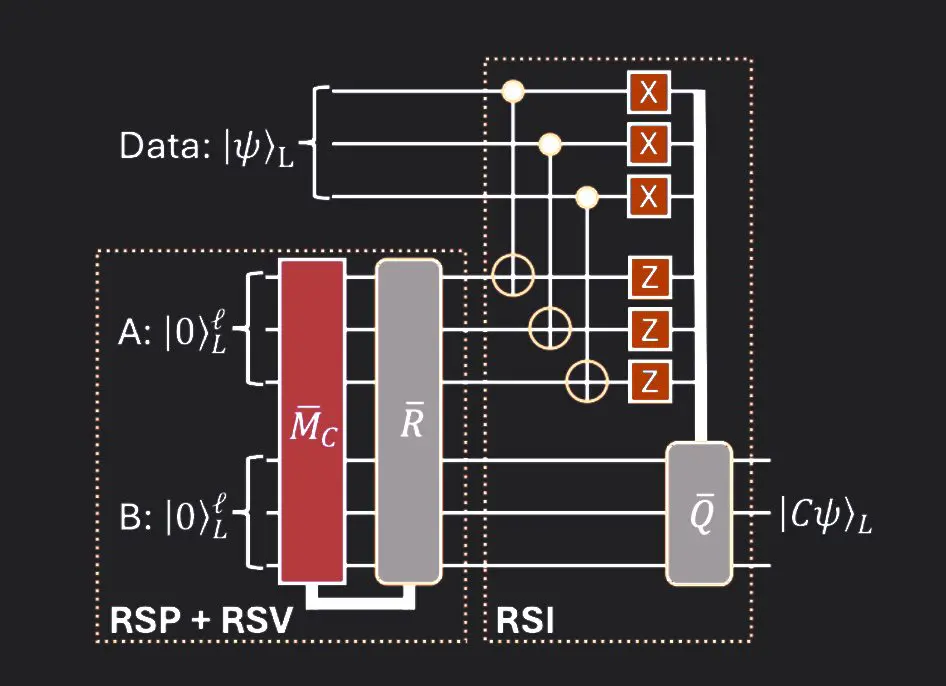
The innovation stems from a novel application of the CliNR, or Clifford Noise Reduction, method, traditionally used for physical circuits, now adapted to operate at the logical level. While CliNR can sometimes increase execution time, IonQ researchers strategically partitioned the scheme between physical and logical levels to improve overall speed.
They also integrated resource state preparation and verification steps within their new logical measurement protocols, streamlining the process and contributing to the observed gains. The company stated that to deliver commercially meaningful quantum advantage in fields like materials science, financial modeling and logistics, quantum computers must achieve fault tolerance, highlighting the importance of this development. This approach not only accelerates Toffoli gates but also achieves a substantial speedup of up to 74x for logical Clifford operations, a critical component in transforming data within quantum systems.
The resulting faster logical execution translates to higher shot output, meaning more data points for analysis and ultimately, greater computational value for each dollar spent on machine runtime. According to IonQ, this combination of improvements provides “a realistic path toward executing deep fault-tolerant quantum algorithms sooner than previously anticipated,” suggesting a significant step toward practical quantum computing applications.
qLDPC Innovations Enhance Fault Tolerance and Enterprise Value
This acceleration stems from a new logical CliNR protocol, adapting a physical scheme to streamline gate operations and reduce the computational burden of error correction. The company reports this improvement directly impacts the execution of complex calculations, potentially shortening the timeline for realizing practical quantum applications. This parallel processing approach contrasts with traditional sequential methods, which incur substantial delays during error-correction cycles. These gains in logical execution rate and QEC scheduling efficiency are central to IonQ’s strategy for delivering enterprise value.
The company emphasizes a shift in focus from solely increasing physical qubit counts or improving T1 times, toward metrics that directly impact usability and cost-effectiveness. By integrating software and classical scheduler codes, IonQ aims to maximize the efficiency of its qLDPC architecture, enabling more logical qubits within the same physical hardware footprint.