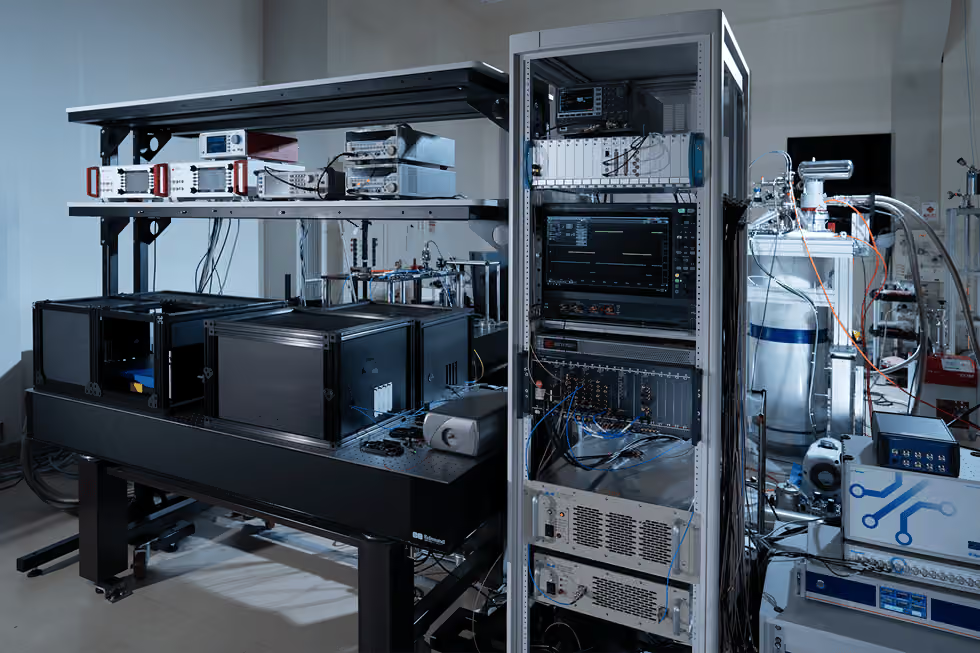
Fujitsu has developed the world’s first working prototype of a diamond-spin quantum computer incorporating tin-vacancy (SnV) centers into photonic integrated circuits. Operating at -271.6°C, this prototype surpasses the typical temperature of superconducting quantum computers by a fraction of a degree, potentially easing cooling demands. The development, stemming from joint research with Delft University of Technology and QuTech, marks a step toward scalable quantum computing through modular architecture. Vivek Mahajan, Corporate Executive Officer at Fujitsu, said the technology also has the potential to be integrated with superconducting quantum computers.
Tin-Vacancy Centers Integrated with Photonic Circuits Enable Scalability
Fujitsu’s prototype incorporates nanometer-sized diamond crystals containing tin-vacancy centers with alumina optical waveguides; this fabrication technology allows for the extraction of single photons emitted from the SnV centers during qubit readout. This precise integration represents a departure from earlier designs, enabling efficient optical connectivity that supports scaling quantum processors. The company developed thinning technology to reduce diamond substrate thickness from several hundred micrometers to several hundred nanometers, a feat necessary for creating functional quantum computing chips.
The prototype’s operation at -271.6°C is noteworthy because it exceeds the typical operating temperature of -273.13°C for superconducting quantum computers, suggesting potential reductions in cooling system complexity and cost. This higher operating temperature stems from the properties of the diamond-spin approach and its integration with the developed photonics-integrated circuits.
Fujitsu also created a mechanism to convert quantum circuits into control sequences for physical operations specific to the diamond spin approach, allowing control through the existing Fujitsu Hybrid Quantum Computing Platform. Looking ahead, Fujitsu plans to develop a prototype multi-module diamond-spin quantum computer by 2027, signaling a commitment to a modular architecture for scalability.
Kees Eijkel, General Director of QuTech at Delft University of Technology, described the prototype as acknowledging the ongoing challenges in demonstrating the scalability expected of diamond spin quantum computing. “By further strengthening our collaboration with Fujitsu, we are committed to tackling this ambitious and meaningful challenge and leading the development of next-generation quantum technologies,” Eijkel added.
The diamond-spin approach we have applied in this prototype not only offers exceptional scalability in its own right, but also has the potential to be integrated with superconducting quantum computers to further extend their capabilities, enabling more complex and large-scale computations.


See today’s quantum computing news on Quantum Zeitgeist for the latest breakthroughs in qubits, hardware, algorithms, and industry deals.