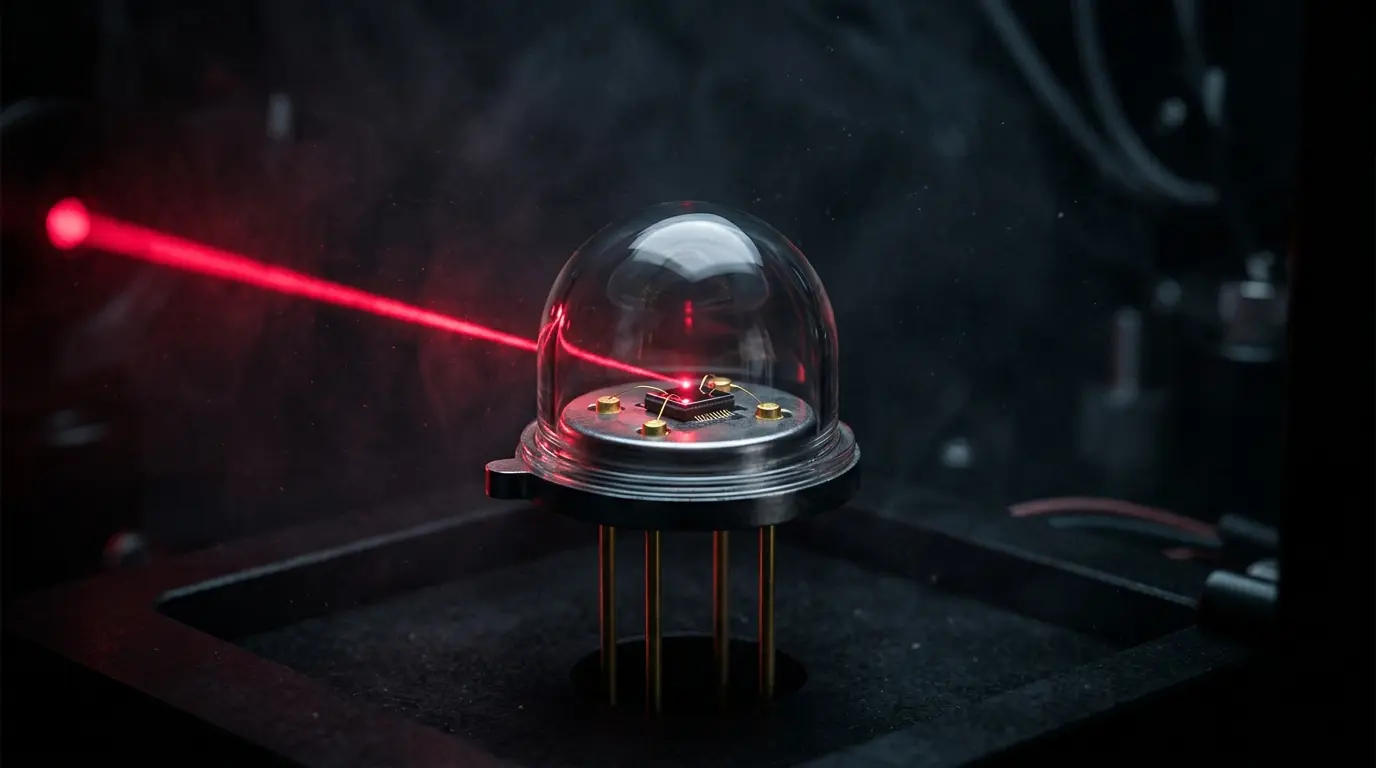
Dutch-German firm QuiX Quantum, alongside Taiwanese companies Artilux Inc. and Brillink Inc., has secured funding for a 36-month project beginning in January 2027. The QSPAD project, supported by the TechBridge Taiwan Call 2026, will focus on developing single-photon detectors capable of operating near room temperature. Currently, the most advanced photonic quantum computers require operation below 2.5 kelvin, colder than deep space, a limitation this collaboration aims to overcome. “QSPAD represents an important industrial building block for our long-term roadmap toward scalable, fault-tolerant quantum computing,” says QuiX Quantum, removing a key hardware barrier for wider deployment.
QSPAD Project Develops Room-Temperature GeSi Single-Photon Detectors
The QSPAD project will co-integrate germanium-silicon single-photon avalanche diode arrays with QuiX Quantum’s silicon nitride photonic integrated circuits, aiming for operation down to 40 °C using conventional thermoelectric cooling. This approach bypasses the need for the extremely low temperatures currently required by the most advanced photonic quantum computers, which operate below 2.5 kelvin. Eliminating cryogenic cooling removes the single largest cost component from photonic quantum systems and expands potential applications beyond specialized laboratory settings.
This 36-month collaboration, beginning in January 2027 and concluding in December 2029, pairs QuiX Quantum with Taiwanese firms Artilux Inc. and Brillink Inc., supported by funding from the TechBridge Taiwan Call 2026, Photonics Integrated Circuits program. The partnership benefits from complementary strengths. QuiX Quantum contributes its silicon nitride platform and quantum-system integration expertise, while Artilux provides its germanium-silicon detector technology and CMOS-compatible fabrication at commercial volumes.
Brillink will focus on advanced packaging and testing, bridging the region’s supply chain, the company says. “This collaboration is an important step in translating our GeSi technology into a key building block for future quantum computing and network. Together with QuiX Quantum and Brillink, we look forward to realizing integrated, manufacturable solutions for quantum systems,” said Dr. Erik Chen, Co-founder & CEO of Artilux Inc. The development of these detectors directly supports QuiX Quantum’s progression beyond its 2026 CARINA platform, advancing the company’s Dedalo architecture.
Dedalo is designed for loss-tolerant logical qubits with planned demonstrations between 2028 and 2030, and commercially deployable fault-tolerant systems targeted beyond 2030. Achieving these goals requires industrial manufacturing and integration of high-performance photonic components, and QSPAD aims to deliver that capability. The project’s success will translate system-level requirements into concrete, manufacturable technology, supporting the foundations for increasingly scalable photonic quantum computers.
The detectors developed through QSPAD are also designed to be sensitive at the 1310/1550 nm telecom wavelength, an important feature for compatibility with existing fiber optic infrastructure. This wavelength sensitivity, combined with CMOS compatibility, positions the detectors for broader integration into existing photonic networks. The detector and photon-source circuits will be joined through an engineered optical coupling, packaged in a compact Photonic Assembly Control Unit, further streamlining integration.
“Together with our Dedalo roadmap toward logical-qubit demonstrations between 2028 and 2030, QSPAD helps lay the manufacturing and integration foundations for quantum systems that can operate beyond the laboratory. It is another step in turning European, and now European and Taiwanese, scientific excellence into scalable industrial capability,” said Stefan Hengesbach, CEO of QuiX Quantum. The project aims to establish a resilient, internationally competitive quantum-photonics supply chain, combining Taiwanese detector leadership with a European manufacturing pathway.
Beyond the technical advancements, Brillink emphasizes the importance of reliable integration and scalable packaging for photonic quantum computing. “The future of photonic quantum computing depends not only on advances in individual devices but also on reliable integration and scalable packaging. At Brillink, we are committed to advancing photonic integration and packaging technologies that bridge innovative components with practical system-level solutions,” said Dr. Fang Yen Hsiang, COO of Brillink Inc. This focus on practical system-level solutions is critical for moving beyond laboratory demonstrations and towards commercially viable quantum systems. “Room-temperature single-photon detection is one of the missing industrial building blocks on the path to deployable fault-tolerant quantum computers.
The future of photonic quantum computing depends not only on advances in individual devices but also on reliable integration and scalable packaging.
Dr. Fang Yen Hsiang, COO, Brillink Inc.

See today’s quantum computing news on Quantum Zeitgeist for the latest breakthroughs in qubits, hardware, algorithms, and industry deals.