The encryption safeguarding online banking, messaging, and secure work systems faces a looming threat as quantum computing advances. While still years away from widespread capability, powerful quantum computers could break widely used encryption methods like RSA and elliptic curve cryptography (ECC) due to their ability to efficiently solve complex mathematical problems.
Symmetric encryption, such as AES, is more resilient, but the potential for disruption has prompted governments and organizations to proactively adopt post-quantum cryptography, a new generation of encryption designed to withstand quantum-computer attacks. Security teams recognize the urgency, preparing for a potential “harvest now, decrypt later” scenario where intercepted data is decrypted once quantum computers become powerful enough.
Shor’s Algorithm Exposes Vulnerabilities in RSA and ECC
Shor’s algorithm, developed by mathematician Peter Shor in 1994, presents a defined threat to the mathematical foundations of RSA and elliptic curve cryptography (ECC), two asymmetric encryption methods currently securing vast amounts of digital communication. The algorithm’s efficiency in solving problems like factoring large numbers, intractable for classical computers, directly undermines the security of these widely deployed systems. This computational advantage stems from the unique properties of qubits, which, unlike traditional bits representing 0 or 1, can exist in a superposition of both states simultaneously through quantum phenomena like superposition and entanglement.
The vulnerability isn’t theoretical; the potential for retroactive decryption is driving immediate concern. Attackers are actively pursuing a “harvest now, decrypt later” strategy, intercepting and storing encrypted data with the expectation of decrypting it once sufficiently powerful quantum computers become available.
This poses a particular risk to information requiring long-term confidentiality, including government secrets, intellectual property and personal identity information. The timeframe for this threat is uncertain, but the lengthy migration process to new cryptographic standards necessitates proactive preparation. NIST’s recent publication of its first three finalized post-quantum cryptography standards on August 13, 2024, reflects this urgency. The standards, FIPS 203 using ML-KEM, FIPS 204 employing ML-DSA, and FIPS 205 featuring SLH-DSA, are designed to resist attacks from both classical and quantum computers.
These algorithms are based on different mathematical problems, such as lattices and hash functions, believed to be resistant to efficient solutions by quantum computers. Unlike quantum cryptography, which relies on specialized hardware, post-quantum cryptography is software-based, facilitating broader and more rapid deployment.
NIST is also developing a standard for FN-DSA, based on the FALCON algorithm and selected HQC as an additional key-encapsulation algorithm to function as a backup. While asymmetric encryption faces an existential threat, symmetric encryption, like AES, demonstrates greater resilience.
Quantum attacks would weaken AES but not break it entirely, and employing longer key lengths, such as AES-256, is considered a sufficient safeguard. This distinction highlights a fundamental difference between the two encryption types. AES focuses on rapidly encrypting large volumes of data, while RSA and ECC are primarily used for secure key exchange, identity verification and digital signatures.
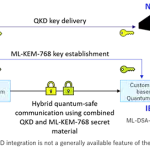
Security teams are already testing hybrid approaches, combining traditional and post-quantum algorithms to ensure continued security even if vulnerabilities are discovered in the new standards. “Many organizations are testing hybrid methods that combine traditional and post-quantum algorithms, so connections stay secure even if one method turns out to have weaknesses,” the source notes. Organizations are prioritizing a shift towards “crypto-agility,” the ability to swap out encryption algorithms without requiring complete system overhauls.
This adaptability is important for both the current transition and future cryptographic updates. A key component of preparation involves building a comprehensive cryptographic inventory, identifying all instances of encryption across the organization, from applications and certificates to VPNs and databases. This inventory allows teams to prioritize systems protecting the most sensitive and long-lived data, ensuring those are upgraded first. The transition to post-quantum cryptography is anticipated to be one of the largest security upgrades in history, demanding a skilled workforce capable of planning and executing the complex migration process.
NIST Establishes PQC Standards: ML-KEM, ML-DSA, and SLH-DSA
The National Institute of Standards and Technology formalized three new cryptographic standards, ML-KEM, ML-DSA and SLH-DSA, on August 13, 2024, marking a critical step in the ongoing transition to post-quantum cryptography. These algorithms, detailed in FIPS 203, 204, and 205 respectively, are designed to secure digital communications against the future threat of quantum computers, offering distinct functions for encryption and digital signatures.
ML-KEM, based on the CRYSTALS-Kyber algorithm, is the primary method for general encryption and key exchange, while ML-DSA, using CRYSTALS-Dilithium and SLH-DSA, based on SPHINCS+, will both provide digital signature capabilities, with the latter functioning as a backup option. This layered approach reflects an understanding of the evolving threat landscape and a commitment to providing multiple lines of defense against potential vulnerabilities.
The agency’s draft report, NIST IR 8547, proposes a timeline for phasing out currently vulnerable public key algorithms like RSA and ECC, designating them as deprecated after 2030 and disallowed for compliant systems after 2035. The new NIST standards are software-based, a characteristic that significantly eases their deployment at scale compared to hardware-dependent solutions like quantum key distribution, which relies on specialized equipment and quantum physics principles.
Successfully navigating this transition will require a workforce equipped with specialized knowledge. Every post-quantum project, according to CIAT, demands a solid understanding of cryptography, public key infrastructure and secure architecture, highlighting the need for skilled professionals to implement and maintain these new systems.
“Harvest Now, Decrypt Later” Drives Urgent PQC Adoption
This proactive stance acknowledges that while a sufficiently powerful quantum computer capable of breaking current encryption standards does not yet exist, the lengthy migration process necessitates immediate preparation, particularly given the threat of “harvest now, decrypt later” attacks. The urgency stems from the potential for adversaries to amass encrypted data now, anticipating future decryption capabilities. This strategy poses a significant risk to information requiring confidentiality for a decade or more, prompting organizations to prioritize systems protecting such data for immediate upgrades.
Symmetric encryption, like AES, offers a degree of resilience against quantum attacks, but NIST recommends longer key lengths, such as AES-256, to maintain adequate security. The agency’s selection of ML-KEM, ML-DSA and SLH-DSA as initial standards reflects a layered approach to security, providing multiple options for organizations to implement PQC. Beyond simply selecting algorithms, organizations are actively building cryptographic inventories to understand where encryption is used across their infrastructure.
Security teams are also engaging with vendors to assess their PQC roadmaps and incorporate quantum readiness into procurement processes. This collaborative effort is important, as organizations depend on a complex web of suppliers, cloud providers, and software libraries that must also adapt. As one expert noted, “Data is being harvested today. Sensitive data stolen now could be exposed later,” highlighting the need for immediate action to mitigate the long-term risks posed by quantum computing.
Building Crypto-Agility for Long-Term Quantum Resistance
These algorithms are vulnerable because a sufficiently powerful quantum computer could efficiently solve the complex problems upon which their security relies. While symmetric encryption, such as AES, offers greater resilience against quantum attacks, its limitations necessitate a proactive approach to cryptographic agility. Organizations must now build the capacity to rapidly switch encryption algorithms, a process that requires detailed inventories of all cryptographic assets. This includes identifying every instance of encryption across applications, certificates, virtual private networks, databases and even third-party services, a task that presents significant administrative challenges.
This scenario highlights the need for immediate action, even before the arrival of “Q-Day,” the point at which quantum computers can break current public-key encryption. No one knows precisely when Q-Day will occur, but the lengthy timelines associated with migrating to new encryption standards demand preparation now.
Building this crypto-agility requires a workforce with specialized knowledge, extending beyond basic cryptography to encompass public key infrastructure and secure architecture. CIAT’s cybersecurity programs address these needs, covering secure communication protocols alongside network and cloud security, and risk management. The 5-day CompTIA Security+ Bootcamp offers a fast track to certification, validating these fundamentals with a policy of unlimited retakes for CIAT-backed CompTIA exams.
The National Institute of Standards and Technology’s publication of FIPS 203 (ML-KEM) in August 2024 for encryption and key exchange, alongside FIPS 204 (ML-DSA) and FIPS 205 (SLH-DSA) for digital signatures, provides a foundation for compliant systems. However, these are not the final standards. Additional algorithms are still under development, requiring organizations to remain adaptable. “Ready to help secure the next era of encryption?” asks CIAT, highlighting the growing demand for skilled professionals in this critical field.


See today’s quantum computing news on Quantum Zeitgeist for the latest breakthroughs in qubits, hardware, algorithms, and industry deals.