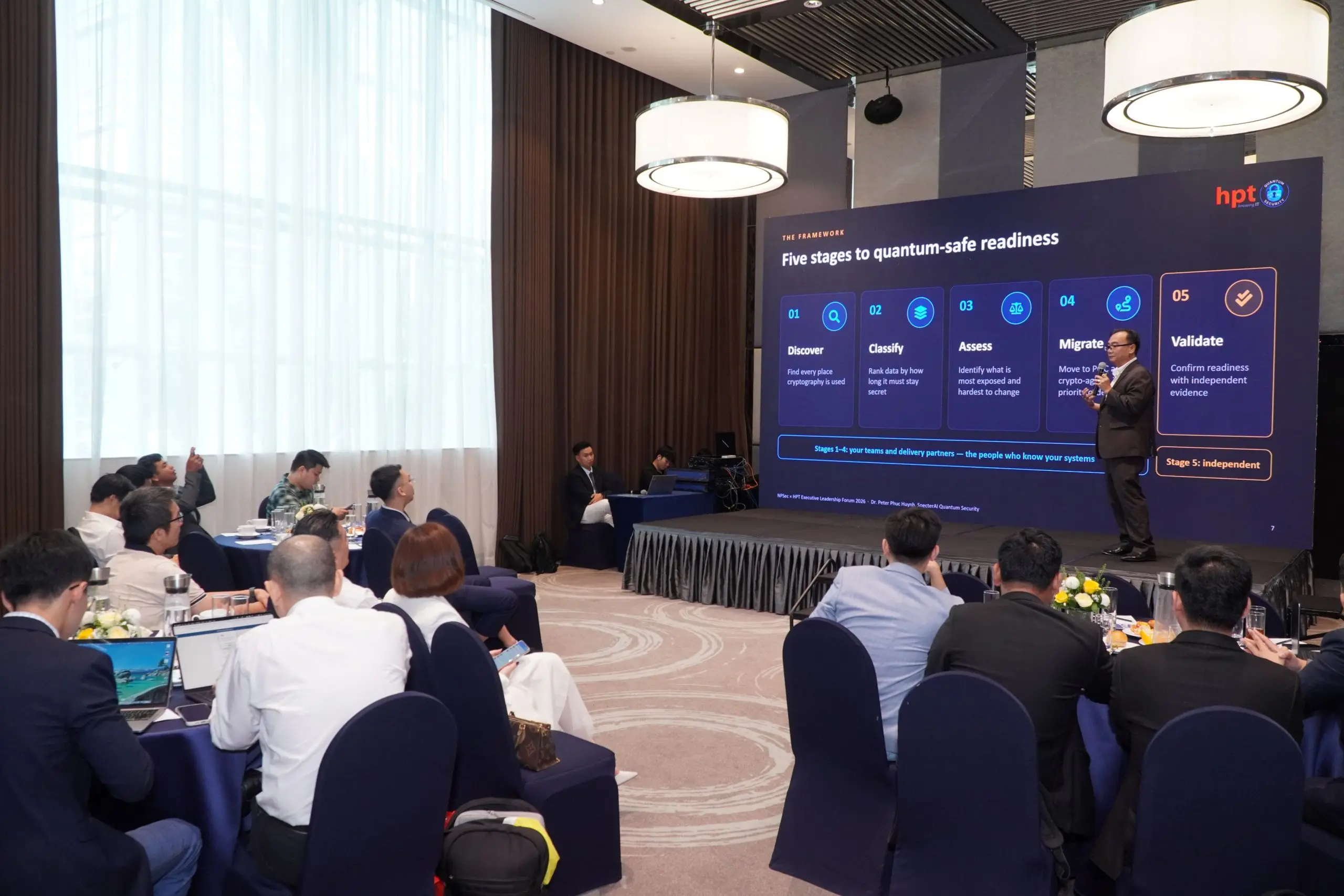
Eleven Cambodian banks joined Vietnamese banking leaders at the NPSec × HPT Executive Leadership Forum 2026 to address an evolving cybersecurity challenge. SpecterAI Quantum Security presented a five-stage path to quantum-safe readiness on November 7, 2026, framing the necessary migration not as a looming threat, but as a vital upgrade to customer trust.
“Quantum readiness is not a story about fear,” said Dr. Peter Phuc Huynh, Chairman APAC of SpecterAI Quantum Security, “It is the next upgrade of the trust every bank already promises its customers.” The session followed the recent publication of NIST’s post-quantum cryptography standards, signaling an immediate need for action.
SpecterAI’s Five-Stage Path to Quantum-Safe Readiness
This framework, presented to leaders from eleven Cambodian banks alongside their Vietnamese counterparts, prioritizes internal execution for the initial four stages, but demands independent validation as the final step. Dr. Huynh stated, “But assurance must come from eyes that did not build those systems. No organization can independently validate work it performed itself. Banks already live by that principle in audit and penetration testing, and quantum readiness should follow it too.” The proposed methodology acknowledges the urgency of protecting long-lived data, recognizing that encrypted communications intercepted could be decrypted by a future quantum computer.
SpecterAI’s approach suggests that proactive migration to quantum-safe protections ensures lasting security, regardless of the precise timeline for quantum decryption capabilities. This strategy is further supported by Dr. Huynh’s application of Michele Mosca’s X + Y > Z framework, which highlights that the primary controllable factor for organizations is the duration of their migration process, SpecterAI says. Every month of preparation shortens it.
Beyond the technical stages, SpecterAI’s presentation focused on immediate leadership actions. The company recommends that banks appoint an executive owner to champion the quantum-safe transition, initiate a comprehensive cryptographic inventory, and integrate cryptography and crypto-agility into procurement policies. A pilot deployment of a hybrid TLS channel, a connection capable of using both classical encryption, is also advised, alongside a clear definition of “ready” status, subject to independent verification. This emphasis on practical, near-term steps reflects a deliberate effort to move beyond abstract threat assessments and toward concrete action.
Huynh said the banks that start now will define what that trust means for the next decade. A critical point raised during the session concerned the potential for silent failures in hybrid connections. SpecterAI warned that a hybrid connection could revert to classical cryptography if a partner system lacks support, doing so without generating any error messages or alerts.
This highlights the necessity of live testing to confirm the actual use of quantum-safe protocols, rather than relying on configuration settings alone. Mr. Nguyen Thanh Nam, Deputy CEO of HPT Vietnam Corporation, affirmed the importance of collaborative efforts in addressing these evolving cybersecurity challenges, stating, “The Executive Leadership Forum 2026 brings financial leaders together at a time when cyber threats are growing in scale and sophistication.” He added that HPT will continue to invest in expertise and technology, working with SpecterAI and NP-Secure, to bolster cyber resilience across the region.
The Executive Leadership Forum 2026 brings financial leaders together at a time when cyber threats are growing in scale and sophistication.
Mr. Nguyen Thanh Nam, Deputy CEO of HPT Vietnam Corporation



See today’s quantum computing news on Quantum Zeitgeist for the latest breakthroughs in qubits, hardware, algorithms, and industry deals.