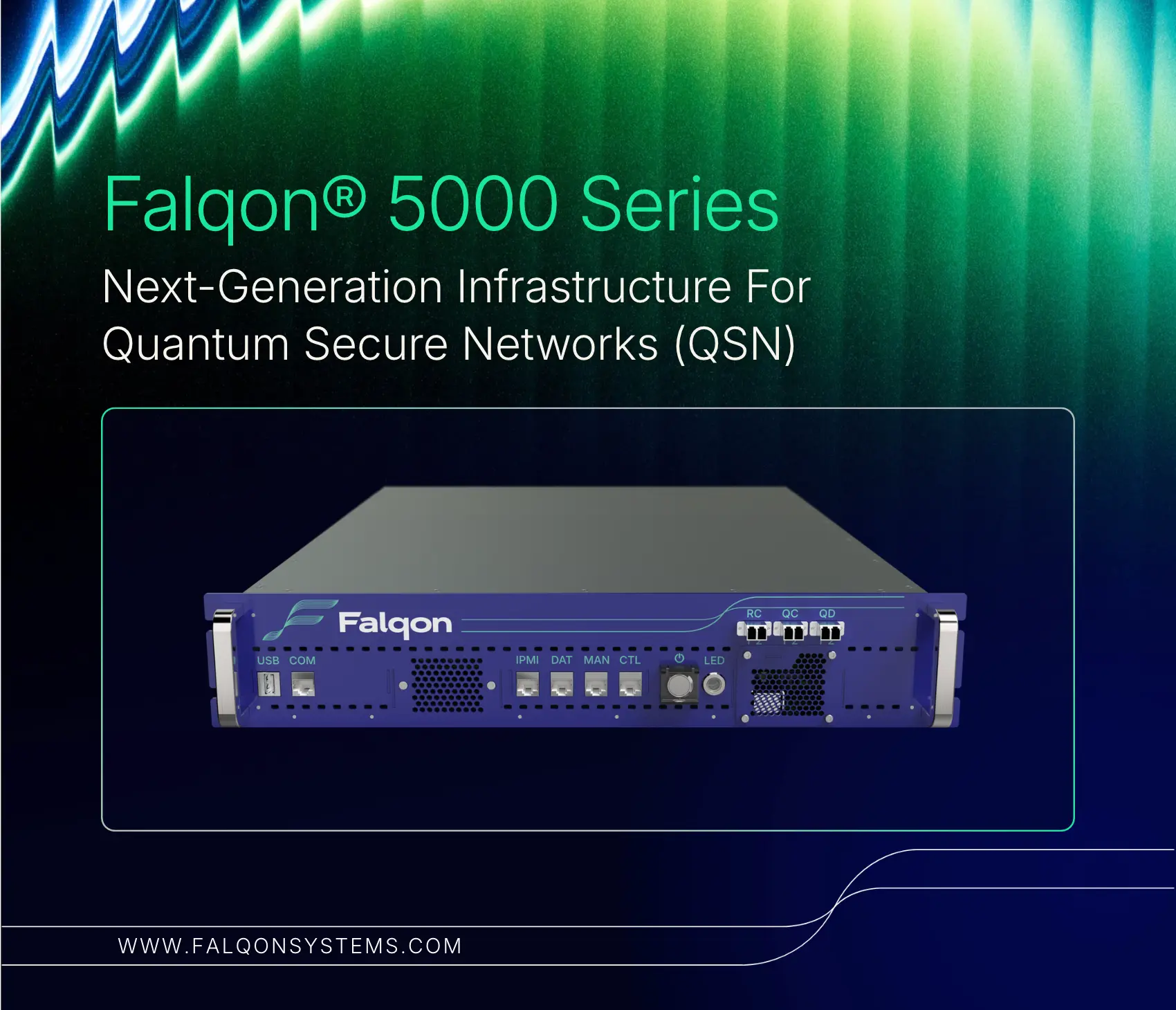
Forschungszentrum Jülich will deploy the Falqon 5000 Series as its first customer, demonstrating a commitment to quantum-secure infrastructure from a major European research center. Falqon Systems launched the new series, building on its existing 4000 Series deployments across Europe, to address the growing need for resilient quantum secure networks amid increasing threats to digital infrastructure.
“Europe has an opportunity to lead in secure digital infrastructure,” said Dr. Ingrid Romijn, CEO and Co-Founder of Falqon Systems, “but technological leadership must translate into solutions that can be deployed and scaled.” The Falqon 5000 Series introduces enhanced physical security and scalable network connectivity for long-term cryptographic protection.
Falqon 5000 Series Enables Scalable Measurement-Device-Independent QKD Networks
The Falqon 5000 Series introduces three core hardware components, the Connectivity Hub (CH5000), QKD Node (QN5000), and Quantum Optical Switch (QOS5000), designed to provide the infrastructure for secure key generation and flexible optical routing using Measurement-Device-Independent Quantum Key Distribution (MDI-QKD). These components work together to establish shared quantum network connectivity, a critical step towards building robust and scalable quantum secure networks.
Engineered for smooth integration into existing telecom and data center environments, the series allows network operators to expand quantum secure connectivity services, including Quantum Secure Networks as a Service (QSN-as-a-Service), across various geographical scales. The new series extends Falqon Systems’ network-first architecture, moving beyond isolated connections to interconnected Quantum Secure Networks (QSN) capable of meeting the demands of critical digital infrastructure, according to Remon Berrevoets, CTIO of Falqon Systems.
New features like dual-homing and inter-hub connectivity are central to this scalability, allowing for network resilience and adaptability as quantum networks grow in complexity and scope. This focus on network architecture distinguishes the Falqon 5000 Series from earlier iterations and positions it as a key enabler for widespread quantum communication adoption. Forschungszentrum Jülich will use the Falqon 5000 Series to investigate integrating quantum key distribution into power system communication networks, providing a platform to evaluate secure and resilient communications in critical energy infrastructure, according to Daniele Carta, Head of Control Solutions Department at Forschungszentrum Jülich.
Complementing the hardware, the Falqon Key Manager handles secure cryptographic key lifecycle management and delivery, while the Falqon Domain Controller provides centralized quantum network management and orchestration. The integrated technology portfolio, the Falqon 5000 Series, Key Manager and Domain Controller, provides the tools needed to deploy, manage, and scale Quantum Secure Networks.
Standards-based interoperability, including adherence to ETSI GS QKD 004, 014, 020 and SKIP standards, ensures compatibility with existing telecom, encryption and third-party key management infrastructure. Dr. Joshua Slater, CTO of Falqon Systems, emphasizes the long-term vision, stating, “The network infrastructure we are developing today lays the foundation for the next generation of interconnected quantum systems.” The Falqon 5000 Series, designed, developed, and manufactured in Europe, reinforces the company’s commitment to European technological sovereignty and trusted communication infrastructure.
The Falqon 5000 Series represents an important addition to our quantum communication research infrastructure, enabling us to investigate the integration of quantum key distribution into power system communication networks.
Dr. Daniele Carta, Head of Control Solutions Department at Forschungszentrum Jülich
Falqon Systems’ Infrastructure Supports European Quantum Security and Sovereignty
Forschungszentrum Jülich will be the launch customer for the Falqon 5000 Series, marking another milestone in Falqon Systems’ expanding pan-European quantum network footprint. This deployment builds on existing deployments of its 4000 Series. This inherent security advantage is now coupled with a network-first design, connecting multiple QKD Nodes via shared Connectivity Hubs, a departure from point-to-point systems. This architecture allows for an expanding number of secure connections without compromising individual node security, a critical feature for large-scale deployments.
This interoperability is a deliberate design choice, intended to ease integration into established networks rather than requiring wholesale replacement. Beyond QKD, the Connectivity Hub architecture anticipates future applications, including connections between quantum processors, computers, sensors and other emerging quantum devices. The company intends to support European government, defence and critical infrastructure organizations with sovereign, interoperable infrastructure for national and cross-border Quantum Communication Infrastructure programs.
Our collaboration with Falqon Systems reflects a shared commitment to strengthening the security of critical energy infrastructure through scalable and interoperable European quantum communication technologies.
Dr. Daniele Carta, Head of Control Solutions Department at Forschungszentrum Jülich



See today’s quantum computing news on Quantum Zeitgeist for the latest breakthroughs in qubits, hardware, algorithms, and industry deals.