The Okinawa Institute of Science and Technology (OIST) has created a spin-based microwave amplifier that boosts quantum signals by more than 1,000-fold while adding minimal noise. This device, a reimagining of mid-century maser technology, operates near absolute zero and uses substitutional nitrogen impurities, known as P1 centers, within a diamond to amplify weak microwave signals.
Yuimaru Kubo, head of the Hybrid Quantum Device Team at OIST, said, “But now, with quantum computers operating at temperatures very close to absolute zero, we have given them new life.” The amplifier’s ability to handle stronger signals and function in magnetic fields offers a more robust alternative for practical quantum computing and advanced sensing technologies.
Diamond Maser Amplifies Signals Beyond 1,000-Fold with Minimal Noise
The OIST device achieves over 1,000-fold amplification of microwave signals while adding just 2.55 quanta of noise, a figure remarkably close to the theoretical minimum imposed by quantum mechanics itself. This performance surpasses many existing quantum-limited amplifiers, which can struggle with saturation when simultaneously reading multiple qubits. These P1 centers are key to the device’s ability to boost weak signals without introducing substantial interference. The design of this maser, a reimagining of mid-20th century technology, addresses limitations found in current amplification methods.
The OIST team’s maser operates near absolute zero, a condition now more readily achievable thanks to the development of quantum computers that themselves function at extremely low temperatures. The principle behind the device is rooted in stimulated emission, a process where incoming photons trigger the release of identical photons, effectively amplifying the signal.
Applying a microwave field to the diamond first prepares the electron spins, shifting most into a higher-energy state. When microwave signals then enter the device, these excited spins release energy, amplifying the incoming signals at the same frequency. “We were surprised by how much amplification we could achieve using such a small amount of microwave power,” added Kubo, highlighting the efficiency of the design.
The team’s work, published in Nature Communications, details an amplifier that not only boosts signal strength but also maintains a low noise floor, which is important for accurate quantum measurements. Beyond its immediate application in quantum computing, the low-noise microwave amplification offered by this diamond maser has implications for diverse scientific fields.
Spectroscopy, nuclear magnetic resonance (NMR), the technology underpinning MRI scanners, and fundamental physics experiments, such as the search for dark matter, could all benefit from the ability to detect extremely faint microwave signals with minimal added noise. The device’s compatibility with spin-qubit quantum computing platforms, due to its operation within a magnetic field, further expands its potential integration into existing quantum systems. The researchers are now focused on developing the technology towards commercialization, aiming to make this high-performance amplifier widely available for a range of scientific and technological applications.
Despite being invented before optical lasers, masers – microwave lasers – have been left far behind because they often require cryogenic conditions to function, which made them impractical until very recently.
Dr. Yuimaru Kubo, head of the Hybrid Quantum Device Team at OIST
P1 Centers Enable Spin-Based Microwave Amplification
The OIST device achieves amplification exceeding 1,000-fold while introducing just a few photons’ worth of noise. This process shifts the majority of spins into a higher-energy state, creating a population inversion essential for stimulated emission. The design of the amplifier also ensures compatibility with existing spin-qubit quantum computing platforms, a key consideration for practical implementation. The device operates within magnetic fields already standard in these systems, streamlining potential integration.
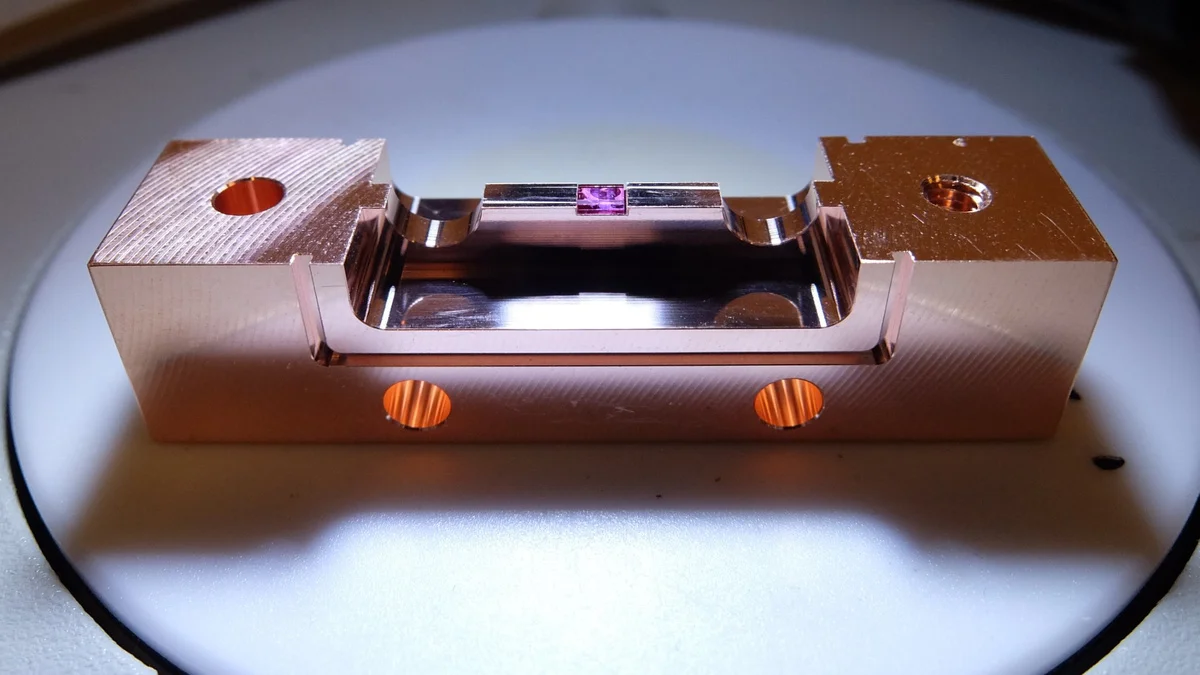
A schematic illustration details how microwave amplification occurs through stimulated emission showing the creation of a population inversion and the subsequent release of energy from excited spins. The diamond itself is housed within a copper resonator, a component removed in a close-up view to reveal the pink diamond at the heart of the amplifier.
We were surprised by how much amplification we could achieve using such a small amount of microwave power.
Dr. Yuimaru Kubo, head of the Hybrid Quantum Device Team at OIST


See today’s quantum computing news on Quantum Zeitgeist for the latest breakthroughs in qubits, hardware, algorithms, and industry deals.