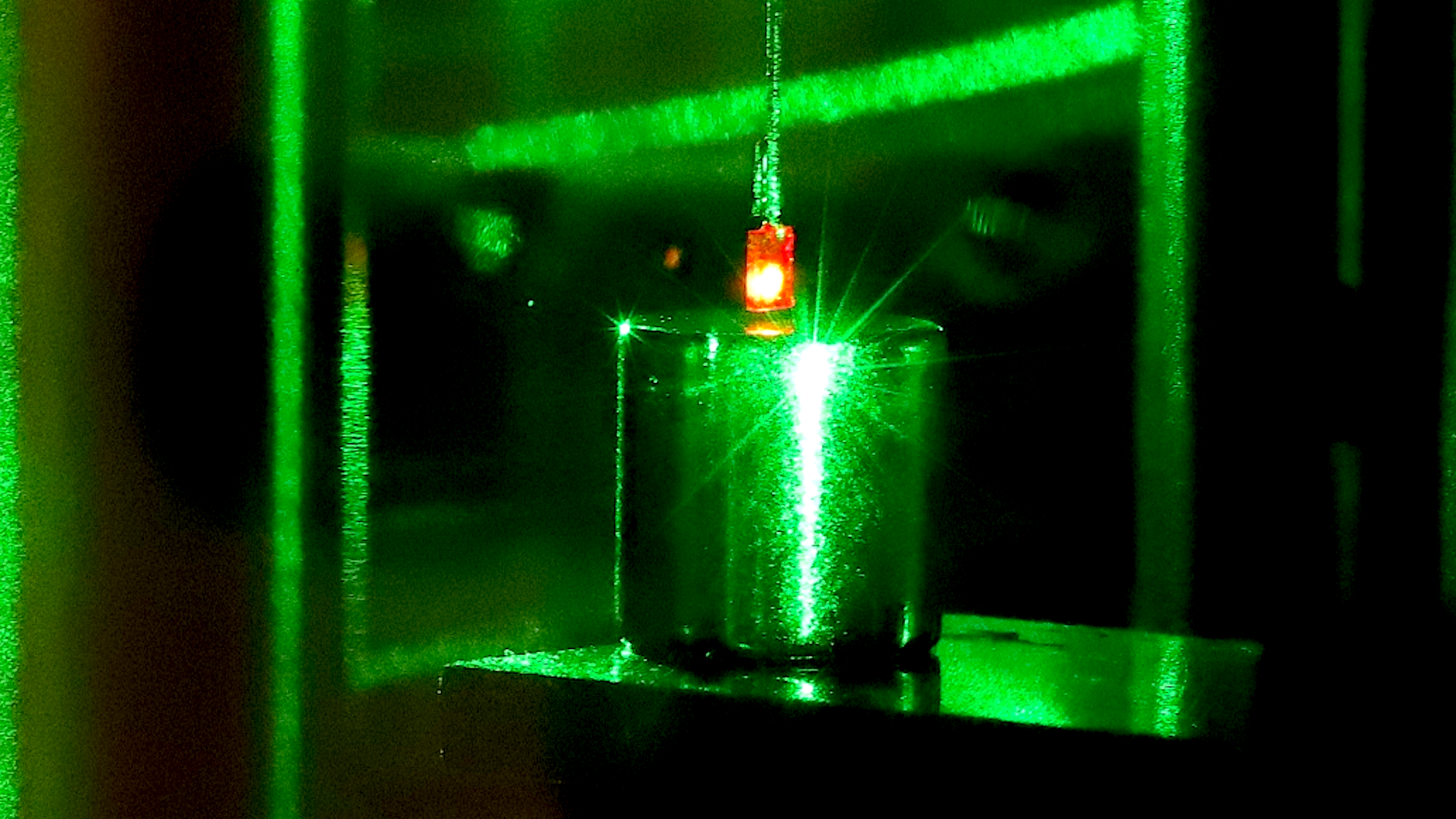
Researchers from the Okinawa Institute of Science and Technology (OIST) have achieved the first observation of quantum spins directly shifting a centimeter-wide diamond, a feat eight to nine orders of magnitude larger than previous spin-mechanical experiments. This demonstration marks the first time a quantum effect has manipulated an object meaningfully influenced by gravity, establishing a new baseline for exploring the boundary between classical and quantum physics.
“There have been many efforts to test whether quantum mechanics holds for anything larger than a few tens of nanometers, so far without success,” explains Professor Jason Twamley of the OIST Quantum Machines Unit. The findings, published in Science Advances, also suggest potential for new sensors capable of detecting dark matter and gravitational waves.
Centimeter-Scale Diamond Moved by Quantum Spin Force
Displacements of up to several picometers in the centimeter-wide diamond were observed, a movement induced solely by the collective spin of electrons within the material’s nitrogen-vacancy (NV) centers by the team. The experimental setup involved suspending the diamond above a magnet using a carbon fiber rod, meticulously shielded from external vibrations and interference to isolate the quantum signal.

Researchers used a green laser to polarize the NV centers, effectively creating controllable quantum magnets within the diamond lattice. Periodic illumination of the diamond with this laser generated fluctuating magnetic fields, exerting a force that drove the diamond’s vertical motion.
An interferometer, capable of measuring distances with picometer precision, detected these minute movements, confirming the direct link between the spin polarization and the mechanical displacement. “It’s no longer a question of whether such technology is possible, but of how we can refine experimental conditions to achieve quantum superposition within the regime of Einstein’s general relativity.” The choice of NV diamonds was deliberate, stemming from their well-understood properties and exceptionally long coherence times.
These characteristics allow the quantum spin states within the diamond to maintain superposition, a fundamental quantum phenomenon, for extended periods, even at room temperature. Maintaining this prolonged coherence is important for generating and manipulating macroscopic quantum states.
Daehee Kim, a PhD student at OIST, explained that “NV diamonds are well understood and easy to control. That, and the fact that NV centers have some of the longest known coherence times, allowing them to maintain quantum superposition at room temperature much longer than other systems, makes them particularly attractive for generating macroscopic superposition of the motion or object in future research.” The implications of this work extend beyond fundamental physics, potentially leading to the development of highly sensitive sensors. The same principles used to move the diamond could be adapted to create devices capable of detecting extremely weak forces, such as those associated with dark matter or gravitational waves.
To test the quantum nature of gravity, we ultimately need to put objects with large enough masses into quantum superposition. And these objects need to be levitated in a vacuum to minimize the influence of environmental noise.
Interferometry Detects Picometer-Scale Displacement from Spin Polarization
This demonstration represents a departure from conventional approaches to testing quantum mechanics at larger scales. “To test the quantum nature of gravity, we ultimately need to put objects with large enough masses into quantum superposition. And these objects need to be levitated in a vacuum to minimize the influence of environmental noise,” explains first author Anshuman Nayak, PhD student in the unit. “The typical approach has been to start with extremely small, levitated objects and gradually increase their mass until the effects of gravity become relevant.
But levitating macroscale objects using conventional techniques, such as optical traps, has proven extremely challenging. That’s why we’re taking a different approach, going from large to small.” By starting with a relatively large object, the team circumvented the difficulties of levitating increasingly massive particles, establishing a new baseline for probing the boundary between the quantum and classical worlds.
The diamond itself contains billions of nitrogen-vacancy centers, unpaired electrons acting as controllable quantum magnets. Periodically illuminating the diamond with the laser polarizes these centers, creating the magnetic fluctuations that exert force on the diamond. This force, though minuscule, was sufficient to induce measurable displacement, a finding that emphasises the potential for harnessing quantum effects to manipulate macroscopic systems. The team reports observing a classical mechanical response to a quantum force on an object that is eight to nine orders of magnitude more massive than the current spin-mechanical experiments.
The implications extend beyond fundamental physics, potentially opening avenues for novel sensor technologies. The sensitivity of the interferometer, combined with the diamond’s unique quantum properties, could lead to devices capable of detecting subtle changes in gravitational fields or even the elusive signatures of dark matter. Twamley summarizes the significance of the work: “We’ve shown a large classical response from a small quantum effect.” This achievement suggests that macroscopic quantum effects, once considered purely theoretical, may be within reach of experimental verification.
There have been many efforts to test whether quantum mechanics holds for anything larger than a few tens of nanometers, so far without success. Now, we have observed a classical mechanical response to a quantum force on an object that is eight to nine orders of magnitude more massive than the current state-of-the-art spin-mechanical experiments.
Jason Twamley, Professor of the OIST Quantum Machines Unit




See today’s quantum computing news on Quantum Zeitgeist for the latest breakthroughs in qubits, hardware, algorithms, and industry deals.