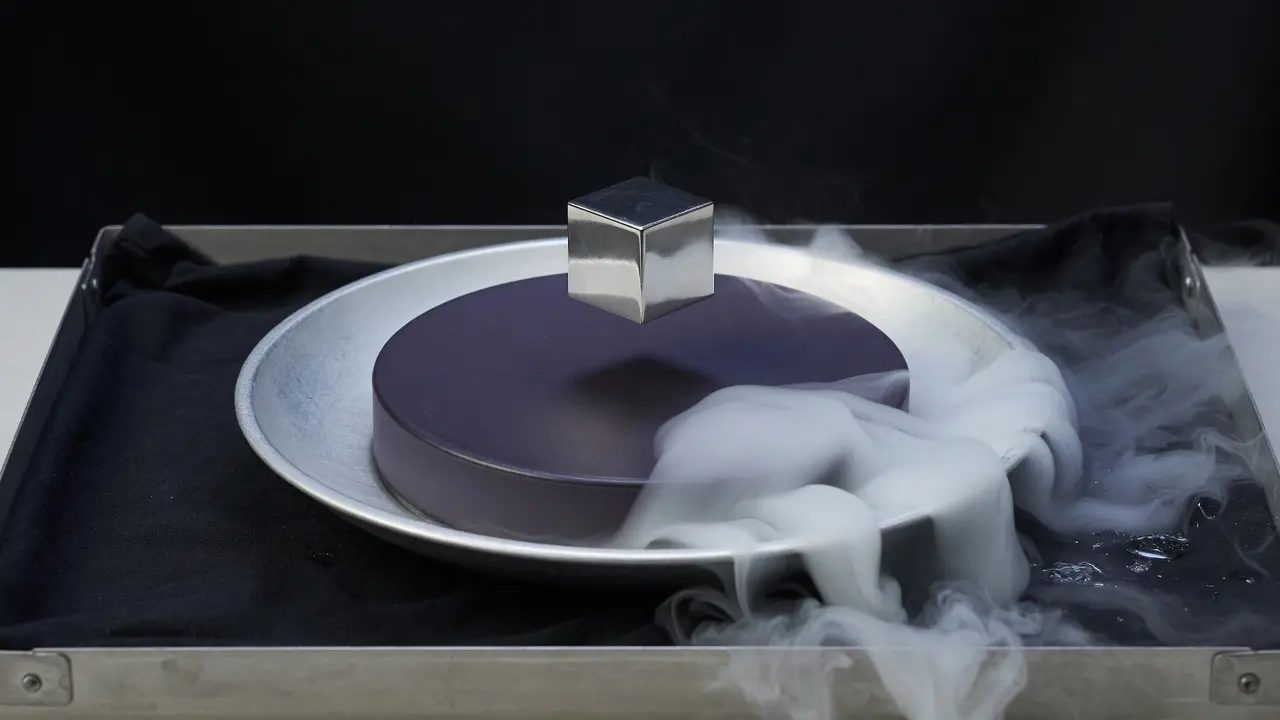
Researchers from the Shanghai Institute of Ceramics have linked a superconductor’s critical temperature specifically to four measurable properties: carrier concentration, thermal expansion coefficient, interatomic distance and ionic radius. The new model, published in the Journal of Materiomics, explains how a sufficiently high carrier concentration effectively screens impurities, with the screening length (λ) following the power law λ ∝ n -1/6.
For cuprate superconductors like YBa 2 Cu 3 O 7-δ, the model highlights electron confinement within the CuO 2 planes and along Cu-O bonds as a factor enhancing screening. According to the researchers, this work “establishes a phenomenological link between the superconducting critical temperature and macroscopic material parameters,” offering a new path toward designing higher-temperature superconductors.
SIC Model Links Critical Temperature to Carrier Concentration
This relationship, derived from Thomas-Fermi theory, suggests that increasing the number of charge carriers effectively shields the material from disruptions that hinder superconductivity. The model posits that a higher carrier concentration leads to a shorter screening length, enhancing the robustness of the superconducting state against imperfections. Researchers at the Shanghai Institute of Ceramics further refined this understanding by incorporating the impact of atomic vibrations, quantified by the thermal expansion coefficient α, on the width of these superconducting channels.
Anharmonic atomic vibrations, which increase with temperature, effectively narrow these channels, reducing the critical temperature at which superconductivity emerges. This confinement intensifies screening and further diminishes the screening length, contributing to a higher critical temperature. The team validated their model against experimental data from a diverse range of materials, including both cuprate superconductors and conventional metals like aluminum, cadmium and lead.
Despite the significant variations in crystal structure and chemical bonding among these materials, they all adhered to the predicted −1/6 power law. This consistency, the researchers claim, demonstrates the broad applicability of their approach. “A phenomenological model for critical temperature of superconductors” offers a new pathway for understanding superconductivity and for designing materials with elevated critical temperatures. The researchers suggest that improvements in the precision of key parameter measurements will further refine the accuracy of superconducting property predictions.




See today’s quantum computing news on Quantum Zeitgeist for the latest breakthroughs in qubits, hardware, algorithms, and industry deals.