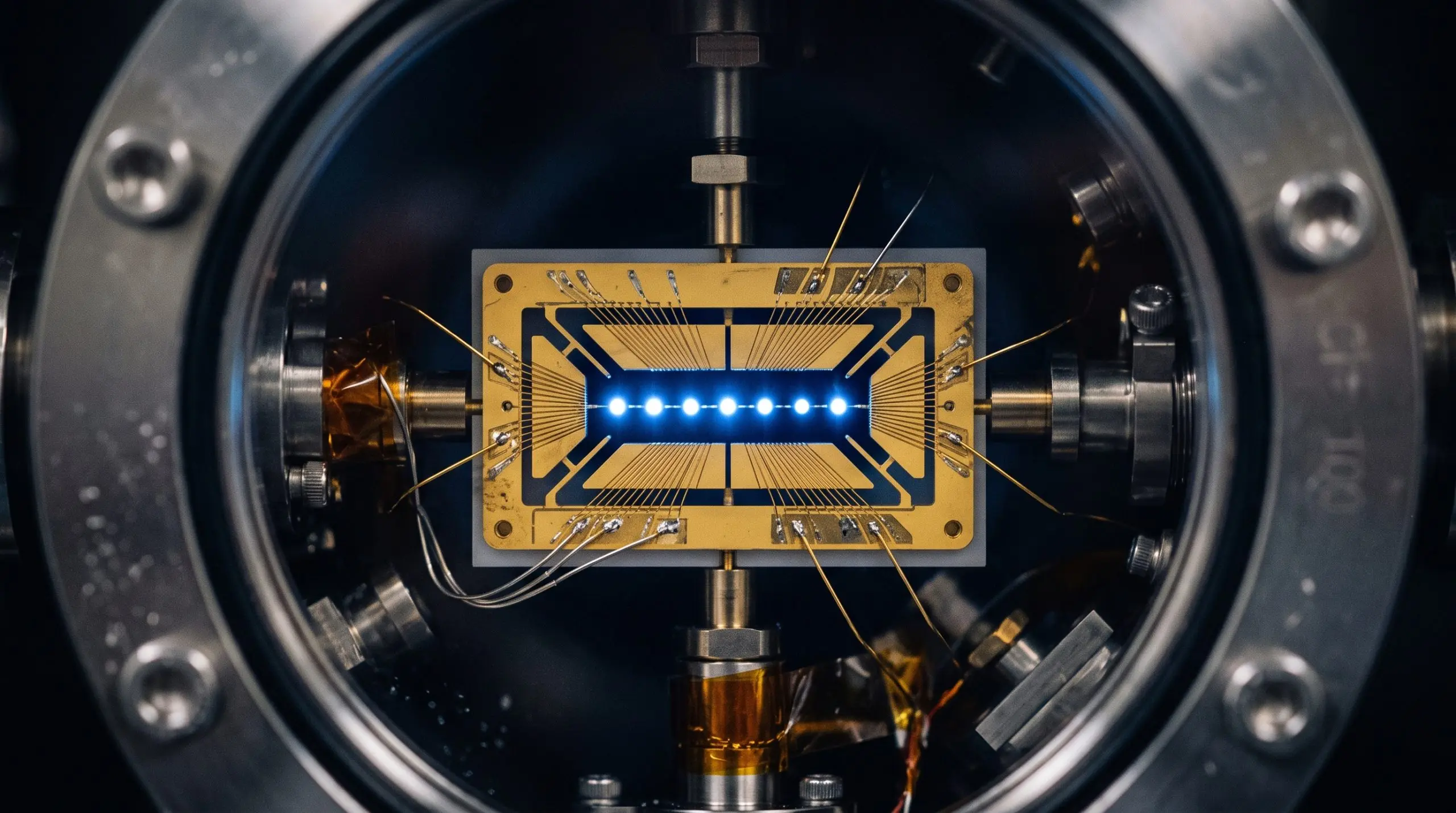
Researchers at Leibniz University Hannover have developed a new framework for analyzing how moving ions contribute to errors in quantum processors. The work details a method to isolate and benchmark the “heating” effects of individual ion movements, rather than simulating entire trajectories, using an 8-qubit processor design. This approach allows for determining the motional excitation of qubits and incorporates these costs as a function within the compiler itself. The team demonstrates that accounting for these motional costs at the chip design level can significantly reduce the overall runtime of quantum algorithms.
Framework Benchmarks Transport-Induced Excitations in Ion-Trap Processors
Researchers at Leibniz University Hannover developed this method to analyze how ion movement impacts the stability of quantum states within trapped-ion processors, moving beyond simulations of entire ion trajectories to isolate individual “shuttling primitives”. By discretizing the physical layout of the trap into interconnected space intervals, the team created a system for benchmarking the heating performance of each primitive operation. This approach characterizes the contribution of each movement to overall heating, enabling the creation of a cost function incorporated directly into the compiler level of quantum algorithm design.
The work details a methodology to approximate transport-induced excitations, initially demonstrated on a single ion before scaling to an 8-qubit quantum processor design using linear transport and swap operations for full connectivity. The team’s framework also accounts for anomalous heating, requiring experimental characterization and the creation of trap-specific heating models using measurements of radial and axial trapping frequencies.
The researchers emphasize that quantifying noise contributions at the compiler level is important, particularly when operating in a “noisy regime” where minimizing individual transport-induced excitations is paramount. The developed methods are intended to optimize the performance of trapped-ion quantum processors by directly addressing the impact of shuttling operations on motional state occupation.
Decomposition of Shuttling into Primitive Heating Operations
By breaking down ion movement into fundamental steps, scientists have created a method to pinpoint the source of heating errors in quantum processors. Instead of simulating complete ion trajectories, the new approach characterizes each individual “primitive operation”, the smallest unit of movement, by its contribution to overall heating. Isolating heating from these primitive operations is important for optimization, as the accumulated motional excitation directly impacts qubit stability.
Researchers found that individual operations could be adjusted to maintain a low level of excitation, specifically targeting a value of approximately 0.1, as measured by a parameter denoted ‘’. This precise control is enabled by the framework’s ability to decompose a complete “shuttling” sequence into its constituent parts, allowing the heating contribution of each step to be evaluated independently.
The inhomogeneous solutions derived from this decomposition depend solely on these pre-evaluated primitive operations, while the interference term is determined by the sequence itself. The framework also accounts for anomalous heating, stemming from electrical noise on electrode surfaces that induce unwanted vibrations in the ion traps. Characterizing this noise requires experimental measurement and the creation of a corresponding model within the simulation.
Knowing how to quantify the heating induced by each manipulation sequence, the team then focused on finding the ideal sequence that minimizes both operation time and phonon excitation, a measure of vibrational energy. This optimization occurs at the compiler level, incorporating the cost of motional operations as a function within the algorithm design process, suggesting a shift toward a more comprehensive quantum algorithm optimization that considers both logical and physical error sources.
8-Qubit Processor Design for All-to-All Connectivity
An 8-qubit quantum processor design served as the testing ground for a new method of analyzing heating errors, demonstrating the framework’s ability to model complex architectures. This design achieves all-to-all qubit connectivity through physical shuttling of ions between specialized zones for storage, gate operations, cooling and detection, a feature that can significantly reduce overhead in error correction. The platform’s success hinges on selecting an appropriate error correction code, potentially minimizing the number of physical qubits needed to implement a single logical qubit.
The method moves beyond simulating entire ion trajectories to instead isolate and characterize the heating performance of individual “shuttling primitives”. By extracting the motional excitation of each operation starting from a resting state, researchers can model the effects of initial conditions and assemble an analytical expression for phonon number in cascaded operations.
This approach allows for a streamlined analysis, determining the heating properties of each primitive operation separately and combining them algebraically to predict the global result. The team’s 8-qubit processor, implemented in a linear trap, features a storage register with an electrode multiplexing approach designed to minimize signal complexity. Essential to this all-to-all connectivity are three identified primitive operations: single-ion transport for moving ions between storage and the computational zone, two-ion merging/splitting to prepare crystals for multi-qubit gates, and two-ion swapping to reorder qubits.
“To achieve all-to-all connectivity, the computational zone should be capable of performing merging and splitting operations for multi-ion Coulomb crystals as well as swapping operations for qubit pairs,” the researchers write, outlining the requirements for their processor’s functionality. The framework’s ability to decompose complex sequences into these individual operations provides a pathway to optimize quantum algorithms for both logical errors and the physical heating introduced by qubit movement.
Motional Excitation Limits and Sympathetic Cooling Costs
Quantifying motional excitation during ion transport requires careful consideration of individual operations, as sympathetic cooling can consume a considerable fraction of total runtime. The presented framework moves beyond simply minimizing the number of transport steps, instead focusing on the heating characteristics of each primitive action within a sequence. This detailed analysis allows for a more subtle optimization of quantum algorithms and chip design, potentially reducing overall computational cost.
The methodology decomposes complex ion reordering into these fundamental operations, associating each with a specific level of heating. The framework’s ability to isolate these heating properties enables a cost function to be incorporated at the compiler level, influencing algorithm design. This approach differs from previous methods by focusing on the heating induced by each operation, rather than attempting to engineer transport profiles that eliminate excitation entirely.
The team’s analysis demonstrates that the cost of individual transport primitives can vary significantly, highlighting the importance of benchmarking each step. “Taking motional excitations into account at the level of chip design and compilation of algorithms can therefore significantly reduce the cost of carrying out a quantum algorithm and/or improve the performance of the device,” the paper states, emphasizing the potential for optimization beyond topological considerations. This granular understanding of heating effects promises a pathway towards more efficient and scalable trapped-ion quantum computation.
Influence of Initial Conditions on Phonon Number Calculation
Analyzing initial conditions during ion transport proves critical for accurately estimating total phonon number following a quantum operation, a factor previously underrepresented in simulations. The team’s method dissects complex ion rearrangement into individual steps, allowing for separate analysis of motional excitation originating from each primitive operation, rather than simulating entire trajectories. The framework’s utility was demonstrated using an 8-qubit processor designed for a linear ion trap, where researchers first identified hardware and design specifications limiting transport speed.
Numerical simulations then calculated control voltages and analyzed the impact of voltage interpolation on motional excitation, feeding data into a model that improves approximations of total phonon number. This integration allows for a compiler that balances low heating with minimized transport time, establishing a benchmark specific to the chip’s design.
Further analysis focused on the inclusion of initial conditions in calculating average phonon numbers, revealing advantages of incorporating motional heating as an operation cost. The team presents an example demonstrating this benefit, alongside a design instance intended as a performance benchmark for future iterations. “We feed the previously mentioned model to obtain better approximations of the total phonon number,” the researchers write, highlighting the iterative process of refining simulations with real-world hardware constraints.
Trap Array Design and Hardware Speed Limitations
Chip dimensions directly impact computational zone size in the 8-qubit processor design, limiting the space available for both processing and essential functions like state readout and cooling. Storage registers require larger electrodes to maintain sufficient axial trap depth, effectively constraining the computational zone to accommodate 16 storage slots within the chip’s overall length. This physical limitation highlights a key trade-off in scaling trapped-ion systems, balancing storage capacity with processing power.
The team’s methodology focuses on approximating transport-induced excitations during single-ion transport, and then extends this analysis to two-ion shuttling operations. This granular approach allows for extracting the specific contributions of each operation to overall heating, enabling a more precise understanding of error sources. The framework’s utility extends to compiler implementation, where motional operation costs are incorporated as a cost function alongside transport time.
This integration facilitates optimization for both minimizing heating and accelerating qubit movement, providing a benchmark for the specific chip design. Discretizing the layout into space intervals connected by “shuttling primitives” prepares the trap for export into this operation compiler. The processor layout, based on a Quantum CCD architecture, features a linear trap with dedicated zones for information storage, state readout and computation, representing a key step toward extending universal computation registers in multi-zone trap arrays.
Voltage Interpolation Impact on Motional Excitation
Numerical simulations revealed a direct link between voltage interpolation and motional excitation during ion transport, informing strategies to minimize heating within quantum processors. Analysis of different transport profiles demonstrated that distortions in the intended ion trajectory, caused by interpolation between calculation points, can contribute to unrecorded motional excitations. Smoother waveforms allow interpolation functions to accurately capture voltage slopes, reducing sensitivity to the number of interpolation points used.
Compiler Optimization for Heating and Transport Time
By manipulating the total transport time, researchers have devised a method to decompose heating effects into contributions from individual operations within ion traps. This allows for pre-calculation of motional excitation for each primitive operation, streamlining the analysis of complex ion “shuttling” sequences and avoiding the need to simulate entire ion trajectories for each scenario. The approach relies on a matrix function, Θ(t,T), which enables manipulation of transport time alongside initial conditions without repeatedly solving differential equations.
This decomposition allows the total heating accumulated during a reordering routine to be calculated as the sum of contributions from each individual operation, evaluated in sequence. Numerical simulations were used to calculate control voltages, and the resulting model provides improved approximations of the total phonon number, a key metric for assessing qubit stability. The team then integrated this understanding of heating into a compiler designed to optimize for both low heating and reduced transport time, creating a benchmark for their specific 8-qubit chip design.
Register Transport, Merging, and Swapping Operations
This granular approach isolates the heating effects of each step, streamlining analysis of complex “shuttling” protocols and enabling a more efficient assessment of performance. The team discovered that swapping operations, while essential for reordering ions and enabling connectivity, can introduce residual static electric fields that impact the storage registers, necessitating unoccupied slots during execution to mitigate crosstalk. These operational constraints are now incorporated into the analysis, providing a more realistic assessment of the trade-offs between connectivity and error.
Rather than simulating complete routines, the method decomposes transport into these primitive operations and calculates the total heating as an algebraic sum of individual contributions. “To find the total phonon excitation after an entire routine is completed, we do not wish to simulate all the successive operations from start to end,” the researchers explain, indicating a shift towards a more modular and scalable analysis technique.
This allows for the quantification of different reordering operations in terms of both phonon excitations and operation times, and ultimately enables the incorporation of motional operation costs at the compiler level as a cost function. The framework utility lies in its ability to predict and minimize these heating effects during algorithm design, potentially leading to more robust and efficient quantum computations.
👉 More information
🗞 Framework for the benchmarking of transport-induced excitations in shuttling-based ion-trap quantum processors
✍️ Rodrigo Munoz, Phil Nuschke, Teresa Meiners, Brigitte Kaune and Christian Ospelkaus
🧠 DOI: http://link.aps.org/doi/10.1103/krgw-pwjk



See today’s quantum computing news on Quantum Zeitgeist for the latest breakthroughs in qubits, hardware, algorithms, and industry deals.