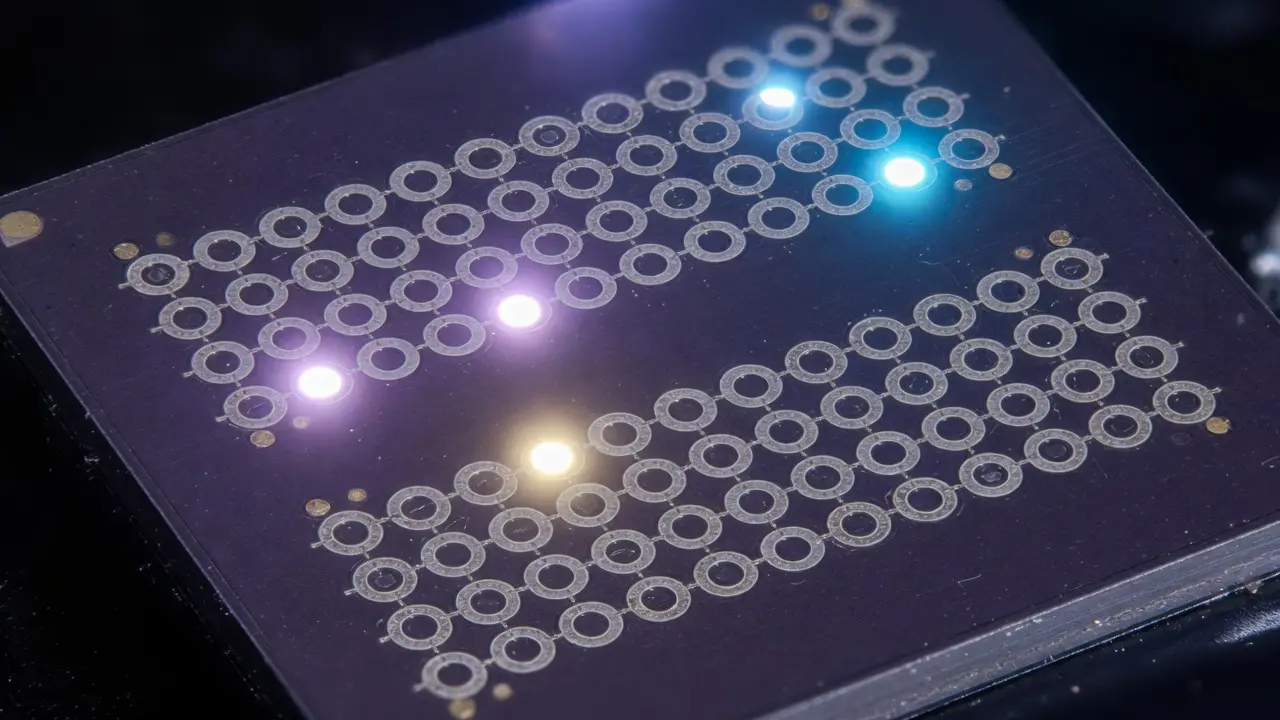
Researchers successfully demonstrated coherent operation of a single RF-dressed qubit and selective readout of hyperfine states within a two-ion Coulomb crystal using the chip. The device, a multilayer microstructured ion trap, features an integrated resonator creating a gradient in the RF magnetic field, enabling both the addressing and coupling of these dressed qubit states. This work characterizes the chip experimentally with laser-cooled 171Yb+ ions and a modulated RF field oscillating near 12.6 GHz.
RF Gradient Enables Individual Qubit Addressing
The resulting gradient allows for precise individual addressing of dressed qubit states and their subsequent coupling, without the need for complex optical systems. The chip’s design directly addresses a challenge in controlling multiple qubits: minimizing crosstalk during individual addressing. By varying the RF amplitude experienced by each ion within the Coulomb crystal, the energy separation between dressed states becomes unique for each qubit.
This differentiation enables selective manipulation of individual qubits by simply tuning the frequency of an additional RF field, or by modulating the RF field creating the dressing at the desired resonance frequency. Experiments with a two-ion Coulomb crystal, positioned at -100 μm within the region of maximum RF gradient, demonstrated this principle with a separation of 10 μm between the ions.
This approach builds on existing methods for individual qubit control, such as static magnetic field gradients used in MAGIC (magnetic gradient induced coupling), but offers distinct advantages. This enhancement is due to the lower frequencies of axial modes, leading to stronger interaction between the qubit and its motional state. The resonator integrated into the chip contributes significantly to its performance, delivering a 1.2300(27) MHz Rabi frequency on the 171Yb+ hyperfine transition with only 10 mW of applied RF power.
This efficiency is a direct result of the resonator’s design, which focuses the RF energy and creates the necessary amplitude gradient. The team demonstrated essential single-qubit operations on dressed-state qubits, including state preparation, manipulation and detection, confirming the viability of this approach for quantum information processing.
The gradient-induced coupling between dressed qubit states and ion motion opens the door to long-range spin-spin coupling using a single oscillating gradient, or the implementation of quantum gates employing double-dressed states. This capability is essential for performing complex quantum computations and simulations. The ability to create a controlled interaction between qubits is a key step toward building more powerful and versatile quantum processors.
The chip’s functionality was verified using the π-transition of the 171Yb+ hyperfine manifold as the initial bare qubit, a common choice for trapped ion quantum computing due to its well-defined energy levels and long coherence times. This choice allowed for precise characterization of the dressed states and their response to the applied RF fields. The experimental setup and data analysis confirmed that the chip effectively creates the necessary RF gradient and enables individual addressing of the two-ion Coulomb crystal.
The researchers successfully demonstrated individual addressing of dressed state qubits, a critical milestone for scaling up trapped ion quantum computers. This technology is not limited to two-ion systems. The principles can be extended to larger ion chains.
Multilayer Ion Trap Chip Design & Manufacturing
The fabrication of the ion trap chip began with a 17-nanometer layer of titanium and a 50-nanometer layer of gold deposited onto an aluminum nitride substrate, chosen for its thermal conductivity of 180 watts per Kelvin-meter. This initial metallic layering served as a foundation for a subsequent electroplating process to build the multilayer structure. The titanium layer enhanced adhesion, while the gold provided a conductive base for the more substantial metal layers to follow, demonstrating a deliberate approach to material selection for optimal performance.
The chip’s design incorporates a spiral-shaped RF resonator within the bottom layer, connected to an RF feedline and DC electrodes, alongside a top layer containing RF electrodes responsible for creating the effective trapping potential. These layers are separated by a dielectric layer containing vertical interconnect access, or VIAs, facilitating communication between the layers.
This multi-layer architecture allows for the generation of a radio frequency gradient field along the weak-confinement axis of a Coulomb crystal, a key element in individually addressing qubits within the trap. Simulations of the RF magnetic field amplitude at a position 72 micrometers above the spiral center revealed a quality factor, or Q-factor, of 5, derived from the full width at half maximum of the resonance curve.
The design also prioritizes optical access, with the central portion of the chip engineered to minimize scattered light from the region directly beneath the trapped ions. This was achieved by positioning the RF resonator to create a shadowed area below the ions, improving signal clarity and reducing noise. The simulated RF magnetic field amplitude, measured at position A with 1 watt of RF power applied, varied depending on the frequency, providing a tunable parameter for manipulating the dressed qubit states.
Manufacturing involved an adaptation of existing multi-level metalization processes to the aluminum nitride substrate, a material selected for its superior heat dissipation capabilities. The process began with the initial deposition of titanium and gold, followed by electroplating to build up the necessary metal layers for the RF resonator and electrodes. The resulting chip features a complex three-dimensional structure, carefully designed to create the desired RF gradient field. Ivan A. Boldin and Elham Esteki, both affiliated with the University of Siegen and currently with eleQtron GmbH, were equally involved in the work.
The team’s expertise in microfabrication and quantum optics was instrumental in realizing this novel chip design. The resulting device represents a step towards building more scalable and controllable quantum systems. The design, as detailed in the source, allows for a degree of control over the quantum states that was previously difficult to achieve with traditional ion trap architectures.
Dressed-State Qubits & RF Field Interaction
The ability to individually manipulate qubits within a multi-ion system is now demonstrated through a chip, using a gradient in radio frequency (RF) magnetic field amplitude. This approach moves beyond static magnetic gradient induced coupling, or MAGIC, by replacing static fields with a gradient of RF magnetic field amplitude and using dressed states instead of bare hyperfine states. The resulting system allows for coherent control of ions directly with RF fields, interacting with motional states through the induced coupling.
This interaction is essential for implementing conditional quantum dynamics, as motional degrees of freedom act as a quantum bus to transfer information between qubits. Initial qubit initialization occurred in the ^|F = 0⟩ state, followed by an adiabatic transition to the |⟩ dressed state via a 70 microsecond ramp of the near-resonant RF field. At maximum amplitude, the ions exhibited Rabi frequencies of 155.5 kHz and 200.8 kHz, respectively.
Subsequent modulation of the RF field at a frequency resonant with one ion’s Rabi frequency resulted in observed oscillations of 3.165 kHz, confirmed by fitting experimental data. The modulation depth was maintained at 0.1, meaning the driving RF field amplitude fluctuated between 0.9 and 1.1 times its non-modulated value. The team then adiabatically turned off the RF field to transfer dressed-state populations back into bare state qubits, allowing for readout of the populations as previously established.
This process confirms the ability to not only prepare and manipulate dressed-state qubits but also to selectively read out their states. The researchers note that the gradient also facilitates coupling between the dressed state qubit and the motion of the ions, opening avenues for multi-qubit gates. Future work will focus on implementing multi-qubit quantum gates using this oscillating RF field with axial gradient.
The goal is to control multiple interacting dressed qubits, protected from decoherence, with a single RF control electrode. This strategy represents a novel pathway toward scaling quantum information processing with trapped ions. The chip’s architecture, with its integrated resonator and multilayer construction, is designed to support this expansion.
The demonstrated individual addressing and coherent manipulation of dressed-state qubits, combined with the potential for scalable gate operations, positions this technology as a promising platform for future quantum computing research. The ability to create and control these gradients with a single RF control electrode simplifies the architecture and potentially reduces the complexity of controlling larger systems.
171Yb+ Ion Characterization of the Trap Chip
The fabrication process for the multilayer ion trap chip achieves alignment between layers with sub-micrometer precision. Specifically, the upper layer aligns to within 0.5 micrometers of the bottom layer in the x-direction, and 1 micrometer in the y-direction, a level of accuracy critical for maintaining the integrity of the RF gradient field. This precision was verified through scanning electron microscopy (SEM) inspection of chips from the same production batch, revealing the spiral shape of the RF resonator positioned near the ion trapping location.
The chip’s RF resonator, integral to generating the qubit control field, is designed to operate near 12.64 GHz, corresponding to a wavelength of 2.4 cm in vacuum and approximately 1 cm on the chip itself. Achieving resonance required careful consideration of the coil dimensions, determined through simulation-based analysis to match the desired frequency for driving hyperfine transitions in 171Yb+ ions.
This frequency selection allows for precise manipulation of the ions’ internal states, forming the basis for qubit encoding and control. The resonator’s open spiral design, connected to an RF feedline, ensures efficient energy coupling and signal transmission. Surface flashover tests conducted on similar chips demonstrated robustness against high voltages. The fabrication process included a fluorine-based plasma etching step to remove polyimide (PI) from gaps in the gold layer.
This removal minimizes the accumulation of uncontrolled charges on dielectric surfaces, which could otherwise disrupt ion trapping and qubit coherence. Pre-assembly characterization, including SEM inspection and surface flashover tests, was performed on chips from the same batch to ensure quality control and identify any potential defects before integration into the full experimental apparatus.
👉 More information
🗞 Dressed-State Quantum Information Processing Using a Multilayer Ion Trap Chip with an Integrated Radio Frequency Resonator
✍️ Bogdan Okhrimenko and Christof Wunderlich (Department of Physics, School of Science and Technology, University of Siegen, Siegen, Germany); Friederike Giebel, Konstantin Thronberens, Amado Bautista-Salvador and Christian Ospelkaus (Physikalisch-Technische Bundesanstalt, Bundesallee 100, Braunschweig, Germany); Ivan A. Boldin and Elham Esteki
🧠 ArXiv: https://arxiv.org/abs/2611.24910v1


See today’s quantum computing news on Quantum Zeitgeist for the latest breakthroughs in qubits, hardware, algorithms, and industry deals.