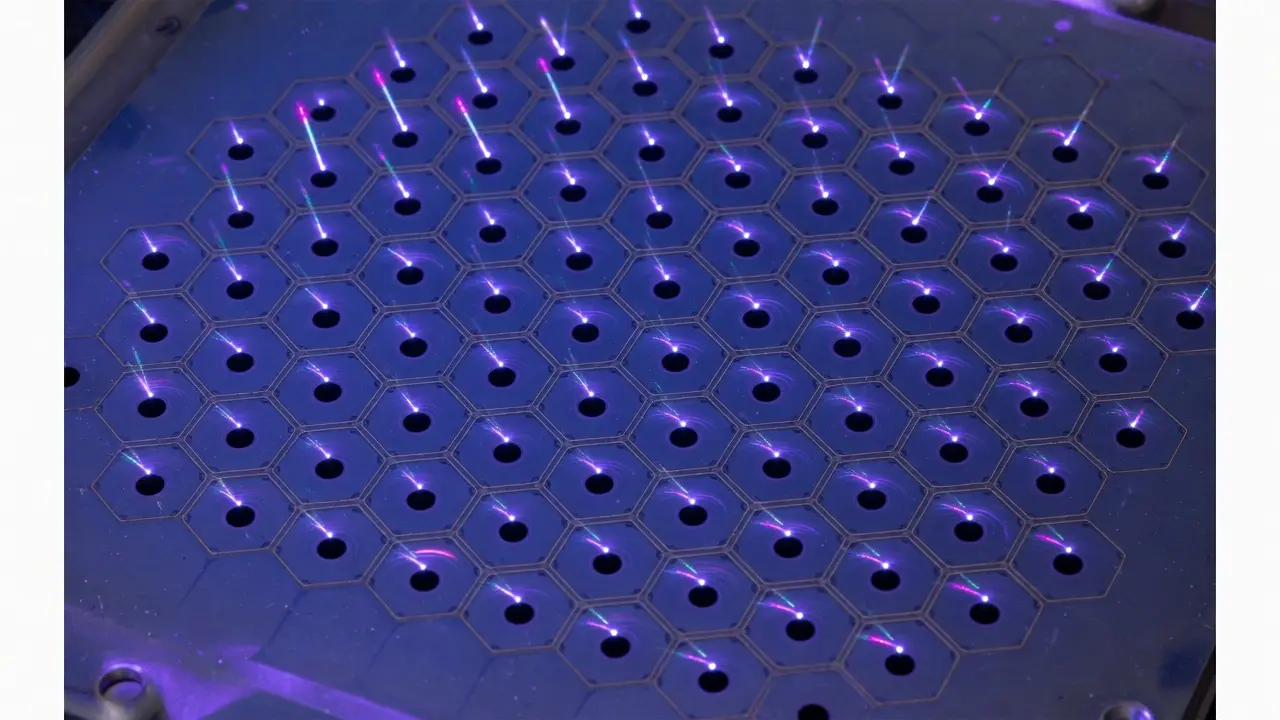
Researchers from RIKEN Center for Quantum Computing, The University of Tokyo, and OptQC Corp. have created a high-speed programmable quantum computing platform using one hundred inputs. This continuous-variable system, built on a full-stack architecture, operates at a 100 MHz clock frequency and integrates a cloud interface with the open-source Python software development kit, mqc3. The work demonstrates multi-input teleportation and programmable routing across 101 input modes, establishing a testbed for future integration of non-Gaussian resources and large-scale optical neural networks. Quantum computing is widely regarded as a transformative technology in the field of information technology.
Full-Stack Optical Quantum Platform with 100 Inputs
This system integrates a cloud-based interface alongside an open-source Python software development kit, mqc3, which significantly expands access for researchers with strong computational skills but potentially limited hardware expertise. The mqc3 toolkit allows for the flexible implementation of arbitrary Gaussian operations across multiple input modes, streamlining the process of designing and testing quantum circuits.
Researchers verified the system’s capabilities through multi-input and multi-step quantum teleportation, successfully transferring quantum states between modes, and demonstrated programmable routing of those states across all input modes. The development of a full-stack platform, encompassing both hardware and software, represents a departure from approaches that rely on assembling pre-made components, providing a higher degree of control and customization.
High-Speed Gaussian Quantum Computing at 100 MHz
The platform’s ability to execute programmable Gaussian operations on one hundred input modes at a 100 MHz clock frequency establishes a new benchmark for analog optical quantum computing, exceeding the scale of many prior demonstrations. This speed is achieved through time-domain multiplexing, a technique that allows multiple operations to be performed in rapid succession, effectively increasing the system’s processing power. The system’s architecture supports arbitrary multi-mode Gaussian operations by using beam splitter networks and squeezing operations, confirming its status as a universal and programmable Gaussian computing platform.
This design choice deliberately prioritizes usability, allowing users with strong problem-solving skills, even without deep knowledge of the underlying hardware, to design and run quantum circuits remotely. The platform is currently specialized for Gaussian operations, but provides a robust foundation for future integration of non-Gaussian capabilities and the development of large-scale optical neural networks.
Time-Domain Multiplexing and Ultra-Wideband OPAs
With 6 terahertz bandwidth optical parametric amplifiers central to its speed and scale, Helios enables a 100 MHz clock frequency for two-mode operations. This ultra-wideband capability, achieved through time-domain multiplexing, allows for the generation of extensive entanglement within a compact setup, a key feature for measurement-based quantum computing. Maintaining a stable operating environment is critical for this analog quantum computer, requiring a temperature-controlled booth and vibration isolation.
Optics are covered to minimize air currents, and optical path lengths are actively feedback-controlled using field-programmable gate array controllers. The successful execution of programmable routing confirms the reliability of complex, large-scale circuits within the platform. “By leveraging time-domain multiplexing and a Python SDK, we have successfully verified fundamental single- and two-mode operations, multi-step teleportation, and programmable routing,” the researchers state.
mqc3 SDK and Cloud-Based System Integration
The newly developed mqc3 software development kit and cloud interface are central to the platform’s design, automating the complex process of translating quantum circuits into specific hardware parameters. The open-source Python SDK allows users to design quantum circuits remotely and execute them on the platform, streamlining the experimental workflow and facilitating collaborative research. The architecture is designed with future scalability in mind, explicitly compatible with recently reported high-quality Gottesman-Kitaev-Preskill (GKP) qubits.
Fundamental operations on these GKP qubits, including entanglement and error syndrome measurements, can be directly implemented within the system. collaborated to build the system, a partnership combining academic research with corporate engineering expertise. The team views this as a stepping stone towards more complex systems, with the current infrastructure serving as a foundation for future fault-tolerant universal quantum computing.
101-Mode Quantum Teleportation and State Routing
Demonstrating a significant advance in scalability, the platform successfully executed parallel quantum teleportation across 101 modes in a 100-step process, suppressing noise and biases introduced by multiple operations. This achievement validates the system’s ability to maintain quantum information fidelity even with complex, multi-step procedures, a critical hurdle for practical quantum computation. The team verified the quantum nature of these operations, confirming the reliability of the system’s core functionalities.
Beyond teleportation, the system’s programmable routing capabilities allow for the dynamic rearrangement of quantum states, consolidating randomly distributed resources into designated target modes. Researchers demonstrated this by successfully sorting modes based on their displacement amplitudes, arranging them in both ascending and descending order. The cloud interface and software package significantly broaden the potential user base and accelerate experimentation.
Optical Lattice Structure with Micronode-Macronode Entanglement
This lattice structure, detailed of the source material, allows for computation through sequential measurements of these macronodes, with digitally applied feedforward operations refining the results. The architecture’s design relies on the interconnectedness of these macronodes, establishing a two-dimensional lattice on a cylindrical surface. The platform’s reliance on continuous-variable electromagnetic field quadratures, x and p, with a defined commutation relation, provides a unique approach to quantum information processing.
This method contrasts with qubit-based systems and offers potential advantages in certain computational tasks. The system’s ability to generate and manipulate this entanglement is fundamental to its operation, enabling the execution of multi-input and multi-step teleportation protocols. The design allows for a high degree of control over the quantum states, facilitating the exploration of complex quantum algorithms and the development of new quantum technologies.
Compatibility with GKP Qubits for Future Scalability
The platform’s architecture is designed to accommodate Gottesman-Kitaev-Preskill (GKP) qubits, an important step toward realizing fault-tolerant quantum computation. External quantum states are coupled into the system via optical switches that inject them into designated input modes. The developers created mqc3, an open-source Python software development kit, and an integrated cloud-based interface to automate the compilation of quantum circuits into hardware parameters, mirroring the functionality of qubit-based quantum computers. Further scalability is paramount, as higher operational speeds will enhance data throughput and accommodate the resource overhead required for fault-tolerant quantum computing.
👉 More information
🗞 Full-stack analog Gaussian optical quantum computing platform with one hundred inputs
✍️ Shota Yokoyama et al.
🧠 DOI: http://link.aps.org/doi/10.1103/mz47-v4fr



See today’s quantum computing news on Quantum Zeitgeist for the latest breakthroughs in qubits, hardware, algorithms, and industry deals.