In a leap forward for topological quantum computing, researchers at QuTech have demonstrated real-time readout of fermionic parity – a critical step towards building stable and scalable Majorana qubits. Published in Nature on February 12, 2026, the breakthrough enables the initialization and tracking of quantum states encoded in these exotic qubits, which promise resilience against environmental noise. The team achieved this by utilizing quantum capacitance to measure parity, overcoming the challenge that “the parity states are effectively charge-neutral, so the standard charge-sensor approach…cannot, by itself, provide a robust readout,” according to Nick van Loo. This “measurement primitive protected qubits have been missing,” concludes Francesco Zatelli, paving the way for future operations and bringing fault-tolerant quantum computation closer to reality.
Majorana Qubit Parity Readout via Quantum Capacitance
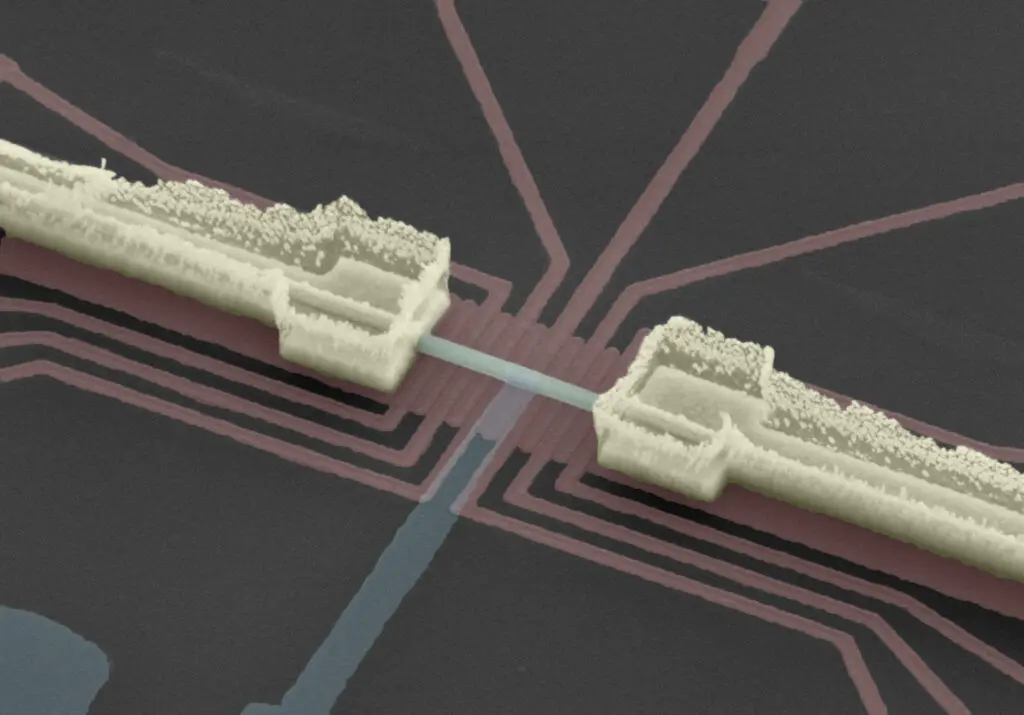
Unlike conventional qubits vulnerable to disturbances, Majorana qubits store information non-locally, spread across separated modes, but this distribution presented a significant measurement challenge. A standard probe targeting only one end of the device couldn’t reveal the qubit’s parity state. The QuTech team fabricated a minimal Kitaev chain, comprising two quantum dots linked by a superconducting segment, to create two Majorana modes, then employed quantum capacitance for readout. This involved an RF resonator connected to the superconductor, sensing charge flow and revealing the joint state of the two-dot system. “Getting this to work required us to tune the device into the regime where Majorana modes form and then isolate it so the parity is not constantly disturbed by the leads,” explains Nick van Loo. The team confirmed that standard charge sensors proved ineffective due to the parity states being charge-neutral, but the quantum capacitance method successfully discriminated parity in single shots, achieving millisecond-scale parity lifetimes. Measurements revealed random telegraph switching between parity states, and the team benchmarked the readout against conventional spin-qubit techniques, noting the charge sensor’s limited response near the operating point. QuTech is now focused on demonstrating coherence and exploring the non-abelian properties of Majorana modes, alongside efforts to extend device concepts to larger systems.
Millisecond Parity Lifetimes Achieved with Single-Shot Readout
Researchers at QuTech have achieved a breakthrough in Majorana-based qubit development with the demonstration of millisecond-scale parity lifetimes alongside single-shot readout capabilities, published in Nature. The team fabricated a minimal Kitaev chain, utilizing two quantum dots, to create and measure the elusive Majorana zero modes, essential for building topologically protected qubits. This advancement addresses a critical hurdle in the field, enabling both initialization and real-time tracking of the quantum state within a device designed for qubit operation.
The innovation lies in a novel readout method employing quantum capacitance, circumventing the limitations of traditional charge sensors which struggle with the charge-neutral nature of parity states. The system uses an RF resonator connected to a superconductor to detect how charge flows, revealing differences in electron pairing based on parity, even or odd, and translating that into a measurable signal. This achievement is hailed as a fundamental step toward practical Majorana qubits, as it provides the necessary tools for scalable readout.
The underlying mechanism of quantum capacitance offers a subtle yet powerful way to detect the collective charge fluctuations inherent to the superconducting system. Quantum capacitance ($$) measures the change in electrical charge stored within the device relative to the change in electrochemical potential, fundamentally linking the electronic structure to the measurable circuit response. For Majorana modes, the parity state dictates the collective charge landscape of the connected quantum dots, even if the net charge remains near zero. By coupling the Kitaev chain to a highly sensitive RF resonator, the measured shift in the resonator’s resonance frequency provides a direct, highly localized proxy for this parity-induced charge fluctuation, effectively circumventing the limitations faced by traditional, macroscopic charge sensors.
The significance of this achievement cannot be overstated when considering the long-term goal of fault-tolerant quantum computation. Conventional qubits, such as transmons or spin qubits, store information in localized states, making them highly susceptible to local environmental noise, or decoherence, from stray electric or magnetic fields. Topological qubits, however, encode information non-locally across separated physical boundaries, making the quantum information intrinsically robust against small perturbations. This physical resilience stems from the theory of non-abelian statistics, which suggests that performing a full quantum gate requires physically ‘braiding’ the Majorana modes around each other, an operation that is protected by the topology of the system itself.
Despite the proof-of-concept success in readout, bridging the gap to a fully functional quantum processor presents significant engineering challenges concerning scaling and connectivity. Current demonstrations involve minimally coupled chains, but a practical quantum computer requires deterministic control over hundreds of individually addressable qubits and the reliable coupling of complex multi-qubit gates. Researchers must solve the problem of integrating high-coherence quantum modules into large arrays while mitigating crosstalk between adjacent components. Furthermore, achieving long-range coherence in the presence of multiple coupling junctions requires refined material science and extremely precise low-temperature control protocols.
Getting this to work required us to tune the device into the regime where Majorana modes form and then isolate it so the parity is not constantly disturbed by the leads.
Nick van Loo
Source: https://qutech.nl/2026/02/12/qutech-demonstrates-real-time-readout-for-majorana-based-qubits/



See today’s quantum computing news on Quantum Zeitgeist for the latest breakthroughs in qubits, hardware, algorithms, and industry deals.