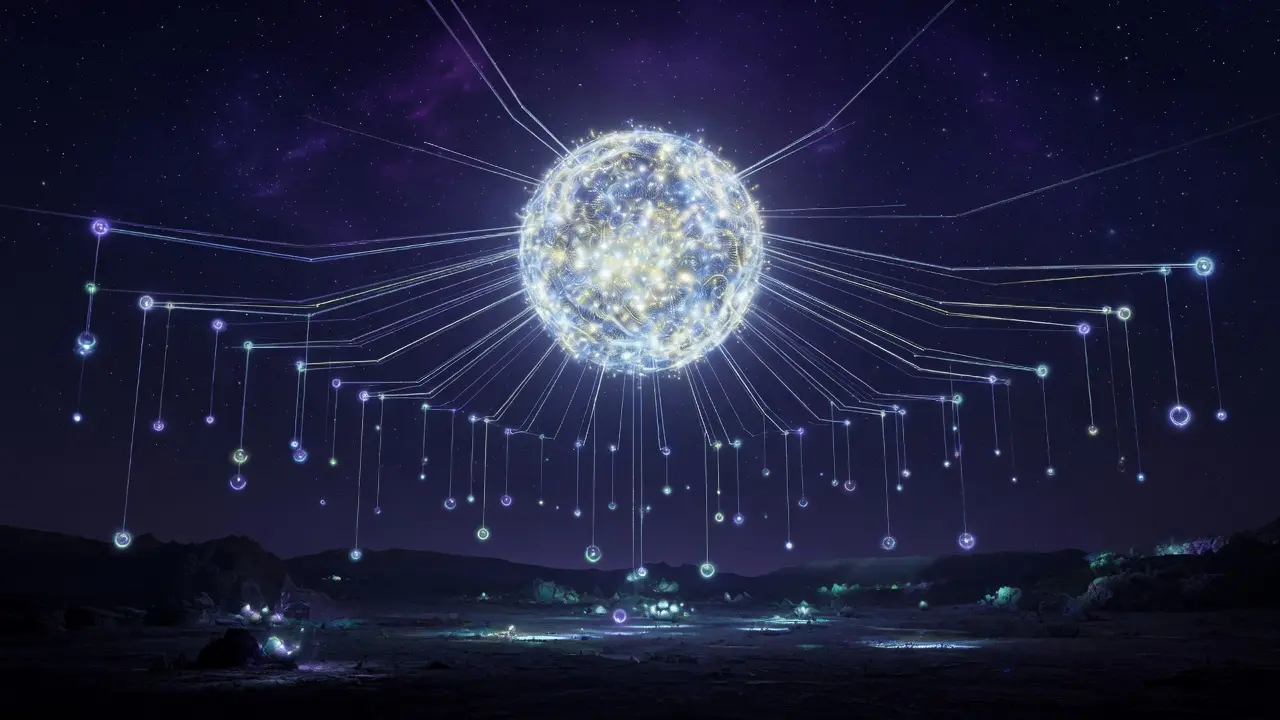
An 8,000 kilometer network now links Chicago with Bilbao and Amsterdam, demonstrating transatlantic quantum security through a hybrid approach to data protection. International research organizations presented the infrastructure at SC26, using both Quantum Key Distribution and Post-Quantum Cryptography to defend against future quantum computing threats. Each connection used the most suitable quantum-safe key, sourced from three providers working through a standard interface. This collaborative demonstration shows how interoperable networks can protect systems as quantum computers mature and threaten existing cryptographic systems.
Hybrid QKD & PQC Secure 8,000 km Transatlantic Network
The demonstration network incorporates five quantum nodes distributed across Chicago, Bilbao and Amsterdam, establishing a transatlantic reach of over 8,000 kilometers. These nodes, positioned at locations including the Ciena and Poznań Supercomputing and Networking Center booths at SC26, are equipped with technologies designed to counter future quantum-based attacks on data transmission. Ciena’s systems provide encryption directly within the optical fiber itself, forming the first layer of a multi-tiered security approach.
This initial encryption occurs at the physical layer, protecting data as it travels through the fiber optic cables connecting the sites. Further bolstering security, the network implements secure tunnels using IPsec at the network layer, safeguarding traffic across the long-distance links between locations. This builds on the physical layer encryption, adding a layer of protection for data in transit across the wider network infrastructure.
Complementing these measures, a modified open-source video-call application encrypts audio and video streams at the application layer, employing a unique key for each direction of communication. This three-pronged approach aims to provide robust protection against evolving quantum threats. The interoperability of the network is facilitated by QuLore’s orchestration platform, which allows for the automatic selection of either post-quantum cryptography (PQC) or quantum key distribution (QKD) keys based on network capabilities between any two points.
This flexibility benefits networks that may not be able to deploy quantum hardware at every location, offering a pathway to secure mixed networks. “QuLore’s orchestration and the validated interoperability enable flexible hybrid quantum-safe networks,” according to the source material. GÉANT and RedIRIS contributed to the demonstration by providing insights from Europe’s research and education networks, bringing a perspective on real-world network requirements.
RedIRIS, established in 1988, is an important part of Spain’s digital infrastructure, connecting over 500 universities, research centers and scientific institutions via a high-capacity fiber-optic network. SURF, a Dutch cooperative, specializes in providing advanced IT services to education and research institutions, including high-speed internet and cloud solutions. The collaborative effort highlights the importance of integrating diverse expertise and infrastructure to build resilient, future-proof networks. The demonstration’s success at SC26 emphasises the growing maturity of hybrid quantum-safe networking technologies and their potential for protecting critical data in a post-quantum world.
Ciena’s WL6e/WL5e Optical Encryption & Key Integration
Ciena’s WL6e and WL5e platforms integrated quantum key distribution with post-quantum cryptography to secure data transmission across the transatlantic network, encrypting traffic at line rates of 1.6 Tb/s and 800 Gb/s respectively. This dual approach, demonstrated between Chicago and Bilbao, addresses the limitations of fiber optic quantum key distribution, which is most effective over metropolitan distances of around 100 kilometers. The longer links, spanning from Bilbao to Amsterdam and Amsterdam to Chicago, relied on post-quantum cryptography to maintain security over distances exceeding 1,200 and 7,000 kilometers, respectively.
The demonstration used Ciena’s high-speed optical transport platforms to combine quantum-derived keys from Luxquanta with post-quantum algorithms, creating a hybrid security layer, the company says. This integration allowed the system to use the strengths of both technologies, offering a defense-in-depth strategy that protects data at the optical, network and application layers.
The University of the Basque Country, Luxquanta, Ciena, GÉANT, Poznań Supercomputing and Networking Center, RedIRIS, and SURF collaborated to achieve this multi-layered encryption. “This approach encrypts data at three levels, providing defense in depth,” according to the source material. Beyond encryption, the network’s architecture also focused on interoperability, allowing different quantum-safe solutions to be managed through a single framework. QuLore’s platform facilitated this orchestration, enabling the secure exchange of keys and data between systems from multiple vendors.
The participants in the demonstration are also part of the EHU Quantum Center, further solidifying the collaborative effort. Ciena, described as the global leader in high-speed connectivity, emphasizes its focus on optical networking and delivering an AI advantage through innovation and customer co-creation, according to the company.
The company’s portfolio is designed to address evolving requirements with end-to-end capabilities across systems, interconnects, automation software and services. Ciena provides a reliable path forward to support AI-ready networks at scale. This demonstration demonstrates how its technology can be integrated with other quantum-safe solutions to create a robust and flexible security infrastructure.
QuLore Framework Adapts Security Between Bilbao, Amsterdam, Chicago
The network demonstration at SC26 used a multi-layered approach to security, extending beyond the physical layer to encompass network tunnels and live video calls. This architecture, spanning Bilbao, Amsterdam and Chicago, relied on a framework called QuLore to dynamically select the optimal encryption method for each connection. QuLore assesses the capabilities of both endpoints and the network itself, choosing between Quantum Key Distribution and Post-Quantum Cryptography based on distance and suitability.
This adaptive system is critical for long-distance communication, as fiber optic-based QKD is most effective over metropolitan distances, typically up to 100 kilometers. Keys were established using ML-KEM, a standard published by the US National Institute of Standards and Technology, demonstrating a commitment to interoperability and established cryptographic protocols.
This hybrid approach, combining QKD for shorter links and PQC for longer ones, represents a pragmatic solution to the challenges of building a truly quantum-safe network. The University of the Basque Country’s i2T research group developed QuLore specifically to manage this complexity, orchestrating the entire demonstration and ensuring smooth key exchange.
Luxquanta’s Nova lq QKD systems generated encryption keys using the principles of quantum mechanics at four nodes, while Ciena integrated these QKD-derived keys with PQC algorithms within its platform. This integration is significant because it allows for a phased transition to quantum-safe cryptography, using existing infrastructure and gradually incorporating new technologies as they mature.
Luxquanta Nova lq QKD Coexists with Classical Data Channels
Luxquanta’s commercial CV-QKD system, Nova lq, is already deployed across telecommunications, government, data center and critical infrastructure sectors worldwide, indicating a growing market for accessible quantum security. The University of the Basque Country (EHU) contributed to the demonstration, hosting nodes in Bilbao and Zamudio, connected by a 25 kilometer link where QKD was deployed.
Source: Direct text input

See today’s quantum computing news on Quantum Zeitgeist for the latest breakthroughs in qubits, hardware, algorithms, and industry deals.