Welinq, a company based at 14 rue Jean Macé in Paris, France, has developed a quantum memory capable of adapting photon timing across three orders of magnitude. The system, named QDrive, simultaneously achieves near-unity storage-and-retrieval efficiency while deterministically reshaping single photons into arbitrary and programmable waveforms. This capability addresses a critical challenge in scaling quantum technologies by bridging the compatibility gap between different quantum platforms. The work establishes a key building block for scalable entanglement-based quantum networks and modular quantum computing architectures.
QDrive System Architecture for Quantum Memory
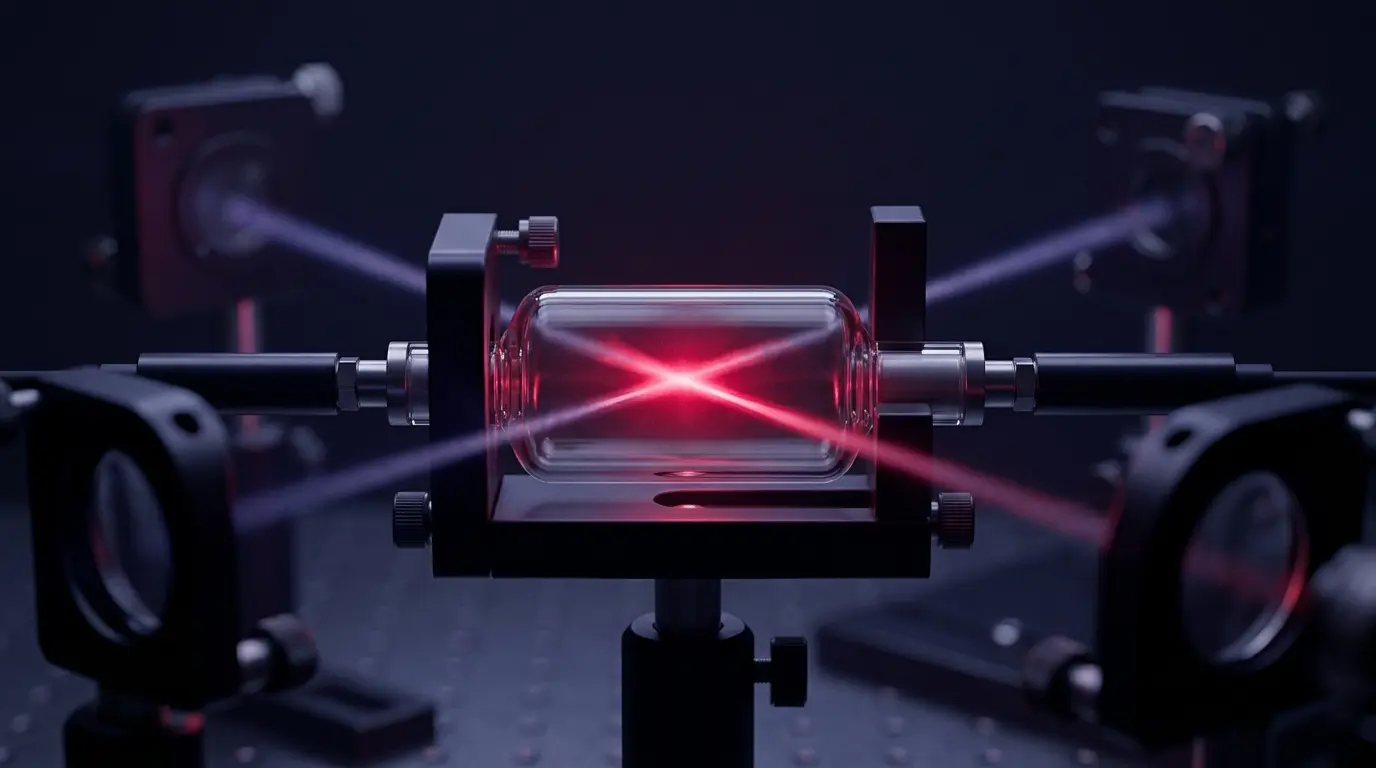
The system’s architecture incorporates an integrated laser system for cooling and trapping, control electronics, optical benches and a magnetically-shielded ultra-high vacuum chamber containing the 87Rb atoms used as the storage medium. The core of QDrive’s adaptability lies in its manipulation of the temporal profile of the control beam power, denoted as , which governs the mapping between the incoming optical field and the collective spin-wave excitation within the atomic cloud.
By employing methods from optimal control theory, researchers engineered to achieve programmable reshaping of pulses during both storage and retrieval, efficiently mapping them onto arbitrary target temporal waveforms. This capability allows the system to store photons with durations spanning over three orders of magnitude and reshape them arbitrarily without compromising efficiency, achieving compatibility with many current platforms.
The system’s ability to handle such a wide range of pulse durations, spanning over three orders of magnitude, is important for bridging the compatibility gap between diverse quantum platforms. Following a programmable storage time, the spin wave is read out as an output pulse, , using a second control pulse of the same power. Performance is characterized by storage-and-retrieval efficiency, η and the overlap integral, , of the output pulse with a target waveform, , which is in a standard benchmark.
Researchers benchmarked the system’s performance across different signal pulse bandwidths. The system’s optical depth, a measure of the light’s interaction with the atomic cloud, reaches 750. This level of optical depth is maintained for approximately 10 milliseconds, limited by the thermal properties of the system.
To further enhance stability, three pairs of Helmholtz coils within a magnetic shield zero residual magnetic fields induced by eddy currents generated during the rapid switch-off of the quadrupole field. The ability to actively program the temporal characteristics of photons allows for the creation of photonic interconnects between heterogeneous quantum nodes, each potentially using different physical platforms.
This active interface is important because heterogeneous quantum platforms inherently emit and absorb photons with differing properties, severely limiting interference and connectivity. The achievement of near-lossless storage alongside full temporal adaptation has been a long-standing challenge, and the QDrive system represents a step toward overcoming these limitations.
Three-Order-of-Magnitude Adaptation of Photon Timing
This adaptation allows for the conversion of photon waveforms characteristic of disparate quantum platforms, effectively addressing a critical challenge in building interconnected quantum devices. Experiments involved storing Gaussian and exponentially peaked pulses, typical of superconducting and photonic sources, and transforming them into non-Gaussian waveforms optimized for compatibility with ion-based quantum systems. This versatility is important for establishing efficient photonic links between nodes employing different quantum technologies.
Once encoded in the spin wave, the excitation no longer carries information about the input pulse’s duration, allowing for complete reshaping during retrieval. This process maintains high efficiency and conditional overlap, ensuring minimal information loss during the waveform transformation. Demonstrations included adapting a signal to match the temporal characteristics of a photon emitted by a calcium ion embedded in a cavity, a waveform differing in timescale by over one order of magnitude from the initial input pulse.
The team also successfully transformed a non-Gaussian, double-exponential input pulse, characteristic of cavity-enhanced spontaneous parametric down conversion, into a target waveform, further illustrating the system’s adaptability. These results confirm that the desired output temporal mode can be generated independently of the input waveform while preserving high efficiency and conditional overlap.
The experimental setup uses a resonant signal field interacting with the atomic cloud, with both signal and control beams derived from external cavity diode lasers and modulated with acousto-optic modulators. Signal pulses, containing approximately one photon on average, are offset-locked to the control beam and attenuated to optimize the storage and retrieval process. The system’s performance was evaluated through detailed analysis of stored waveforms, with error bars determined by Poissonian errors in photon counting and power fluctuations during data acquisition.
Deterministic Waveform Control via Programmable Power
The ability to precisely manipulate the timing of individual photons has expanded significantly, with a new quantum memory demonstrating adaptation across a range of over 1,000-fold variations in pulse waveforms. This level of temporal control, achieved through precise calibration of the control power, addresses a longstanding challenge in linking disparate quantum systems, each often operating with unique signal characteristics. The system allows for the deterministic reshaping of incoming photon waveforms, effectively translating signals between different quantum languages.
This adaptation isn’t merely a smoothing of edges. The memory can transform a Gaussian input pulse into a non-Gaussian waveform mirroring the emission spectrum of an ion embedded within an optical cavity. Similarly, a double-exponential waveform, typical of photons generated through spontaneous parametric down-conversion, can be accurately reproduced as a target waveform.
This capability extends beyond simple replication. The memory also facilitates programmable temporal multiplexing, successfully splitting a single Gaussian pulse into two, five, or ten identical pulses. Researchers achieved this by modulating the control field during the write stage to efficiently absorb non-Gaussian inputs, and during readout to deterministically shape the output. This process, using techniques from optimal control theory, numerically optimizes the unconditional overlap integral between the output pulse and the target waveform.
This dynamic modulation of the pulse group velocity is important to the memory’s ability to reshape the incoming signal. Data acquisition involved careful analysis of photon counting probabilities and accounted for power fluctuations, ensuring the accuracy of the reported results. The error bars, derived from Poissonian statistics and power fluctuations, provide a quantitative measure of the system’s reliability.
The team’s approach differs from previous attempts at waveform control, which often sacrificed efficiency for programmability, or vice versa. The ability to generate multiple temporal modes from a single stored excitation further expands the memory’s potential applications. The optimization process involves transforming the problem of maximizing the overlap integral into an unconstrained optimization by introducing Lagrange multipliers for each equation of motion.
This allows for a more efficient and accurate computation of the optimal control field. The resulting control profiles are then used to dynamically modulate the group velocity of the signal pulse, effectively shaping its temporal characteristics. This level of control, combined with near-unity storage-and-retrieval efficiency, positions this quantum memory not merely as a storage device, but as an active, programmable photonic interface.
The implications extend beyond fundamental research, offering a potential pathway towards practical quantum communication and computation systems. The researchers’ objective is to generate an arbitrary and programmable target output waveform, and their results demonstrate a significant advancement towards achieving this goal.
High Efficiency Maintained Across Variable Bandwidths
The ability to reshape a stored photon’s temporal profile without sacrificing efficiency represents an advance in quantum information processing, and a recently developed quantum memory maintains near-unity storage and retrieval efficiency across a bandwidth range exceeding three orders of magnitude. This level of control is not merely about expanding the range of compatible technologies. It’s about doing so without compromising performance.
The system consistently achieves efficiencies approaching unity, with conditional overlap integrals also nearing one, among the highest values reported for quantum memories, even as the output bandwidth varies dramatically. The team demonstrated this performance across a range encompassing pulse durations typical of many quantum technologies, indicating broad applicability.
The minimal reduction in efficiency observed at the lowest input bandwidth is attributed to noise in the phase lock between the signal and control lasers, an extrinsic factor rather than an inherent limitation of the memory itself. This versatility emphasises the memory’s potential as a truly universal quantum interface, capable of mediating communication between many quantum platforms.
The core principle enabling this adaptability lies in the direct influence of temporally modulated control power on the group velocity of the stored signal pulse. The ability to manipulate the output waveform while preserving high fidelity is a departure from previous approaches.
The team’s work demonstrates that the readout power provides direct control over the bandwidth of the retrieved pulse, enabling arbitrary waveform storage and generation. By simultaneously varying the power and duration of the read pulse while maintaining a constant product, the same input pulse can be either compressed or stretched in time, providing over three decades of tunable output bandwidths. This precise control, coupled with the high storage-and-retrieval efficiency, positions this quantum memory as an essential component for future scalable entanglement-based quantum networks.
👉 More information
🗞 Deterministic photon waveform adaptation for quantum connectivity
✍️ Jeffrey Mohan et al. (Welinq, Paris, France); Félix Hoffet (ICFO – Institut de Ciencies Fotoniques, The Barcelona Institute of Science and Technology, Barcelona, Spain.)
🧠 ArXiv: https://arxiv.org/pdf/2609.26889


See today’s quantum computing news on Quantum Zeitgeist for the latest breakthroughs in qubits, hardware, algorithms, and industry deals.