

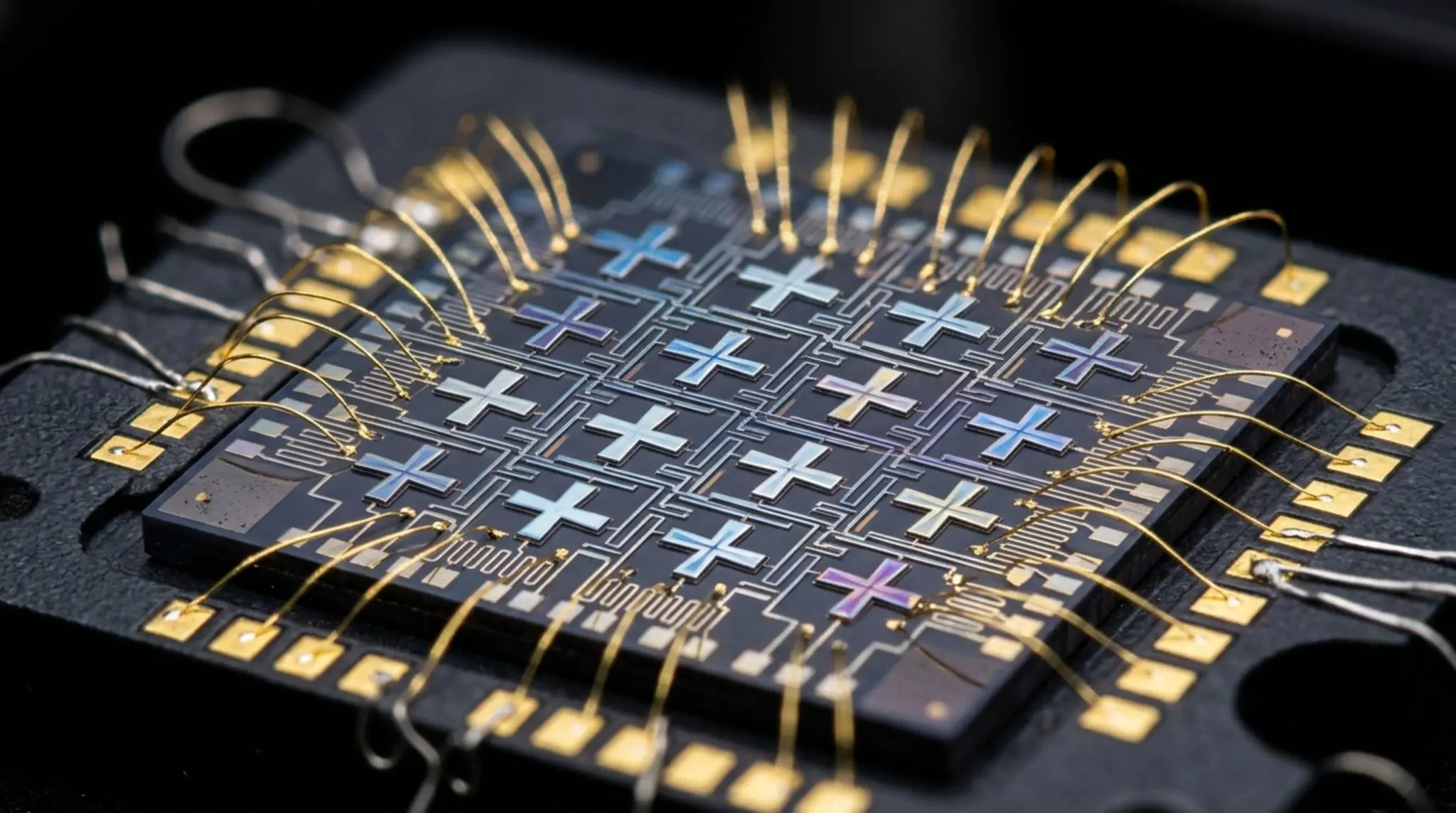
Correcting waveform distortion in superconducting quantum processors previously relied on commercial solutions lacking detailed implementation specifics. Functional digital filters now enable real-time correction using custom hardware, allowing precise control over data formats essential for open-source systems. The new system operates with a fabric clock rate of SI{500}{MHz}, consuming eighty-eight DSP slices and adding only SI{162}{ns} of latency to signals.
Detailed digital filters correct signal distortions within superconducting quantum processors utilising custom hardware; this contrasts with previous reliance on commercial systems lacking transparency regarding their internal workings. This open approach allows precise control over data formats which is vital when building bespoke or shared quantum computing resources. The system operates efficiently at SI{500}{MHz}, adding minimal delay to signals while utilising dedicated processing elements and ensuring stable filter performance through careful design choices.
Researchers at Lawrence Berkeley National Laboratory have developed custom digital filters for real-time correction of signal distortion within superconducting quantum processors, tiny electronic circuits behaving according to the laws of quantum mechanics that form the building blocks of future computers. Previous methods relied on commercial systems offering limited insight into their internal workings, hindering development of open-source hardware and bespoke designs. This system offers precise control over data formats key for collaborative research efforts and allows researchers to tailor processing units using an FPGA, a flexible set of tools reconfigured for specific tasks.
The team’s new approach employs a filter akin to an equaliser on a stereo system, but instead corrects imperfections in signals controlling delicate quantum components while operating at SI{500}{MHz} with minimal signal delay of SI{162}{ns}. But can this level of precision be maintained as these complex filters scale up to manage increasingly powerful processors.
Low latency bias-tee distortion correction via supersampling and pipelined filtering
Scientists at Lawrence Berkeley National Laboratory achieved a sharp reduction in waveform distortion within superconducting quantum processors. Their custom digital filters now correct characteristic bias-tee distortions with only SI{162}{ns} latency, representing a substantial improvement over prior methods. This level of precision was unattainable due to timing constraints imposed by standard Infinite Impulse Response or IIR filter designs alongside the need for transparency regarding fixed-point coefficient formats essential for open-source systems.
The new approach employs a super-sample-rate structure coupled with scattered look-ahead pipelining; this effectively removes feedback recursion from critical signal paths without compromising overall performance. A step response error tolerance derived from bounds on quantization, converting continuous values to fixed numbers, ensured stability and preserved accuracy in their refined digital filters. Quantization could displace key characteristics like poles and zeros, so careful analysis proved crucial.
Specifically, they demonstrated that a cascade comprising an integrator, a second-order section, and a twenty-tap Finite Impulse Response or FIR filter consumed only eighty-eight Digital Signal Processing slices within the QubiC platform at SI{500}{MHz}. This configuration added SI{162}{ns} of latency while simulations revealed maintaining a peak step response error below 0.1 percent necessitated approximately twenty-three fractional bits for bias tee time constant correction using their chosen Q2.25 format; however, designs built from exact poles rather than quantized ones increased oscillation errors sharply.
The accumulator required twenty-nine fractional bits to resolve minimal input changes, implemented with a Q1.29 configuration. Mitigating signal distortion is vital for building larger and more reliable superconducting quantum processors because accurate two-qubit gates depend on pristine waveforms delivered to each qubit.
However, this represents an intermediary step towards complete “cryoscope-based calibration”, currently addressing only characteristic bias-tee distortions, a specific flaw in the equipment used to deliver signals. Lawrence Berkeley National Laboratory researchers detailed that accurate calibration of these initial distortions forms a necessary foundation for further improvements to quantum processors. Their method establishes key parameters relating filter design to practical implementation on Field Programmable Gate Arrays or FPGAs, specialised chips used in controlling qubits.
The research successfully implemented refined digital filters within the QubiC platform at a clock rate of SI{500}{MHz} to correct signal distortion affecting superconducting qubit control lines. The team derived formats for fixed-point coefficients and accumulators based on error tolerance, ensuring stability with an eighty-eight Digital Signal Processing slice configuration adding SI{162}{ns} latency. Researchers indicate this work addresses initial bias-tee distortions as part of broader cryoscope-based calibration efforts.
👉 More information
🗞 Error-Bounded Fixed-Point Design of Super-Sample-Rate IIR Filters for Real-Time Superconducting Qubit Flux Predistortion
✍️ Matt Huszabianlou, Angelos Ioannou, Nirmalendu Bikash Patra, Anastasiia Butko, Gang Huang and Irfan Siddiqi
🧠 ArXiv: https://arxiv.org/abs/2609.16488



See today’s quantum computing news on Quantum Zeitgeist for the latest breakthroughs in qubits, hardware, algorithms, and industry deals.



