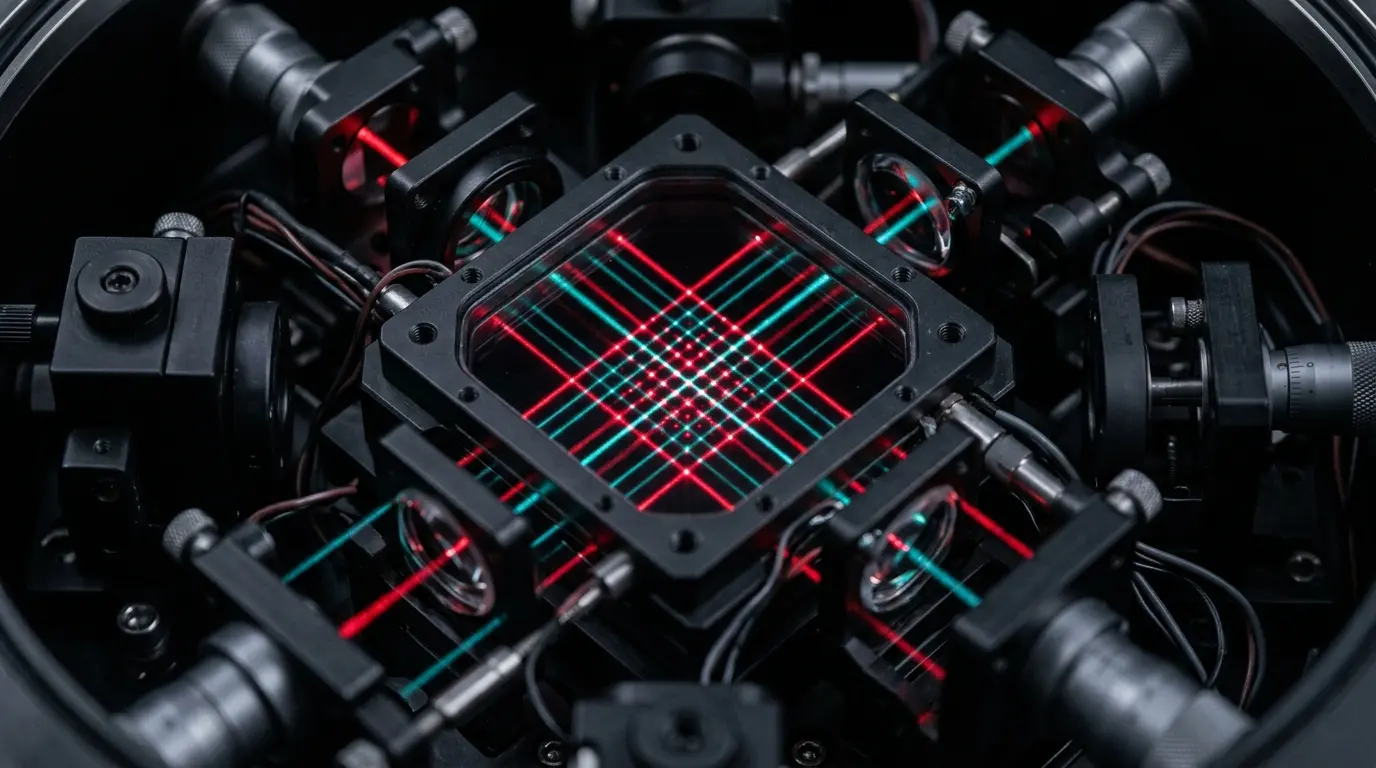
Researchers at Humboldt-Universität zu Berlin and Saint Louis University have demonstrated the thermalization of single- and two-photon states using classical light propagating alongside quantum beams within multimode nonlinear optical systems. The work reveals the emergence of both Rayleigh-Jeans and Boltzmann statistical distributions, indicating a robust level of thermalization in the quantum light. This demonstration harnesses nonlinear multimode optical platforms to induce effective quantum interactions between photons, offering a new way to investigate quantum many-body dynamics. The findings will enable exploration of complex quantum phenomena, including quantum phase transitions, within accessible classical optical settings.
Classical Nonlinearities Drive Quantum Thermalization
Researchers demonstrated this effect by propagating quantum beams alongside classical light within multimode nonlinear optical systems, revealing a pathway to study quantum dynamics using accessible classical technology. This approach allows for the investigation of how classical nonlinearities influence the behavior of fundamental quantum states, specifically single- and two-photon states, offering insights into complex quantum phenomena.
Weak nonlinear interactions are key; strong nonlinearity would lead to soliton formation, inhibiting thermalization by concentrating energy into localized structures. The study proposes a scheme to overcome challenges in quantum optical thermalization by using interactions between classical and quantum light in nonlinear waveguide platforms to drive thermalization of quantum states, a method illustrated schematically in the research.
The team’s approach relies on a Kerr-type nonlinear coupling between a classical light field and a quantum state of light, ensuring the two remain distinguishable through orthogonal polarizations or differing frequencies. This setup causes the classical field’s intensity profile to become effectively chaotic, subsequently driving thermalization of the quantum light. The resulting thermal state is demonstrably dependent on the photon statistics of the initial quantum state; a steady-state distribution originating from two-photon states differs from that of a single-photon input, highlighting the role of particle statistics in the thermalization process.
Further analysis revealed a discrepancy in optical temperature between the classical and quantum subsystems, despite their direct interaction. Thermal equilibrium is established at distinct effective optical temperatures.
The optical temperature, according to the classical nonlinear thermalization theory, depends on the internal energy and total power, which in turn are linked to the mode amplitudes of the initial field. The researchers write, “That is, in the classical and quantum scenarios the constants defining temperature differ.” Consequently, the optical temperature in the quantum case is different from the classical. In the single-photon regime, the quantum state relaxes to a thermal distribution closely matching that of the classical field, demonstrating a clear link between classical chaos and quantum thermalization.
This connection opens possibilities for exploring quantum many-body dynamics through readily accessible classical optical settings, potentially enabling investigations into aspects of quantum phase transitions. The work builds on earlier investigations focused on Kerr-type nonlinearities, demonstrating that optical thermalization is a more generic process.
This robustness is particularly significant, as weak nonlinearity is a necessary condition to avoid energy localization and maintain thermalization. The ability to induce and observe thermalization in this manner provides a new avenue for understanding how classical nonlinearities can be harnessed to investigate quantum systems, potentially bridging the gap between classical and quantum descriptions of complex phenomena. The researchers’ findings suggest that carefully designed classical optical systems can serve as effective emulators for exploring quantum behavior, offering a powerful tool for future research in quantum physics.
Rayleigh-Jeans and Boltzmann Distributions Emerge in Optical Systems
This dual emergence suggests a robust process where energy distributes across multiple modes, mirroring behavior typically associated with classical thermodynamics. The work builds on earlier observations of nonlinearity-induced optical thermalization in platforms like optical fibers and time-synthetic photonic lattices, where increasing entropy leads to steady states described by the Rayleigh-Jeans distribution. Classical nonlinear systems often rely on approximations like mean-field factorization to describe their behavior. But a recent framework has connected these systems to classical thermodynamics applicable across a broad range of multimode optical setups.
This connection allows for the determination of optical temperature based on known eigenvalues and internal energy, a concept validated by experimental observation of the Rayleigh-Jeans distribution in multimode nonlinear optical systems excited with random-phase fields. Researchers extended this investigation to explore how quantum indistinguishability, particularly in two-photon states, alters these thermalization dynamics, questioning whether inherent quantum correlations introduce unique effects within the supermode basis.
Their approach involved propagating co-propagating two-photon states through the same multimode nonlinear optical systems previously used to demonstrate single-photon thermalization. For a lattice, the calculated temperature was 4.91, while a two-dimensional waveguide array yielded a temperature of -2.38, and a coupled cavity system registered 1.15.
These temperature variations, observed after a propagation distance of , highlight the system’s sensitivity to its geometry and internal properties. These findings demonstrate that the introduction of quantum indistinguishability does not preclude thermalization, but rather modifies the resulting statistical distribution and its associated temperature.
Kerr-Type Nonlinearity Enables Quantum-Classical Interaction
Nonlinear optical thermodynamics predicts the spatial thermalization of classical modes, a process governed by established equations defining internal energy and power conservation within the system. The work detailed in a recent publication demonstrates that this thermalization extends to quantum states of light when interacting with classical fields in nonlinear waveguide platforms, a scheme relying on Kerr-type nonlinear coupling between these distinct light sources. This coupling ensures mutual distinguishability through orthogonal polarizations or differing frequencies, a critical element in observing the transfer of thermal properties.
Before exploring quantum thermalization, the researchers first summarized the foundational concepts of nonlinear optical thermodynamics, focusing on how these principles dictate the behavior of classical modes. The total optical power of the system remains constant in the absence of dissipation, with internal energy defined by the sum of mode amplitudes and corresponding eigenvalues.
This allows for the determination of coefficients and, consequently, the mode occupation probabilities of single-photon states, revealing that the single-photon state mirrors the distribution of the classical field despite the linearity of the governing equation. The effective chaotic nature of the z-dependent classical intensity distributions within the waveguides, represented as diagonal entries in a matrix, is key to enabling this thermalization.
Beyond providing a deeper understanding of how classical nonlinearities can be used to investigate quantum many-body dynamics, the findings will enable the exploration of a broader range of complex quantum phenomena, including aspects of quantum phase transitions, within readily accessible classical optical settings. The team’s approach overcomes challenges in achieving quantum optical thermalization, which typically requires strong and controllable nonlinearity under accessible laboratory conditions.
Numerous studies have previously explored few-photon-level interactions, but none have successfully demonstrated the necessary conditions for quantum thermalization until now. Weak nonlinearity, while seemingly counterintuitive, is a necessary condition to prevent soliton formation, which would localize energy and inhibit thermalization. This delicate balance, strong enough to induce thermalization within realistic experimental constraints, yet weak enough to avoid coherent structures, has been a long-standing hurdle in quantum optical systems. The researchers’ success in navigating this intermediate regime demonstrates a novel pathway for exploring quantum many-body dynamics using classical optical techniques.
Modal Thermalization via Nonlinear Wave Dynamics
This distinction emphasises that the mechanism imprints itself onto the single-photon dynamics, suggesting a fundamental connection between classical and quantum thermalization pathways. Normalizing the classical Rayleigh-Jeans distributions yields a perfect match with those computed for single photons. This suggests the underlying classical thermalization mechanism, the nature of the nonlinear mode-mixing interactions, is identically imprinted onto the single-photon dynamics, offering a pathway to understand how classical chaos can induce quantum thermalization.
Expressing the single-photon fields in terms of the eigenmodes of the system allows for substitution into the Schrödinger representation, further clarifying the dynamics at play. Expanding the investigation to two-photon states reveals a shift in the resulting thermal distribution, which more closely resembles Boltzmann statistics, though with an effective optical temperature differing from that of the classical field.
The physical mechanism driving this thermalization is attributed to chaotic dynamics of the classical field, generating spatial fluctuations in the refractive index that, in turn, induce thermalization of the quantum light. Fouad Chahrour, Şahin K. Özdemir, Kurt Busch, Ramy El-Ganainy, and Armando Perez-Leija found that nonlinear propagation of classical light generates these fluctuations, which then affect the quantum light. This chaotic behavior, a hallmark of classical systems sensitive to initial conditions, renders the dynamics effectively irreversible despite the underlying equations of motion being time-reversible.
Challenges of Achieving Quantum Optical Thermalization
Weak nonlinear interactions, while necessary to avoid energy localization through soliton formation, present a significant hurdle to achieving quantum optical thermalization within practical experimental timeframes. The challenge lies in balancing the need for sufficient nonlinearity to induce thermalization with the constraint of avoiding coherent structures that inhibit the process, a difficulty previously encountered in quantum optical systems. Researchers found that the timescales required for thermal equilibrium extend beyond what is feasible for observation when nonlinearity is excessively weak, demanding a careful calibration of interaction strength.
This dual emergence suggests a robust and thorough approach to achieving thermal equilibrium in the quantum regime. Exploring the dynamics of these co-propagating two-photon states within the same multimode nonlinear optical system provided insights into how these quantum correlations modify the thermalization process.
The team’s findings demonstrate that the nonlinear thermalization of a classical field can indeed drive quantum states of light toward thermal equilibrium, a result with implications for exploring complex quantum phenomena. This intriguing discrepancy warrants further investigation, but the results strongly suggest that the observed thermalization is rooted in the chaotic dynamics of the classical field.

See today’s quantum computing news on Quantum Zeitgeist for the latest breakthroughs in qubits, hardware, algorithms, and industry deals.