- Who Jeremy O’Brien is
- The silicon doctorate that came first
- The gate that made photons a computing platform
- Moving quantum optics onto a chip at Bristol
- The published record in one place
- Founding PsiQuantum and the million qubit premise
- Why the argument became one about manufacturing
- Two construction sites and a great deal of public money
- Handing over the chief executive role
- What the bet still has to prove
- Why Jeremy O’Brien matters in quantum computing
- Frequently asked questions
In 2003 Nature published a quantum logic gate made entirely out of light. The first author was Jeremy O’Brien, then a research fellow at the University of Queensland, and the device was a controlled-NOT gate assembled from beam splitters and single photons on an optical bench, reported with his colleagues Geoff Pryde, Andrew White, Tim Ralph and David Branning.
Photons had always been the easiest quantum objects to make and the hardest to make interact, which is why they had been treated as messengers rather than as processors. What that experiment showed was that the missing interaction could be manufactured out of interference and measurement instead of being found in nature, and it opened a line of work that occupied the next fifteen years of his career.
Thirteen years after the gate paper he co-founded a company whose central claim was that physics was no longer the interesting part. PsiQuantum was built on the premise that a quantum computer becomes commercially useful only once it can run error correction, that error correction needs something close to a million physical qubits, and that a million of anything has to come off a production line. This profile traces how Jeremy O’Brien got to that position, what he actually published on the way, and which parts of the argument are still unfinished.
He was first author on the 2003 Nature paper demonstrating an all-optical controlled-NOT gate, one of the first two-qubit logic gates built from single photons.
At the University of Bristol he founded the Centre for Quantum Photonics and helped move quantum optics off the optical bench and onto waveguide chips, reported in Science in 2008.
He was senior author on the 2014 paper that introduced the variational quantum eigensolver, which became one of the most widely run algorithms on near-term quantum hardware.
He co-founded PsiQuantum in 2016 with Terry Rudolph, Pete Shadbolt and Mark Thompson, aiming directly at a million-qubit fault-tolerant machine rather than at small demonstration processors.
Since February 2026 he has been PsiQuantum’s executive chairman rather than its chief executive, after the company appointed the former Xilinx chief executive Victor Peng as interim chief executive.
Who Jeremy O’Brien is
Jeremy O’Brien is an Australian experimental physicist who spent roughly a decade proving that quantum logic could be done with light, and has spent the decade since arguing that the remaining obstacle is industrial rather than scientific. He trained at the University of Western Australia and the University of New South Wales, built his independent reputation at the University of Bristol, and now serves as co-founder and executive chairman of PsiQuantum.
The company’s own leadership page describes him as having dedicated thirty years to the goal of a useful quantum computer and lists his previous posts as professor of physics and electrical engineering at Stanford and Bristol universities, and founding director of the Centre for Quantum Photonics and of the Quantum Engineering and Technology Labs. That is the company’s own account of his career and is worth reading as such, though the Bristol posts and the Bristol centre are also recorded in his Jeremy O’Brien’s ORCID record.
The short version of the career
He took a bachelor’s degree at the University of Western Australia and a doctorate in physics at the University of New South Wales, awarded in 2002 for experimental work on correlated and confined electrons in organic conductors, superconductors and semiconductor nanostructures, together with progress toward a phosphorus-in-silicon quantum computer. That description is his own, written into his ORCID biography, and the same record dates his research fellowship at the University of Queensland to the years 2001 to 2006.
From 2006 he held a Research Councils UK academic fellowship at Bristol, becoming a reader in 2007 and a professor of physics and electrical engineering in 2008, while directing the Centre for Quantum Photonics from 2007. PsiQuantum was incorporated in 2016 and he moved from chief executive to executive chairman in February 2026.
The silicon doctorate that came first
The first thing worth knowing about the founder of a photonics company is that his doctorate was about silicon. His earliest well-cited paper, published in Physical Review B in 2001, is titled Towards the fabrication of phosphorus qubits for a silicon quantum computer, and it reports work on placing phosphorus atoms in a silicon surface with a scanning tunnelling microscope.
The author list on that paper is a useful map of Australian quantum computing at the turn of the century. Alongside Jeremy O’Brien it carries Steven Schofield, Michelle Simmons, Robert Clark, Andrew Dzurak, Neil Curson and Bruce Kane, which places him in the same laboratory as two of the other subjects in this series and in the group founded around Kane’s silicon proposal.
That proposal, published in Nature in 1998, suggested encoding quantum information in the nuclear spins of phosphorus donors in isotopically pure silicon. It gave Australian physics a distinctive research programme, and the practical question it handed the experimentalists was one of fabrication rather than theory.
Jeremy O’Brien left that programme for quantum optics when he moved to the University of Queensland in 2001, but the framing stayed with him. His later argument, that the binding constraint on quantum computing is how devices are made rather than how they work, is recognisably the same question asked about a different material.
The gate that made photons a computing platform
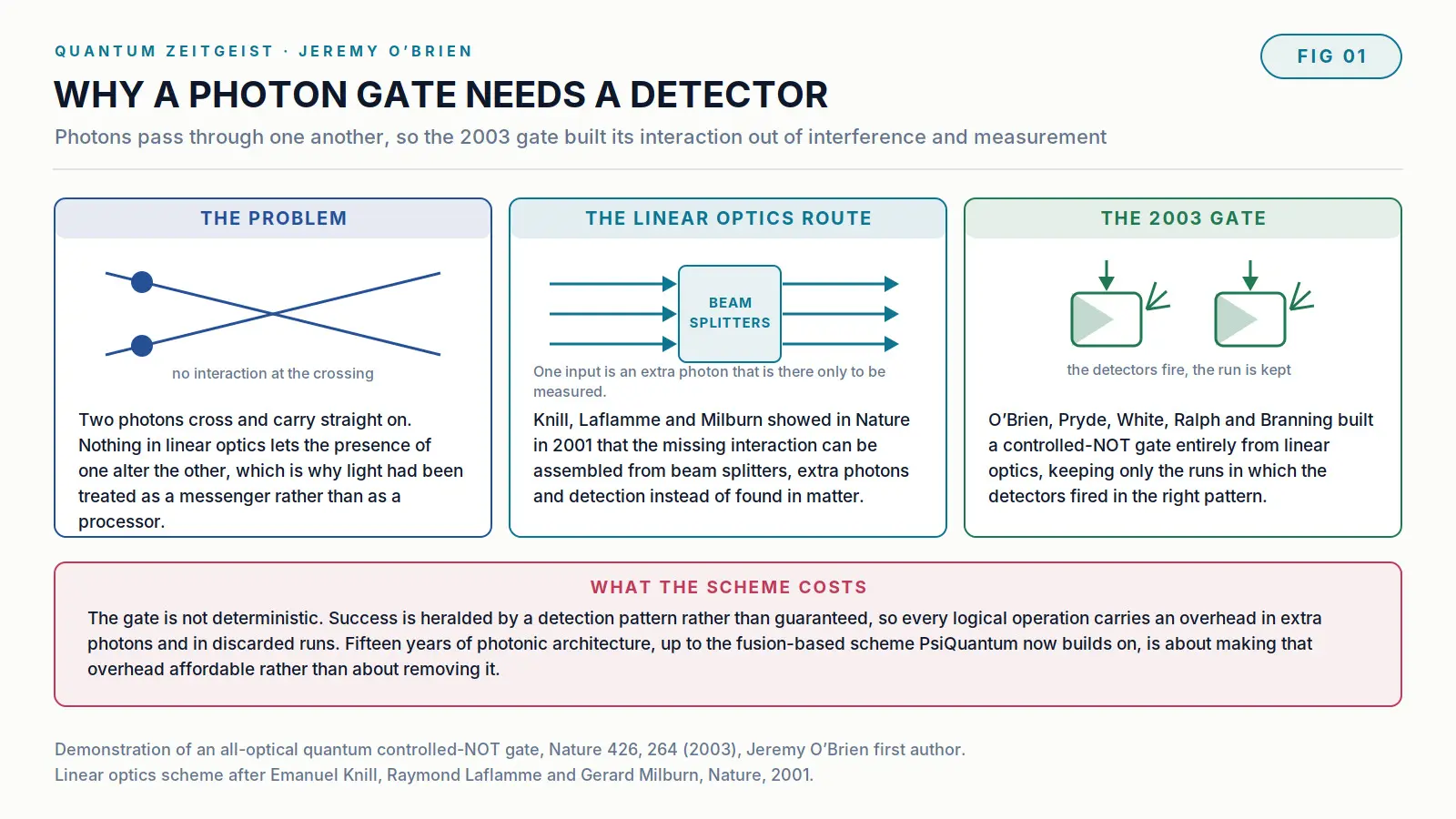
A controlled-NOT gate flips one qubit conditionally on the state of another, and any universal quantum computer needs some equivalent two-qubit operation. Doing it with photons is awkward because photons pass through one another without interacting, which is exactly the property that makes light such a good carrier of quantum information over distance.
The 2003 paper on which Jeremy O’Brien was first author, Demonstration of an all-optical quantum controlled-NOT gate, built the missing nonlinearity out of interference and measurement rather than out of matter. The scheme it implemented followed the linear optics approach set out by Emanuel Knill, Raymond Laflamme and Gerard Milburn in a 2001 Nature paper, in which entanglement is produced probabilistically and the successful cases are identified by detecting photons.
Why the result mattered beyond optics
Before this experiment, photonic quantum computing was largely a theoretical proposal with an uncomfortable overhead attached. Afterwards it was a platform with a demonstrated two-qubit gate, which is the minimum entry requirement for being taken seriously as a route to a computer.
He set out the consequences four years later in a single-author review for Science, Optical Quantum Computing, and again in 2009 in Photonic quantum technologies with Akira Furusawa and Jelena Vuckovic. Both papers argue that the photonic route’s real advantage lies in the manufacturing base it can borrow, which is the argument he later built a company on.
Moving quantum optics onto a chip at Bristol
An optical table covered in mirrors and beam splitters is a poor foundation for a computer, because every additional qubit means more components to align and more ways for the alignment to drift. The obvious answer is to etch the optical paths into a solid substrate, and that is what the Bristol group set out to do.
In 2008 Alberto Politi, Martin Cryan, John Rarity, Siyuan Yu and Jeremy O’Brien reported Silica-on-Silicon Waveguide Quantum Circuits in Science, running photonic quantum interference and a controlled-NOT gate inside waveguides written into a silica chip. The following year Politi, Jonathan Matthews and O’Brien ran a compiled version of Shor’s factoring algorithm on such a chip, reported in Science in 2009.
The algorithm that came out of the same laboratory
The Bristol group’s most-cited output is not a piece of hardware at all. In 2014 Alberto Peruzzo, Jarrod McClean, Peter Shadbolt and colleagues, with Jeremy O’Brien as senior author, published A variational eigenvalue solver on a photonic quantum processor, which introduced the variational quantum eigensolver.
That algorithm splits a chemistry calculation between a quantum processor and a classical optimiser so that the quantum part stays short enough to survive on noisy hardware. It has since become one of the standard workloads on every hardware platform in the field, which is an unusual legacy for a photonics laboratory to leave. Peter Shadbolt, a co-author, later became one of PsiQuantum’s four founders.
The group’s 2015 Science paper Universal linear optics completed the argument on the hardware side, demonstrating a single reconfigurable waveguide device that could be programmed to implement arbitrary linear optical circuits. Mark Thompson, another future PsiQuantum founder, was among its authors.
The published record in one place
The table below lists the results most often attached to his name, with the journal of record and his position in the author list. Every entry has been checked against the publisher’s own metadata rather than a secondary summary.
| Result | Where published | Headline finding | His role |
|---|---|---|---|
| Phosphorus qubit fabrication in silicon | Phys. Rev. B 64, 161401 (2001) | Single phosphorus atoms placed on a silicon surface by STM lithography | First author |
| All-optical quantum controlled-NOT gate | Nature 426, 264 (2003) | A two-qubit logic gate built entirely from linear optics and detection | First author |
| Optical quantum computing | Science 318, 1567 (2007) | Review setting out the case for the photonic route | Sole author |
| Silica-on-silicon waveguide quantum circuits | Science 320, 646 (2008) | Quantum interference and a CNOT gate inside a waveguide chip | Last author |
| Shor’s algorithm on a photonic chip | Science 325, 1221 (2009) | A compiled factoring circuit run on integrated optics | Last author |
| Photonic quantum technologies | Nature Photonics 3, 687 (2009) | Review of photonics for computing, communication and metrology | First author |
| Variational eigenvalue solver on a photonic processor | Nat. Commun. 5, 4213 (2014) | Introduced the variational quantum eigensolver | Last author |
| Universal linear optics | Science 349, 711 (2015) | A single reconfigurable chip programmed for arbitrary linear optics | Co-author |
| A manufacturable platform for photonic quantum computing | Nature 641, 876 (2025) | PsiQuantum’s Omega chipset described as foundry-manufacturable | Company paper |
Founding PsiQuantum and the million qubit premise
PsiQuantum’s own about page states that the company was co-founded by Jeremy O’Brien, Terry Rudolph, Pete Shadbolt and Mark Thompson, who hold the roles of executive chairman, chief architect, chief scientific officer and chief technology officer respectively. The same page describes the founding premise, that photonic qubits combined with mature semiconductor manufacturing could provide a fast path to a commercially useful million-qubit machine.
The million-qubit figure is not a marketing number so much as an arithmetic one. Quantum error correction protects a single reliable logical qubit by spreading it across many noisy physical qubits, so any machine that runs a useful error-corrected algorithm needs physical qubits in quantities that no laboratory assembles by hand.
The choice not to build small machines first
Most competitors in the middle of the last decade were adding qubits a few at a time and publishing the count. PsiQuantum instead spent its early years on components and processes, which meant it had comparatively little to show in the qubit-count comparisons that dominated coverage of the field.
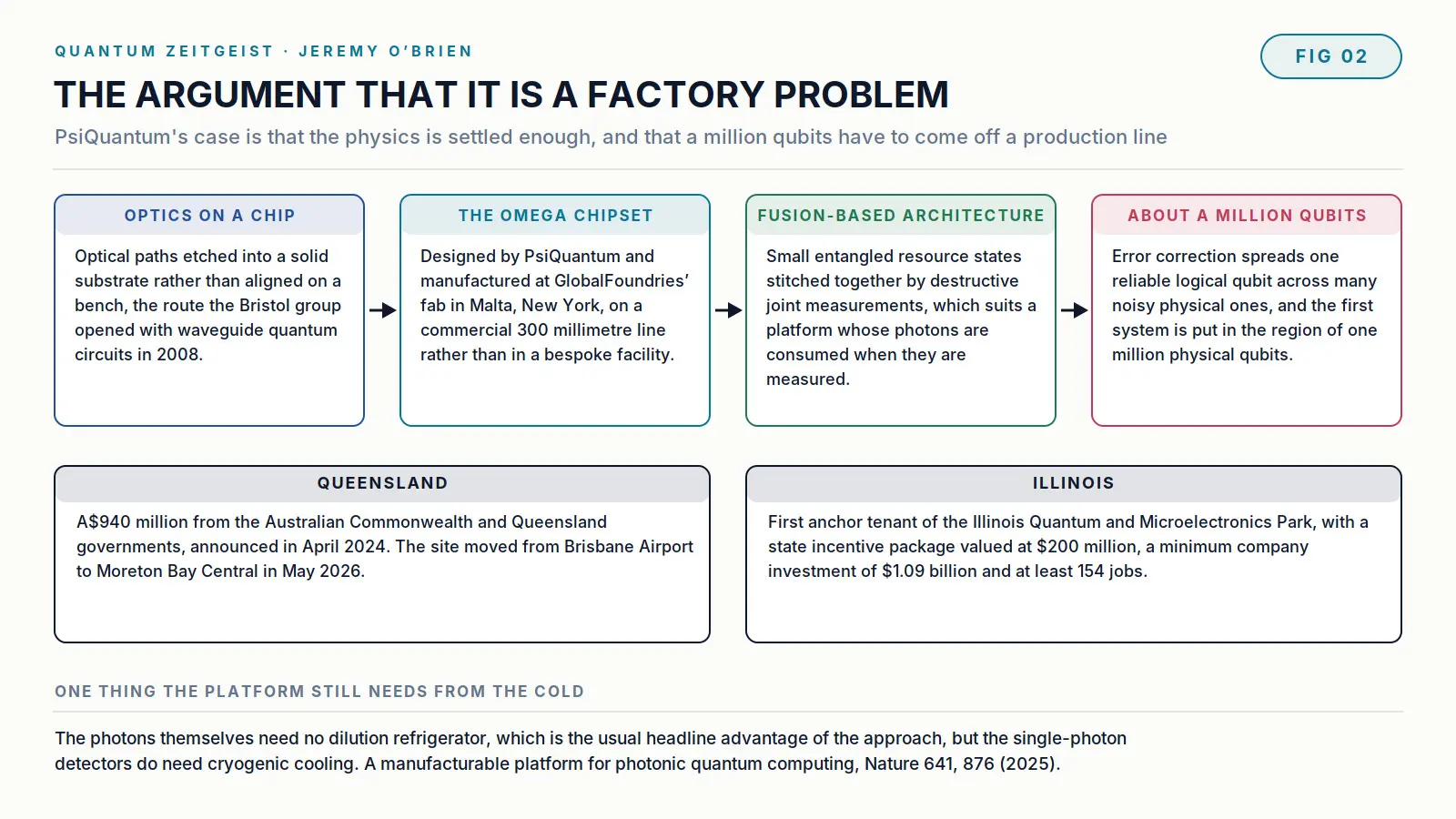
The company’s architectural answer to the linear-optics overhead problem is set out in Fusion-based quantum computation, published in Nature Communications in 2023 by a team including Terry Rudolph. The scheme builds a fault-tolerant computation out of small entangled resource states stitched together by destructive joint measurements called fusions, which suits a platform where photons are consumed when they are measured.
Why the argument became one about manufacturing
PsiQuantum’s public case rests on a single structural claim, that photonic quantum chips can be made in existing semiconductor factories rather than in bespoke facilities. Its own site states that the company designs its chips and manufactures its Omega chipset at GlobalFoundries’ fab in Malta, New York.
In 2025 that claim was put into the peer-reviewed literature. A manufacturable platform for photonic quantum computing, published in Nature with a very large company author list headed by Koen Alexander, describes the components of the Omega chipset and the yields obtained on a commercial 300 millimetre line.
“For more than 25 years it has been my conviction that in order for us to realize a useful quantum computer in my lifetime, we must find a way to fully leverage the unmatched capabilities of the semiconductor industry.”
Jeremy O’Brien, then co-founder and chief executive of PsiQuantum, on the Omega chipset announcement, 26 February 2025
What the platform still needs from the cold
Photonic qubits do not need a dilution refrigerator to hold their state, which is the usual headline advantage of the approach. The single-photon detectors do need cryogenic cooling, so the system is not free of refrigeration, and the company’s own material describes co-locating control electronics close to the qubits as an advantage of a platform whose carriers are indifferent to heat and electromagnetic interference.
The networking argument is the other half of the case. Because the qubits are photons, modules can be joined with ordinary telecom fibre without converting between physical carriers, which is the step that makes scaling beyond a single chip difficult for platforms whose qubits sit still.
Two construction sites and a great deal of public money
On 29 April 2024 PsiQuantum announced that it would build a utility-scale quantum computer near Brisbane Airport, with the Australian Commonwealth and Queensland governments investing A$940 million, about US$620 million at the time, through a package of equity, grants and loans. The company’s release put the first system in the region of one million physical qubits and set a target of an operational site by the end of 2027.
Three months later the State of Illinois named the company as the first anchor tenant of the Illinois Quantum and Microelectronics Park on the former US Steel site on Chicago’s South Side. The governor’s office release valued the state incentive package at $200 million, recorded a minimum company investment of $1.09 billion and at least 154 full-time jobs under the state’s MICRO agreement, and set out a separate $500 million state investment in the campus itself.
The Australian site moved
In May 2026 the company announced that its Australian project would be anchored at Moreton Bay Central, on the site of the former Petrie Paper Mill in the City of Moreton Bay, rather than at the Brisbane Airport location named in 2024. The release announcing the move thanks Brisbane Airport Corporation for its collaboration and quotes the interim chief executive rather than the founder.
Site changes of this kind are ordinary in large infrastructure projects and the release gives power and utility infrastructure as the reason. It is worth recording plainly, because the 2024 announcement and the 2026 announcement name different locations for the same machine.
Handing over the chief executive role
On 10 February 2026 PsiQuantum announced that Victor Peng had been appointed interim chief executive and that Jeremy O’Brien would become executive chairman, leading the board while guiding strategy and key partnerships. Peng was chief executive of Xilinx before its acquisition by AMD and subsequently served as a president at AMD, according to the company’s own announcement.
The founder’s statement in that release frames the change as a shift in the nature of the work rather than a change of direction, saying that the team had spent years doing the hard technical work and that the company was moving into large-scale deployment and execution. Whether that is the whole story is not something an outside observer can establish, and no other motive should be read into it from here.
What can be stated is the current position. PsiQuantum’s own leadership page describes Jeremy O’Brien as co-founder and executive chairman, and now lists Victor Peng as chief executive officer without the interim qualifier used in February 2026. Reference works that still describe O’Brien as chief executive have not caught up with the change.
What the bet still has to prove
The published record establishes that photonic components of the required kind can be made on a commercial line and characterised, which is what the 2025 Nature paper reports. It does not establish that a fault-tolerant machine has been built, and the company has not claimed that it has.
The distance between a manufacturable chipset and a working error-corrected computer is the distance the whole industry is trying to cross. In PsiQuantum’s case that gap has to be closed at a scale nobody has attempted, with millions of components working together at the yields a production line delivers rather than the yields a laboratory can select for.
Timelines are the part most likely to move
The 2024 Australian release targeted an operational site by the end of 2027, and the 2026 release describes early site works beginning at a different location, with the formal start of construction still to come. Readers should treat the original date as an announcement rather than a commitment, because the company has not restated it in the later material.
The second open question is one of physics that money cannot settle. Linear optical schemes buy their two-qubit gates with probabilistic success and heralding, and fusion-based architecture is designed to make that overhead tolerable rather than to remove it. Whether the resulting resource count is affordable at full scale is exactly what the first large system will test.
Why Jeremy O’Brien matters in quantum computing
He is one of a small number of people who took a platform that theory said could work and showed that it did, first on a bench and then on a chip. The 2003 controlled-NOT gate and the 2008 waveguide circuits are the two results that made photonic quantum computing an experimental subject rather than a proposal.
His laboratory also produced the variational quantum eigensolver, an algorithm now run far more often on superconducting and trapped-ion machines than on photonic ones. Contributions that outlive the hardware they were designed for are rare, and this is one of them.
The third reason is the argument he built a company around. Framing quantum computing as a manufacturing problem rather than a physics problem was a minority position in 2016, and the amounts of public money now committed in Queensland and Illinois mean that the position will be tested in public rather than settled by debate. He has since moved to the chair, and the test will run without him at the controls.
- PsiQuantum, the company he co-founded
- Photonic quantum computing explained
- Top photonic quantum computing companies
- What is a qubit, a beginner’s guide
- What is quantum error correction
- Australia quantum computing companies
- A commercial history of quantum computing
- Chris Ballance, another founder who stayed after the exit
Frequently asked questions
Who is Jeremy O’Brien?
Is Jeremy O’Brien still the chief executive of PsiQuantum?
What did the 2003 all-optical CNOT gate demonstrate?
What is the variational quantum eigensolver and why is O’Brien associated with it?
Who founded PsiQuantum and when?
Why does PsiQuantum aim for a million qubits?
How much government money has PsiQuantum been promised?
Where does PsiQuantum manufacture its chips?
Did Jeremy O’Brien work on silicon before photonics?
Why does Jeremy O’Brien matter in quantum computing?




See today’s quantum computing news on Quantum Zeitgeist for the latest breakthroughs in qubits, hardware, algorithms, and industry deals.