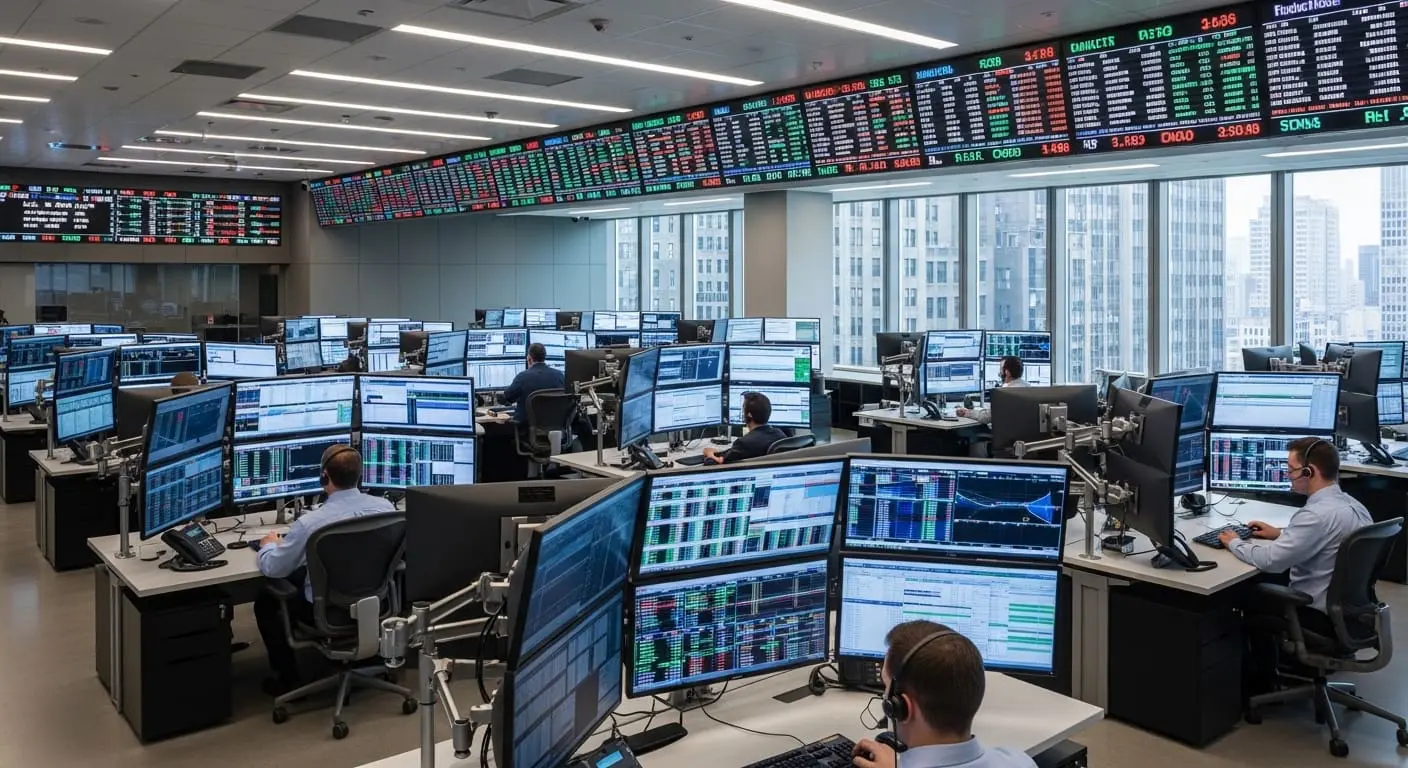
The science of quantum computing was invented in research laboratories. The industry was invented in offices, on roadshows, in venture-capital boardrooms, and increasingly on stock exchanges. This is the parallel story, the one in which physicists become CEOs, lab demonstrations turn into commercial roadmaps, and the question of who pays for the next dilution refrigerator gets answered with term sheets rather than peer review. It begins, improbably, in a Canadian lumber town in 1999, and arrives in early 2026 with photonic IPOs, pure-play chipmaker acquisitions and the first credible signs that quantum computing is becoming a commercial industry rather than a research programme.
Table of Contents
D-Wave and the First Quantum Sale
The story of quantum computing as a business begins in 1999 in Burnaby, British Columbia. D-Wave Systems was founded that year by Geordie Rose, Haig Farris, Bob Wiens and Alexandre Zagoskin, and spent more than a decade in the wilderness of advanced research before producing anything that could be sold. The first commercial machine, the D-Wave One, shipped in 2011 to Lockheed Martin, who installed it at the University of Southern California’s Information Sciences Institute. NASA Ames and Google followed as customers in 2013. Quantum computing was, technically, now something a corporation could buy.
The choice of architecture made sense commercially. Annealing was already a mature classical technique for combinatorial optimisation, used widely in logistics, scheduling, machine learning and operations research since Kirkpatrick, Gelatt and Vecchi formalised simulated annealing in 1983. Translating the same physical metaphor into a quantum setting gave D-Wave a route to commercial product years before the gate-model alternatives were viable, and a customer base of optimisation users who already understood what they were trying to do. By the time the academic discussion about whether the machines offered a meaningful quantum speedup had run its course, D-Wave had established several things that would shape the next two decades. Quantum hardware could be built in industry rather than academia. It could be sold on contract to government and corporate customers. And the door it opened was the door through which the entire gate-model industry would eventually walk.
By 2026 the company had walked through that door itself. On 6 January, D-Wave demonstrated scalable on-chip cryogenic control of gate-model qubits, an industry-first that significantly reduces the wiring required to scale superconducting gate-model systems. A day later, on 7 January, the company announced the $550 million acquisition of Quantum Circuits Inc., the Yale spinout co-founded by Rob Schoelkopf and built around dual-rail superconducting qubits with built-in error detection. The combined entity is now the only company in the industry building both annealing and gate-model quantum computers, with an initial gate-model system targeted for general availability later in 2026. The opener has become a dual-platform supplier.

IBM Pivots to the Cloud
The next inflection point was strategic rather than technical. In May 2016, IBM put a five-qubit superconducting processor on the public internet through a service it called the IBM Quantum Experience. The decision to expose hardware via the cloud rather than sell it as on-premises systems was the most consequential commercial choice of the era. It meant that quantum computing, even before it was useful, would be sold the way classical cloud computing was sold. By the second, on demand, integrated with developer tools and standard APIs.
Within a year IBM had built around it the first serious quantum software ecosystem. Qiskit launched in 2017, followed by Google’s Cirq in 2018, Microsoft’s Q# and Quantum Development Kit in late 2017, and Amazon Braket in 2019. The cloud delivery model has proved durable. In 2026, the major commercial quantum platforms are still accessed through cloud APIs, with on-premises systems reserved for a small number of national-security and large-enterprise customers willing to pay for them.
The First Startup Wave (2013-2016)
The cloud era opened the door to startups in a way the previous era had not. If a company did not have to sell complete physical systems, it could compete on individual qubit modalities, software stacks, error correction approaches or vertical applications. Investment followed.
Rigetti Computing was founded in 2013 in Berkeley by Chad Rigetti, an IBM alumnus, and pursued the same superconducting transmon technology as Google and IBM but with a modular chiplet architecture that linked smaller chips into larger systems. IonQ followed in 2015, founded by Chris Monroe and Jungsang Kim out of the University of Maryland and Duke, applying the trapped-ion hardware that Monroe had pioneered with David Wineland’s group at NIST. Cambridge Quantum, founded in 2014 by Ilyas Khan, took a software-first approach, building tools for quantum chemistry, machine learning and natural-language processing without committing to a particular hardware stack.
Two photonic-first companies arrived in the same period. PsiQuantum was founded in 2016 in Palo Alto by an Australian academic team led by Jeremy O’Brien, with co-founders Pete Shadbolt, Terry Rudolph and Mark Thompson, and bet that fault-tolerant quantum computing would be reached fastest with photons fabricated on standard silicon wafers. Xanadu was founded the same year in Toronto by Christian Weedbrook with a parallel photonic strategy and an early focus on quantum software through PennyLane, the company’s open-source quantum machine learning framework. By 2018 the major modalities each had at least one credible commercial vehicle.
The Neutral Atom Wave (2018-2019)
A second wave began around 2018, this time around neutral atoms in optical traps. The technical foundations had been laid by Mikhail Lukin’s group at Harvard and parallel work at Caltech, JILA and the Institut d’Optique in France. The startup translation came in three companies founded within roughly a year of each other. QuEra Computing was founded in Boston in 2018 with Lukin as a co-founder. Atom Computing was founded in Berkeley the same year. Pasqal was founded in Paris in 2019 by Georges-Olivier Reymond, Christophe Jurczak and the Nobel laureate Alain Aspect, among others. Planqc in Munich and Infleqtion, originally branded ColdQuanta, in Boulder rounded out the field.
The neutral atom argument is straightforward. Atoms in optical tweezers can be reconfigured during a computation, which gives the architecture a flexibility that fixed-on-chip qubits cannot match, and the platform turns out to be unusually well-suited to quantum error correction. By 2025, neutral atom systems were producing the highest published logical-qubit counts of any modality. QuEra’s announcement of 96 logical qubits and a 3,000-qubit array running for two hours, achieved with Harvard collaborators, was one of the milestones of the year.
The SPAC Era (2021-2022)
Between October 2021 and August 2022, three pure-play quantum companies went public via Special Purpose Acquisition Companies. IonQ was first, listing on the New York Stock Exchange on 1 October 2021 in a deal that valued the company at around $2 billion. Rigetti followed in March 2022, completing its merger with Supernova Partners Acquisition Company II at a valuation just under $1.5 billion. D-Wave, after more than two decades as a private company, came to the NYSE in August 2022 via a merger with DPCM Capital.
The financial outcomes have been turbulent. All three lost a significant portion of their initial market capitalisation in the broader 2022 tech sell-off, traded sideways through 2023, and recovered sharply in 2024 and 2025 as the technical milestones began to land. Quantum Computing Inc., which uses a slightly different photonics approach and had listed earlier through a smaller deal, joined the public quantum cohort and saw similarly extreme volatility. By early 2026 IonQ was approaching a $10 billion market capitalisation, having recently raised a further $2 billion at a premium share price. Rigetti and D-Wave had both reclaimed substantial fractions of their listing valuations. The sector remains, for now, what one investment bank politely calls a market that trades on events rather than earnings.
Honeywell, Quantinuum and the Industrial Track
Not every commercial track has run through venture capital. Honeywell, the American industrial giant with a long pedigree in trapped-ion hardware, demonstrated commercial machines in 2020 and merged its Quantum Solutions arm with Cambridge Quantum in November 2021 to form Quantinuum. The combined company is now generally regarded as having the highest-fidelity gate-model quantum hardware in the world, with Quantinuum’s H-series systems reaching quantum volumes well into the millions by 2024. Quantinuum was valued at around $10 billion in 2025, with Honeywell retaining a majority stake of approximately 54 per cent. The company stayed private far longer than its rivals before listing on Nasdaq under the ticker QNT in June 2026, raising roughly $1.68 billion in one of the largest quantum IPOs to date.
A separate industrial cluster has formed in Europe around IQM, founded in Espoo, Finland in 2018, which has built superconducting hardware for the German and Spanish national supercomputing centres and crossed a billion-dollar valuation in 2025. Oxford Ionics, founded in 2019 by Chris Ballance and Tom Harty out of Oxford University, demonstrated some of the highest physical two-qubit gate fidelities ever recorded, reaching 99.99 per cent in 2025 before being acquired by IonQ later that year.
The Tech Giants Inside Quantum
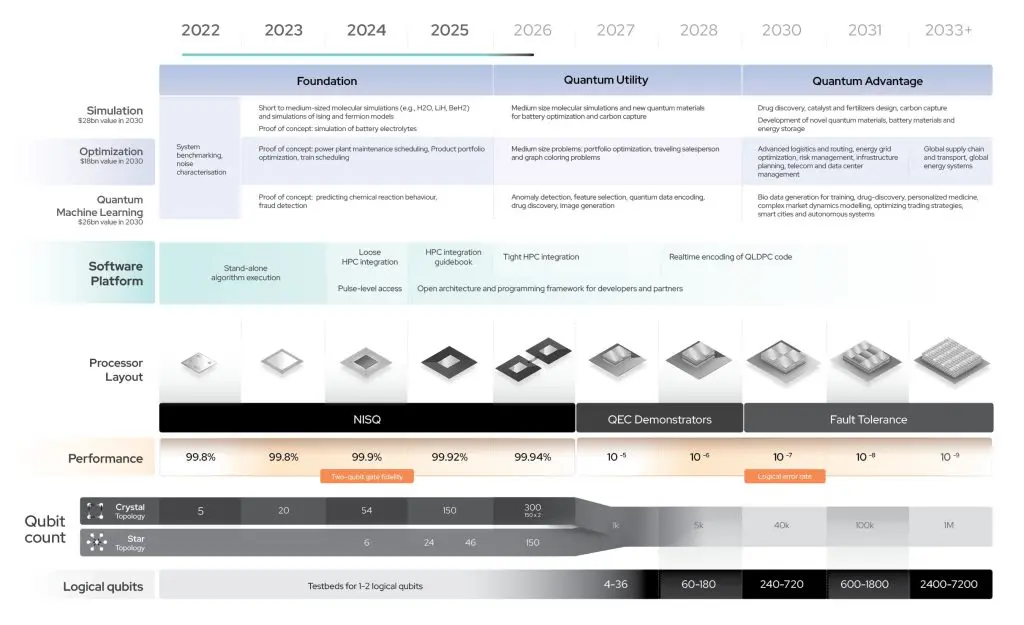
Microsoft, Google, IBM, Intel, NVIDIA and Amazon all run substantial internal quantum programmes. Each is pursuing a different strategic thesis, and the divergence is a useful map of where the major bets are being placed. Google’s quantum programme runs through Google Quantum AI under Hartmut Neven and is built around superconducting transmons. The Willow chip in December 2024 was the most successful single demonstration in the field’s history, and the Quantum Echoes algorithm announced in 2025 was the first claimed verifiable quantum advantage. IBM has run the most public roadmap in the industry, building successive superconducting processors named after birds. Eagle, Osprey, Condor, Heron, Nighthawk and the experimental Loon. The 2025 Nighthawk chip, designed to support up to 5,000 two-qubit gates, is aimed squarely at producing the first verifiable quantum advantage by the end of 2026.
Microsoft’s bet is the most distinctive. The company has spent two decades pursuing topological qubits, an approach that promises hardware-level error protection but has been the most technically challenging platform to realise. The Majorana 1 chip, announced in February 2025, is Microsoft’s first physical product in the space. The reception in the physics community has been mixed, with critics arguing that decisive evidence for topological qubits has not yet been published, and Microsoft has continued to present results at conferences. Microsoft also runs a parallel partnership with Atom Computing on neutral atoms, with the joint Magne system targeting 50 logical qubits for 2027.
Intel has bet on silicon spin qubits manufactured on standard 300mm CMOS wafers. NVIDIA has bet on hybrid quantum-classical computing through CUDA-Q and the cuQuantum simulation library, positioning itself as the integration layer regardless of which hardware modality wins. Amazon Braket aggregates third-party hardware on AWS rather than building its own. The strategic thesis underlying each of these positions is recognisable from the early years of other deep-tech industries. Pick a layer, dominate it.
The Ecosystem of Specialists
A second-tier commercial layer has emerged around the specialised inputs that quantum systems require. The pattern resembles the early semiconductor industry, where the main chip companies sat atop a deep supply chain of specialist providers, and it is increasingly visible in quantum computing.
Cryogenic refrigeration is dominated by Bluefors of Finland and Oxford Instruments of the United Kingdom, with Bluefors in particular benefiting from the surge in demand for dilution refrigerators driven by superconducting and silicon spin qubit programmes. Control electronics are another distinct layer, with Quantum Machines of Israel, Zurich Instruments of Switzerland and Keysight competing for the orchestration platform that links classical control hardware to qubit chips. Riverlane, based in Cambridge, focuses specifically on quantum error correction software and middleware, and has become the standard reference for the field’s shared understanding of the QEC workforce gap.
Q-CTRL, founded in Sydney by Michael Biercuk, specialises in qubit control and noise mitigation, and has built a customer base across hardware companies that wish to extract more performance from their existing devices. Algorithmiq, Multiverse Computing and SandboxAQ, the last of these spun out of Alphabet in 2022 with a $5.75 billion valuation by 2025, work on application-layer software. Multiverse, in particular, has built a chemistry and finance practice that produces revenue today on systems that are not yet fault-tolerant, the kind of business that the cloud-quantum era was supposed to make possible.
National Capital Enters
By 2025, governments had begun moving from research grants to direct industrial investment. The Riverlane and Resonance Quantum Error Correction Report 2025 estimates that Japan now leads public quantum investment with nearly $8 billion committed, with the United States at around $7.7 billion, much of it driven by DARPA‘s Quantum Benchmarking Initiative and the Department of Defence’s broader quantum portfolio. The Genesis Mission launched by the US Department of Energy in December 2025 has been compared in scale and ambition to the Manhattan Project.
The Australian federal government invested almost $1 billion in PsiQuantum’s Brisbane data centre in 2024. The Canadian government supported Xanadu’s IPO with up to CAD $390 million through Project OPTIMISM. The European Quantum Flagship, the United Kingdom’s National Quantum Strategy, and Germany’s quantum initiatives have moved in similar, more diffuse ways. China’s investments are not publicly itemised but are widely thought to exceed the US figure. The geopolitical pattern is essentially unmistakable. Quantum computing is now treated as strategic infrastructure rather than a scientific curiosity.
Consolidation Begins (2025-2026)
The first signs of industry consolidation appeared in 2025. IonQ acquired Oxford Ionics, the British high-fidelity ion-trap startup, in a deal valued at around $1.1 billion. Google Quantum AI acquired Atlantic Quantum, a small superconducting startup spun out of MIT. Both were strategic absorptions of small, technically excellent teams by larger players with capital and distribution.
In January 2026 the consolidation entered a new phase. IonQ acquired SkyWater Technology, an American chip foundry, for $1.8 billion in cash and stock. The deal is the first time a pure-play quantum company has bought a chipmaker outright, and is intended to bring qubit fabrication in-house to reduce dependence on external suppliers. Days earlier, D-Wave had announced its $550 million acquisition of Quantum Circuits Inc., a strategic move that converted the world’s first commercial quantum computing company into a dual-platform supplier covering both annealing and gate-model systems. The two deals together signal a structural shift. The pure-plays now have the capital to make the kind of vertical integration and architectural expansion moves that previously belonged exclusively to Intel, IBM and Google.
The Second IPO Wave (2026)
The capital markets have, in the same period, reopened. In March 2026, Xanadu Quantum Technologies completed its merger with Crane Harbour Acquisition Corporation, becoming the first publicly traded pure-play photonic quantum company. The combined entity began trading as XNDU on Nasdaq and the Toronto Stock Exchange on 27 March 2026, with a pro forma enterprise value of approximately $3.1 billion and an initial market capitalisation of approximately $3.0 billion. The deal brought roughly $302 million in gross proceeds, including a $275 million PIPE financing with strategic participation from AMD and BMO Global Asset Management.
Pasqal announced a $2 billion SPAC merger with Bleichroeder Acquisition Corp II in March 2026, with a closing expected later in the year. PsiQuantum, with over $2 billion raised privately and a $7 billion post-money valuation following its September 2025 Series E led by BlackRock, was widely expected to follow during 2026. The pattern is that of an industry growing into its expected adulthood. The pure-plays are listing. The privates are raising at multibillion-dollar valuations. The strategics are acquiring. The supply chain is layering. None of this constitutes proof of commercial value yet, but the structural elements of an industry are now visibly present in a way they were not five years ago.
What Each Tier Actually Sells
A useful way to read the current commercial landscape is to ask what each tier of company is actually selling, or planning to sell. The hardware companies are selling cloud time on processors, individual machines on contract to national laboratories and large enterprises, and the promise of fault-tolerant capacity in the late 2020s. IonQ, Quantinuum, IBM and Rigetti all derive a meaningful share of their current revenue from cloud-time sales through Amazon Braket, Microsoft Azure and Google Cloud. IonQ’s 2025 revenue of approximately $130 million and 2026 guidance of $225 to $245 million are the largest in the pure-play sector, although they remain small relative to the company’s market capitalisation.
The application-layer companies are selling proofs of concept and pilot deployments in chemistry, materials simulation, optimisation and finance. SandboxAQ, Multiverse Computing, Algorithmiq, Pasqal’s enterprise team, Quantinuum’s chemistry stack and IBM’s Quantum Network are all in this space. Most of these contracts are still in the low millions of dollars per customer, but the customer list now includes major banks, pharmaceutical companies, energy firms, automotive primes and aerospace primes. JPMorgan Chase, Goldman Sachs, Roche, Boehringer Ingelheim, Mercedes, BMW and Airbus all have active quantum partnerships. The contracts are real revenue, and they are growing. Whether they grow fast enough to support the public valuations of the hardware suppliers is the central commercial question.
The infrastructure companies are selling the picks and shovels. Bluefors and Oxford Instruments sell dilution fridges. Quantum Machines, Zurich Instruments and Keysight sell control electronics. Riverlane sells error correction. Q-CTRL sells noise mitigation. The infrastructure layer is the least exposed to which qubit modality ultimately wins, because every modality requires cryogenics, control, calibration, and error correction in some form. It is also the layer where revenue is most predictable, since hardware companies must buy these inputs whether or not they are themselves profitable.
The cryptography companies are selling something different again. Post-quantum cryptography providers, including SandboxAQ in part, as well as a long tail of smaller specialists, are selling the migration tools and protocols that the global financial system, governments, and large enterprises will need before the first cryptographically relevant quantum computer arrives. This is the closest thing the field has to a current, near-term enterprise market, because the threat exists whether or not the underlying machine does, and harvest-now-decrypt-later attacks make it actionable today. The NIST post-quantum standardisation in 2024 effectively kicked off a global migration project that will run through the 2030s.
Three Open Commercial Questions
Three structural questions hang over the commercial landscape. The first is whether public quantum companies can grow to justify their valuations before the market loses patience. IonQ alone is now expected to hit $225 to $245 million in 2026 revenue, against a market capitalisation of around $10 billion. The multiple is forgiving because the technology trajectory is real. Whether it stays forgiving depends entirely on whether the late-2020s fault-tolerance milestones land approximately on schedule. IBM’s stated target of verifiable quantum advantage by the end of 2026, and its broader 2029 fault-tolerance roadmap, are now load-bearing for the entire pure-play public sector.
The second is whether quantum computing will produce a clear, demonstrable, mass-market moment of value, the equivalent of what generative AI experienced with ChatGPT in late 2022. So far it has not. The closest candidates are quantum chemistry simulations for pharmaceutical discovery and materials science, and certain optimisation workloads in finance. These are real applications with real customers, but they are not consumer-facing and they are not yet cheap. A breakthrough that produces a quantum-only result of obvious value at a price classical computing cannot match would change the entire commercial dynamic. IBM, Google and Quantinuum each have working groups dedicated to identifying and demonstrating exactly this kind of result, and the open, community-led quantum advantage tracker launched by IBM and the Flatiron Institute in late 2025 is designed to rigorously certify the first such demonstrations.
The third is consolidation. The number of companies in the space substantially exceeds the number that can be supported by current revenue. Some are technically excellent but commercially fragile. The IonQ-SkyWater deal in January 2026 may mark the first wave of a much larger consolidation rather than the last move in an isolated story. Riverlane’s 2025 forecast for the year ahead explicitly anticipates further mergers and acquisitions across the supply chain, particularly in error-correction software, control electronics, and ion-trap and superconducting hardware. If the pattern of the early semiconductor industry is repeated, a substantial fraction of the current pure-plays will be absorbed into larger players within the next five to seven years.
Looking Ahead: The Commercial Landscape to 2030
The commercial trajectory of quantum computing for the rest of the decade is now legible enough to make several specific predictions with reasonable confidence. The commercial history of quantum computing has been short and accelerating, and the next five years are likely to be its most consequential.
Public listings will continue
PsiQuantum, with over $2 billion in private funding and a $7 billion post-money valuation following its September 2025 Series E led by BlackRock, is the obvious next candidate for a public listing in 2026 or 2027. Quantinuum itself listed on Nasdaq under the ticker QNT in June 2026, the largest pure-play quantum-computing IPO to date. SandboxAQ, IQM and Atom Computing each plausibly precede or follow the same path. The pure-play public sector, which numbered four firms at the start of 2025, will more likely number eight to twelve by the end of 2027.
Consolidation will accelerate
The IonQ-Oxford Ionics deal of 2025, the IonQ-SkyWater deal of January 2026, and the D-Wave-Quantum Circuits deal a few days earlier are the opening moves of a merger-and-acquisition cycle that the field’s history suggests has years left to run. The pattern in adjacent deep-tech industries, from semiconductors in the 1980s to artificial intelligence in the 2020s, is for fifty to seventy per cent of pre-listing entrants to be absorbed into larger players within a decade. There is no obvious reason to think quantum computing will be an exception. The smaller error-correction software firms, the supply-chain specialists in cryogenic and control electronics, and the second-tier hardware companies are the most likely targets.
Revenue will start to matter
For the first generation of public quantum companies, market capitalisation has been determined almost entirely by the credibility of the technology roadmap. By 2027 that is unlikely to remain sufficient. IonQ’s projected 2026 revenue of $225 to $245 million implies a forward revenue multiple of approximately 40x, comparable to the most aggressively valued software-as-a-service companies of the early 2020s. Sustaining that multiple to 2028 would require revenue growth of seventy to one hundred per cent annually. Whether the cloud-time and pilot-deployment business can deliver that growth is the central commercial question of the next two years.
The killer application question will resolve in some direction
Either quantum chemistry, materials simulation or post-quantum cryptography will produce an unmistakably commercial outcome by 2028 or 2029, or the field will enter a more difficult patch of investor sentiment. The major hardware companies and several application specialists are explicitly aiming at the first of these outcomes. IBM’s stated target of verifiable quantum advantage by the end of 2026, the open community-led quantum advantage tracker launched with the Flatiron Institute in late 2025, and the broader regulated effort by IBM, Google and Quantinuum to certify the first such demonstrations rigorously are the visible signs of the industry’s seriousness about this point.
Geopolitical positioning will harden
The Genesis Mission launched by the US Department of Energy in December 2025, Japan’s nearly $8 billion public commitment, the Australian backing of PsiQuantum’s Brisbane facility, and the Canadian support of Xanadu’s IPO via Project OPTIMISM together suggest a competitive national quantum policy environment that will continue to deepen. The DARPA Quantum Benchmarking Initiative’s target of procuring a $1 billion utility-scale quantum computer by 2033 sets an unambiguous floor for major-power competition. China’s investment, while not publicly itemised, almost certainly exceeds the US figure. The commercial decisions of major quantum companies through 2030 will be shaped at least as much by national-security politics as by the underlying physics or revenue economics.
Post-quantum cryptography will be the first mass-market success
Of all the commercial threads currently in motion, the migration to post-quantum cryptography is the only one with an obvious near-term enterprise market. The NIST post-quantum cryptography standardisation finalised in August 2024 has already triggered procurement cycles at every major bank, government agency and large enterprise. The migration will run through the rest of the decade and substantially beyond. SandboxAQ, Quantinuum’s cryptography practice, IBM’s z16 platform and a long tail of smaller specialists are all positioned to capture the resulting spend, regardless of whether the quantum threat actually materialises on the original timeline. This is the closest thing the industry has to a current near-term enterprise market with broad customer demand.
The decade ends in 2030 with the first credible fault-tolerant systems coming online, the first verifiable commercial quantum advantages either claimed or definitively missed, a smaller and more concentrated set of pure-play companies, and a global post-quantum cryptography migration in full swing. None of this requires the science to do anything it has not already shown it can do. The remaining questions are commercial.
At a Glance: The Public Pure-Plays
| Company | Founded | Modality | Public Listing | Approx Market Cap (early 2026) |
|---|---|---|---|---|
| D-Wave Systems | 1999 | Annealing and gate-model (superconducting) | NYSE via SPAC, August 2022 | ~$3 billion |
| IonQ | 2015 | Trapped ions | NYSE via SPAC, October 2021 | ~$10 billion |
| Rigetti Computing | 2013 | Superconducting transmons | Nasdaq via SPAC, March 2022 | ~$4 billion |
| Quantum Computing Inc. (QUBT) | 2018 | Photonic | Nasdaq, 2020 | ~$1.5 billion |
| Xanadu Quantum Technologies | 2016 | Photonic | Nasdaq and TSX via SPAC, March 2026 | ~$3.0 billion |
| Pasqal (announced) | 2019 | Neutral atoms | Nasdaq via SPAC, expected 2026 | ~$2 billion (deal) |
Quantinuum is now public on Nasdaq as QNT after its June 2026 IPO, while PsiQuantum (private, ~$7 billion), SandboxAQ (private, ~$5.75 billion) and IQM (private, over $1 billion) remain among the largest non-listed pure-plays.
Frequently Asked Questions
Which was the first commercial quantum computer ever sold?
When did the first quantum computing company go public?
Which quantum computing company has the largest market capitalisation?
What is the difference between a SPAC merger and a traditional IPO for these companies?
What are tech giants like Google, IBM, and Microsoft actually selling in quantum computing?
What is D-Wave’s dual-platform strategy?
Which are the largest privately held quantum companies?
How much have governments invested in quantum computing?
Which industries are buying quantum computing services today?
What is the post-quantum cryptography market?
Why is consolidation happening now?
When will quantum computing become commercially significant?
Disclaimer. This article is for informational purposes only and does not constitute investment, financial or professional advice. The quantum technology industry evolves rapidly and information may become outdated. Always conduct your own research and consult qualified advisers before making investment decisions. Investing in quantum computing companies involves significant risk, including the potential loss of your entire investment, and past performance is not indicative of future results.




See today’s quantum computing news on Quantum Zeitgeist for the latest breakthroughs in qubits, hardware, algorithms, and industry deals.