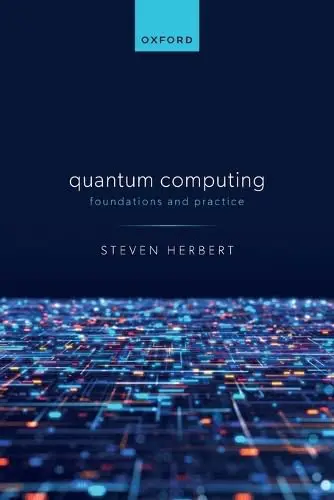
Steven Herbert has written a new quantum computing textbook, out on OUP. He’s an affiliated lecturer at Cambridge in computer science and Head of Quantum Algorithms at Quantinuum, the full-stack company that came out of Cambridge Quantum Computing’s merger with Honeywell’s quantum division. So he’s got a foot in both worlds, which shows in how the book is pitched.
A few things I liked. Complexity theory runs through the whole book rather than being stuck in one chapter. The whole point of quantum computing is the advantage you get from running an algorithm on a quantum computer versus a classical one, so having complexity present throughout makes sense. The usual algorithms are all in there, Grover and Shor and the rest of the canonical list, with worked examples, numerical calculations, and questions with answers. You can actually use it as a working textbook and test yourself against it.
The bit I particularly liked is the adiabatic optimisation chapter. A lot of quantum books don’t do this well. People get stuck on gate-based and forget that near-term quantum is largely about optimisation problems, the travelling salesman being the obvious one. Herbert gives it proper worked-example treatment, which is what the topic needs. HHL gets a good section, too. A bit of signal processing is covered, and the error-correction chapter is well done. References feel current.
There’s a fair amount of maths, but you can engage at whatever level you want, work through it properly or just crib the results. The algorithms are presented in pseudocode rather than being tied to any particular SDK, which I think is right. You should think about algorithms generically, in terms of the maths underneath, not through whichever language happens to be fashionable.
One thing to flag. Herbert works at Quantinuum, which has its own compiler stack called TKET (pronounced “ticket”). He could easily have pushed it throughout the book, but he didn’t. The book stays vendor-neutral, which I respect. He also cites David Deutsch, who’s a hero of mine, so I’m biased in his favour from the start.
The natural comparison is Mike and Ike, which is Nielsen and Chuang’s Quantum Computation and Quantum Information. Mike and Ike have been the standard reference for two decades and run to nearly 700 pages. It’s bigger and probably more comprehensive in terms of examples. Herbert’s is more compact, under 300 pages, and for this kind of book, I think that’s the right call.
I’m a textbook person. I’ve worked through plenty of them, and I enjoy seeing the same concepts laid out in different ways by different authors. There’s a perverse joy in it. So I’m not saying Herbert’s length is a virtue because I want short books for their own sake. I’m saying he fits in what he needs to without padding.
This could end up being part of the new canon. It starts with vectors and matrices and builds up properly, so it works at the undergrad level all the way through to master’s and PhD levels. It’s also the kind of book that earns a spot on the shelf as a reference. Recommended if you’re working in this area, or if you’re totally new to it. As long as you’re prepared to get to grips with how quantum actually works, this book is a recommendation. You can buy a copy from Amazon. Here is our sponsored link: https://amzn.to/4cjD3mY


See today’s quantum computing news on Quantum Zeitgeist for the latest breakthroughs in qubits, hardware, algorithms, and industry deals.