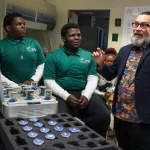
Sixteen female students experienced a day as quantum optics researchers at the Max Planck Institute of Quantum Optics, continuing a commitment to the nationwide Girls’ Day initiative that has lasted approximately 15 years. The program combined lectures, lab visits, and hands-on experiments, culminating in a demonstration during the lunch break: the creation of instant ice cream and the shattering of roses using liquid nitrogen. Two participants successfully used a Michelson interferometer to determine the wavelength of light, demonstrating engagement and scientific aptitude. “It was great to see so many interested girls,” said Dr. Silke Stähler-Schöpf, head of the student laboratory, “I was especially pleased that two participants worked with a Michelson interferometer and correctly determined the wavelength of light.” This immersive experience aims to encourage greater female representation in STEM fields through direct exposure to research and practical application.
Max Planck Institute Hosts Girls’ Day Initiative
This year’s program drew 16 female students eager to experience research firsthand, building on 15 years of outreach and its PhotonLab. Participants engaged in a curriculum designed to move beyond theoretical concepts, immediately immersing them in practical experimentation and the realities of scientific work; the schedule included talks and lab visits, as well as extended periods of active engagement. The emphasis on hands-on learning extended beyond traditional laboratory setups, with the lunch break featuring a demonstration of physics in action. Liquid nitrogen was used to create instant ice cream from simple ingredients and to shatter roses, illustrating scientific principles through memorable experiences. The day concluded with a Kahoot quiz to reinforce learning, with prizes awarded to the top three performers, solidifying the institute’s long-term investment in fostering the next generation of female scientists.
PhotonLab Experiments with Michelson Interferometers and Liquid Nitrogen
This year’s program featured a blend of lectures, laboratory tours, and hands-on experimentation designed to immerse the sixteen students in scientific inquiry; the program moved beyond theoretical instruction to emphasize active engagement with physical phenomena. Participants actively conducted experiments, a factor noted by Dr. Beyond the precision of interferometry, the program extended its hands-on approach to an unexpected area during the lunchtime break, utilizing liquid nitrogen to demonstrate dramatic physical changes. Students prepared instant ice cream using simple ingredients and observed the brittle fracture of roses when rapidly frozen, transforming a routine meal into a memorable scientific illustration of material properties. This integration of engaging demonstrations, alongside rigorous experimentation, underscores PhotonLab’s approach to fostering scientific curiosity and providing a tangible connection to the world of quantum optics; Dr.
“I was especially pleased that two participants worked with a Michelson interferometer and were able to determine the wavelength of light correctly.
Dr. Silke Stähler-Schöpf, head of the student laboratory


See today’s quantum computing news on Quantum Zeitgeist for the latest breakthroughs in qubits, hardware, algorithms, and industry deals.