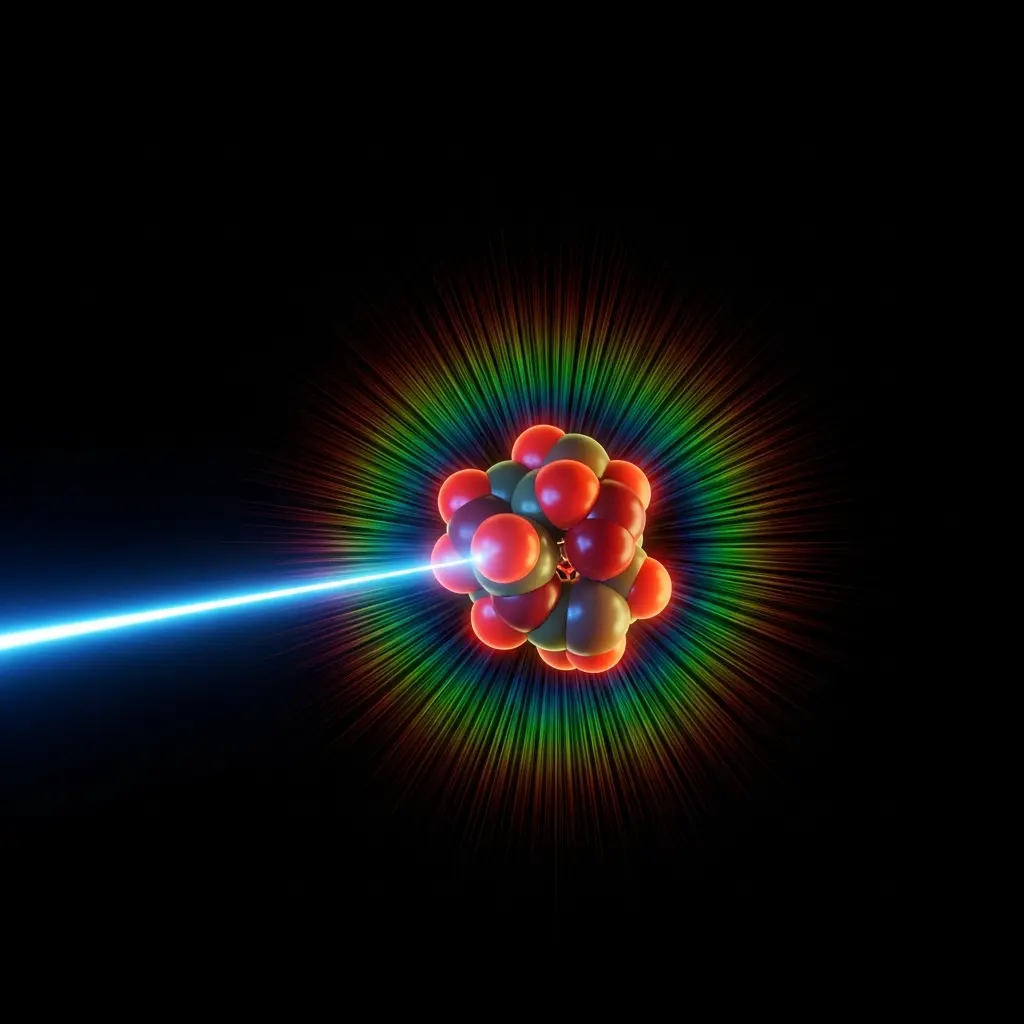
The leading top photonic quantum computing companies in 2026 build qubits from individual photons (or continuous-variable photonic modes) routed through integrated silicon-photonic chips, free-space optics, and fibre interconnects, a computing fabric that runs without dilution refrigerators, vacuum chambers or magnetic shielding, with cryogenic cooling confined to the single-photon detectors rather than to the machine around them. That manufacturability advantage, plus a steeply growing roadmap on logical qubits, is why photonic gained a pure-play public listing of its own in 2026.
The top photonic quantum computing companies span eighteen commercial vendors covering the full architectural map: discrete-variable photonic (PsiQuantum, Quandela, ORCA, Aegiq, Sparrow Quantum, TuringQ, OptQC), continuous-variable photonic (Xanadu, QuiX, QC82, Quanfluence), the photonic-spin-hybrid approach used by Photonic Inc through silicon T-centre qubits coupled to telecom-wavelength photons, the photonic-networking-fabric layer (Nu Quantum, Qunnect), the deterministic photon-atom route taken by Quantum Source, the coherent Ising machines QBoson builds for optimisation, the single-photon qudits of Rotonium, and the architecture work Iceberg Quantum does on top of other people’s photons. The 2026 NASDAQ listing of Xanadu under ticker XNDU (SPAC merger approved March 2026) made photonic the second pure-play quantum-computing modality on a major US public market after IonQ.
Why photonic scales differently
Photonic quantum computing runs without dilution refrigerators, vacuum systems or magnetic-shielding rigs, a property it shares with diamond nitrogen-vacancy hardware and with no other mainstream modality. The cryogenics that remain sit around the single-photon detectors, not around the computer. The qubits are individual photons (or modes of the electromagnetic field), the gates are linear-optical components like beamsplitters and phase shifters, and the manufacturing path is standard silicon photonics that already runs at high volume in datacenter optical-interconnect production lines. Xanadu’s photonic-chip scaling milestones and PsiQuantum’s multi-decade scaling roadmap both bet on this manufacturability advantage as the dominant long-term differentiator.
The historical trade-off and how vendors are closing it
The trade-off historically has been gate fidelity and qubit production. Generating individual photons on demand is hard (most photon sources are probabilistic, not deterministic), and two-photon gates are non-deterministic without quantum memory or measurement-based feedback. The 2024-2026 trajectory has been about closing both gaps: Sparrow Quantum’s deterministic single-photon source from quantum dots, the lithium-tantalate photonic-integrated-circuit work that stabilises photonic chips, and ORCA’s integrated quantum-memory approach all attack the on-demand-photon problem. The fault-tolerant logical-qubit story is led by PsiQuantum and Xanadu through measurement-based quantum computing.
How photonic quantum computing works
A photonic QPU encodes quantum information into individual photons routed through an array of beamsplitters, phase shifters, and single-photon detectors. In the discrete-variable approach (PsiQuantum, Quandela, Aegiq), the qubit is encoded in the polarisation, time-bin, or path-degree-of-freedom of an individual photon, and gates are linear-optical operations that act on these degrees of freedom. In the continuous-variable approach (Xanadu, QuiX), the qubit lives in the phase-space of a single mode (squeezed-light states, Gottesman-Kitaev-Preskill states), and the gates are Gaussian and non-Gaussian operations on these modes.
The single-photon source supply chain
Single-photon sources are the foundational hardware primitive. Probabilistic sources use spontaneous parametric down-conversion in nonlinear crystals or silicon waveguides; deterministic sources (the harder, higher-quality path) use quantum dots or single atoms in photonic cavities. Detection uses superconducting nanowire single-photon detectors (SNSPDs) or transition-edge sensors at cryogenic temperatures, the only cryogenic component in an otherwise room-temperature stack. Photonic quantum walks for universal computation and silicon-carbide photon generation are the two primitives that determine the modality’s commercial trajectory.
The top photonic quantum computing companies
Fourteen commercial vendors define the top photonic quantum computing companies in 2026. Two operate at fault-tolerant scale (PsiQuantum, Xanadu); seven are mid-scale photonic-QPU specialists (Quandela, ORCA, QuiX, TuringQ, OptQC, QC82, Quanfluence); two anchor the single-photon source supply chain (Sparrow Quantum, Aegiq); Photonic Inc occupies the photonic-spin-hybrid niche through silicon T-centre qubits; and Nu Quantum plus Qunnect build the photonic networking fabric that lets multiple QPUs scale out across racks and across cities.
Geographic distribution is unusually balanced, with North American, European, and Asian representation: the United States (three: PsiQuantum, QC82, Qunnect), Canada (two: Xanadu, Photonic Inc), France, Germany, the United Kingdom, the Netherlands, Denmark, China, Japan, and India each contributing a serious commercial player. The QED-C industry consortium tracks the top photonic quantum computing companies alongside the broader quantum-hardware ecosystem with quarterly status updates on QPU access and deployments.
Company directories covering the photonic quantum computing sector list a similar shortlist of names, and the QED-C membership roster is the closest thing to a neutral register. The profiles below cover the leading organisations in depth.















What the lineup reveals
Three observations stand out. First, photonic joined the public markets in 2026, later than trapped-ion and superconducting but on the same terms. Xanadu became a publicly-listed company on NASDAQ via SPAC merger approved in March 2026 and rang the NASDAQ opening bell at the same time; the company now trades under ticker XNDU and was billed on listing as the first pure-play photonic quantum-computing company to go public. PsiQuantum is privately held but with over $2B raised and an Interim CEO (Victor Peng) leading the utility-scale build-out from February 2026, an IPO trajectory is widely expected once the GlobalFoundries-anchored programme hits its commercial-availability milestone.
Second, the modality’s manufacturing path is unique among quantum-computing modalities. PsiQuantum’s GlobalFoundries silicon-photonic foundry partnership, Xanadu’s EV Group chip-bonding integration (a key milestone toward scalable manufacturing), and QuiX’s University of Twente fabrication lineage all build on existing high-volume silicon-photonic infrastructure rather than custom quantum-specific fabrication. The closest analogue in another modality is Quantum Motion’s silicon-CMOS bet for spin qubits; otherwise no other quantum-computing modality enjoys this kind of pre-existing manufacturing infrastructure.
Third, the geographic story is geographically diverse but still European-heavy. Six of the ten commercial vendors are based in Europe (Quandela in France; ORCA, Aegiq, and Nu Quantum in the UK; QuiX in the Netherlands), one in Denmark (Sparrow), PsiQuantum (US), Xanadu and Photonic Inc (Canada) cover North America, and TuringQ (Shanghai) covers Asia. The European Quantum Flagship and EuroQCI initiative funding has supported the modality more aggressively than the Chinese or US national programmes, which has produced this concentration.
Discrete-variable versus continuous-variable photonic
The technical fork in photonic quantum computing is whether the qubit lives in a discrete two-level photon-number state (DV: the photon is there or not, polarisation horizontal or vertical) or in a continuous phase-space variable (CV: the squeezed-light state of a single mode). DV photonic is the historical default and is the architecture behind PsiQuantum, Quandela, Aegiq, ORCA, and Sparrow. The DV approach maps cleanly to standard quantum-circuit programming and to fault-tolerance through measurement-based quantum computing, but requires deterministic single-photon sources and high-efficiency single-photon detectors to scale.
Squeezed light and GKP qubits on the continuous-variable side
CV photonic (Xanadu and QuiX) encodes quantum information into the phase-space of a single mode and operates with squeezed-light beams rather than individual photons. CV is the approach behind Xanadu’s Borealis quantum-advantage demonstration on Gaussian boson sampling, and Xanadu’s photonic-chip-scaling milestones show how the CV approach maps cleanly to high-volume silicon photonics. The fault-tolerance story for CV uses Gottesman-Kitaev-Preskill (GKP) qubits encoded into oscillator states, an approach that converts well-engineered squeezing into protected logical qubits.
The fault-tolerance race
PsiQuantum and Xanadu both target fault-tolerant photonic quantum computing through measurement-based quantum computing (MBQC), the approach where a large entangled cluster state is generated up-front and the computation runs by adaptive single-qubit measurements on the cluster. MBQC is uniquely well-suited to photonic hardware because measurements on photons are easy and fast, and the architectural overhead of large-scale entanglement-distribution networks maps cleanly to photonic interconnects rather than to chip-to-chip wiring.
From thousands to millions of qubits
The 2025-2026 trajectory has been about closing the gap between the millions of physical qubits required for a useful logical qubit and the hundreds-to-thousands currently producible. The first photonic logical-qubit demonstrations have appeared in the past year, and PsiQuantum’s multi-decade scaling roadmap targets a million-qubit utility-scale machine with the GlobalFoundries-anchored production line. Xanadu’s roadmap is similar in target but uses a different fault-tolerance approach (GKP-encoded qubits rather than discrete-variable cluster states).
When photonic matters for your industry
Pharmaceutical and chemistry
Photonic quantum computing is well-suited to molecular-vibration simulation through Gaussian boson sampling and to variational chemistry workloads on continuous-variable hardware. Xanadu’s PennyLane plus the Borealis platform and PsiQuantum’s National Cancer Center Japan partnership anchor the published chemistry use cases. The combination of room-temperature operation and standard photonic-fabrication infrastructure makes photonic the modality with the lowest deployment friction for pharma research labs that want on-premise quantum hardware without a dilution refrigerator.
Optimisation and machine learning
Photonic Gaussian boson sampling maps cleanly to graph-isomorphism, max-clique, and similar combinatorial problems that arise in operations research and quantum machine learning. Quandela’s quantum-machine-learning platform and the Quandela-Mila quantum-ML partnership are the deepest published QML deployments on photonic hardware. Xanadu’s PennyLane is the dominant photonic-QML SDK and runs hybrid quantum-classical workflows on classical GPUs and photonic QPUs through one programming surface.
Aerospace, defence, and government
Photonic’s room-temperature operation and small footprint matter for deployed-asset use cases. PsiQuantum’s Airbus quantum-fluid-dynamics partnership, the Quandela-Safran engine-design partnership, and Aegiq’s UK Space Agency and ESA contracts are the dominant aerospace deployments. The combined photonic-QPU plus satellite-QKD positioning that Aegiq holds is unusual and aligns with the AUKUS Pillar 2 quantum-technology programme.
What the analysts count, and what they are counting
Dedicated analyst coverage of this segment is thin, and the study most often cited is Markets for Photonic Quantum Computers from Inside Quantum Technology, listed through Research and Markets. Its headline count is roughly fifteen photonic quantum computing models being commercialised, with PsiQuantum having attracted the largest funding to date and Xanadu drawing the most attention after it. Both of those match the public record, and the count is worth reading carefully: it counts machines being commercialised, not companies, which is why it lands below the count of top photonic quantum computing companies profiled here.
The report’s commercial argument does not rest on qubit counts. It rests on two couplings. The first is that photonic hardware sits naturally with measurement-based quantum computing, which is treated as a plausible route to cheaper error correction, and error correction is the cost that decides whether any of these machines become useful. The second is that a machine whose qubits are already photons can be spliced into optical networks without transduction, so the addressable opportunity runs past standalone computers into quantum networking. That second point is the one this sector has that no other modality does.
How to read the revenue forecast
Its revenue projection is that worldwide revenues from photonic quantum computers reach $1.1 billion by 2030 and more than $6.8 billion by 2035. That is a forecast rather than a measurement, made for a segment whose current shipped revenue is small and whose fault-tolerance timelines have moved before, and it should be read as one analyst house’s scenario rather than as a fact about the future.
Machines, vendors, or the whole supply chain
The report’s company list is also wider than the vendor lineup above, because it counts the supply chain alongside the machine builders. Components appear through ID Quantique, Menlo Systems, Toptica Photonics, Toshiba, Nanofiber Quantum Technologies, Nexus Photonics, Nicslab, Vescent and Sparrow Quantum; software through QC Design and QMware; cloud access through qBraid; and research-led entries through MITRE, NTT and ETRI. Anyone sizing this market should settle first on whether they are counting machines, vendors or the whole supply chain, because those three numbers differ by a factor of two.
One name on the lists is not a quantum computer
One frequently listed name needs separating out. Q.ANT, the Stuttgart spin-out from TRUMPF, appears in photonic computing surveys but does not build a quantum computer. Its Native Processing Unit is an analog photonic processor for AI and high-performance computing, sold as a data-centre co-processor, and the company raised a €62M Series A in July 2025 to commercialise it. That is photonics rather than photonic qubits, and the distinction matters when a market number is being assembled from company counts.
Frequently asked questions
Who are the leading top photonic quantum computing companies in 2026?
Fourteen commercial vendors define the modality. PsiQuantum (Palo Alto, $2B+ raised, Brisbane and Chicago datacenter sites) and Xanadu Quantum Technologies (Toronto, NASDAQ: XNDU since March 2026) target fault-tolerant scale. Quandela (Paris and Massy, France) ships Lucy, BELENOS, CANOPUS, and the MerLin quantum-ML platform. ORCA Computing (London) builds photonic systems with integrated quantum memory through the PT-2 and upcoming PT-3. QuiX Quantum (Amsterdam and Enschede, Netherlands) builds integrated silicon-nitride photonic processor chips with the upcoming Carina universal QC.
Aegiq (UK, spun out of the University of Sheffield) operates the Artemis photonic quantum computer at the NQCC Harwell campus. Sparrow Quantum (Copenhagen) supplies deterministic-quantum-dot single-photon sources (the chip inside ORCA’s PT-2). Nu Quantum (Cambridge-origin, London) builds the photonic-networking entanglement fabric for multi-QPU scale-out. Photonic Inc (Vancouver) builds silicon T-centre spin-photonic hybrid systems with CA$375M raised and the first quantum teleportation over 30 km of commercial TELUS metro fibre. TuringQ (Shanghai) operates a 36-qubit integrated photonic quantum chip and is the leading Chinese pure-play photonic-QC company.
What is the difference between photonic and other quantum computing modalities?
Photonic quantum computing operates at room temperature using individual photons or continuous-variable modes routed through integrated silicon-photonic chips, beamsplitters, and single-photon detectors. Other modalities require dilution refrigerators (superconducting), high-vacuum chambers (trapped-ion, neutral-atom), or specialised cryogenic platforms (silicon spin). The photonic manufacturing path uses standard silicon-photonic foundries (PsiQuantum at GlobalFoundries Malta NY, Xanadu using EV Group bonding, QuiX at University of Twente lineage), the same infrastructure that produces datacenter optical interconnects. The trade-off is that single-photon sources are historically probabilistic and gates are non-deterministic without quantum memory or measurement-based feedback.
How does Xanadu’s NASDAQ listing affect the photonic modality?
Xanadu listed on NASDAQ via SPAC merger approved March 2026 under ticker XNDU, billed on listing as the first pure-play photonic quantum-computing company on a major US public market. The listing created public-market price discovery for the modality and has been followed by leveraged single-stock ETF products tracking XNDU exposure alongside the broader leveraged-quantum-stock category. The public-market presence makes investor capital more accessible for follow-on raises and lets institutional buyers gain modality exposure without underwriting an IPO. The listing also signals that the modality has matured to the point where pure-play companies can sustain public-market scrutiny on financial reporting and operating metrics.
What is the difference between discrete-variable and continuous-variable photonic?
Discrete-variable (DV) photonic encodes the qubit in a discrete two-level photon-number state (the photon is present or absent, polarisation horizontal or vertical, time-bin early or late). PsiQuantum, Quandela, Aegiq, ORCA, and Sparrow use DV. The approach maps cleanly to standard quantum-circuit programming and to measurement-based fault tolerance. Continuous-variable (CV) photonic encodes the qubit in the continuous phase-space of a single mode using squeezed-light states. Xanadu and QuiX use CV. The Borealis quantum-advantage demonstration was a CV achievement, and CV maps cleanly to Gottesman-Kitaev-Preskill (GKP) fault-tolerant logical qubits. The two approaches share most of the silicon-photonic supply chain but diverge on the programming model and fault-tolerance architecture.
How many qubits do the top photonic quantum computing companies operate?
Photonic qubit counts are typically reported in modes rather than physical qubits. Xanadu’s Borealis ran at 216 squeezed modes for the 2022 quantum-advantage demonstration and the X-series GBS systems run at hundreds of modes. QuiX ships 8-mode and 20-mode integrated-photonic processors. Quandela’s MosaiQ delivers tens of qubits in the deterministic single-photon source platform; the company delivered a 12-qubit Lucy system to CEA in 2024. ORCA’s PT-1 and PT-2 systems run with quantum memory at modest mode counts. PsiQuantum is targeting roughly one million qubits in its utility-scale fault-tolerant build. Aegiq’s Artemis system, commissioned at the NQCC Harwell campus in September 2025, runs at small mode counts in the early commercial-deployment range.
TuringQ runs 36 qubits on integrated photonic chips out of Shanghai, QC82 reaches up to 70 squeezed quantum modes on a single chip from Charlottesville, and OptQC ships its first commercial optical quantum computer in April 2026 with an NTT-anchored 10,000-qubits-by-2027 and 1-million-qubits-by-2030 roadmap. These three vendors show how quickly photonic quantum computing has moved from laboratory demonstrations to shipping commercial hardware.
Are photonic companies publicly traded?
Xanadu Quantum Technologies is publicly traded on NASDAQ under the ticker XNDU following the SPAC-merger listing approved in March 2026. PsiQuantum, Quandela, ORCA Computing, QuiX Quantum, Aegiq, Sparrow Quantum, and Nu Quantum are private. PsiQuantum has raised over $2B from BlackRock, Temasek, Baillie Gifford, NVentures, SoftBank, M&G Investments, Microsoft M12, Lakestar, Playground Global, and the National Security Strategic Investment Fund, and an IPO is widely expected once the GlobalFoundries-anchored utility-scale build hits its commercial-availability milestone. Quandela and ORCA are mid-stage venture-funded; QuiX, Aegiq, Sparrow, and Nu Quantum are earlier-stage with sub-$50M rounds raised to date. The 2026 Xanadu listing precedent is likely to be repeated by other photonic specialists over the following years.
What are single-photon sources and why do they matter?
A single-photon source is a hardware component that emits exactly one photon on demand into a known optical mode with high purity and indistinguishability. They are the foundational primitive for discrete-variable photonic quantum computing because the gate operations and measurement-based fault-tolerance protocols require deterministic photon delivery rather than the probabilistic photon pairs that come from spontaneous-parametric-down-conversion sources. Sparrow Quantum’s quantum-dot single-photon sources, Quandela’s deterministic emission technology, and Aegiq’s integrated single-photon sources are the leading commercial sources. The 2025-2026 telecom-band single-photon-emission breakthroughs have begun to close the gap between source quality and what fault-tolerant systems require.
How does photonic relate to the broader quantum-technology stack?
Photonic sits in the quantum-computing layer alongside trapped-ion, neutral-atom, superconducting, and silicon-spin modalities. Photonic platforms are accessed through the same quantum cloud providers as other modalities (Xanadu through Strangeworks; Quandela through Scaleway; Aegiq, Sparrow, and Nu Quantum through Amazon Braket and direct integrations) and programmed with photonic-specific SDKs (PennyLane for Xanadu, Perceval for Quandela, ORCA SDK for ORCA). The modality’s structural advantage is room-temperature operation and standard silicon-photonic manufacturing, and the photonic-networking primitives also feed the broader quantum-networking ecosystem.
Disclaimer. This article is for informational purposes only and does not constitute investment, financial or professional advice. The quantum technology industry evolves rapidly and information may become outdated. Always conduct your own research and consult qualified advisers before making investment decisions. Investing in quantum computing companies involves significant risk, including the potential loss of your entire investment, and past performance is not indicative of future results.



See today’s quantum computing news on Quantum Zeitgeist for the latest breakthroughs in qubits, hardware, algorithms, and industry deals.