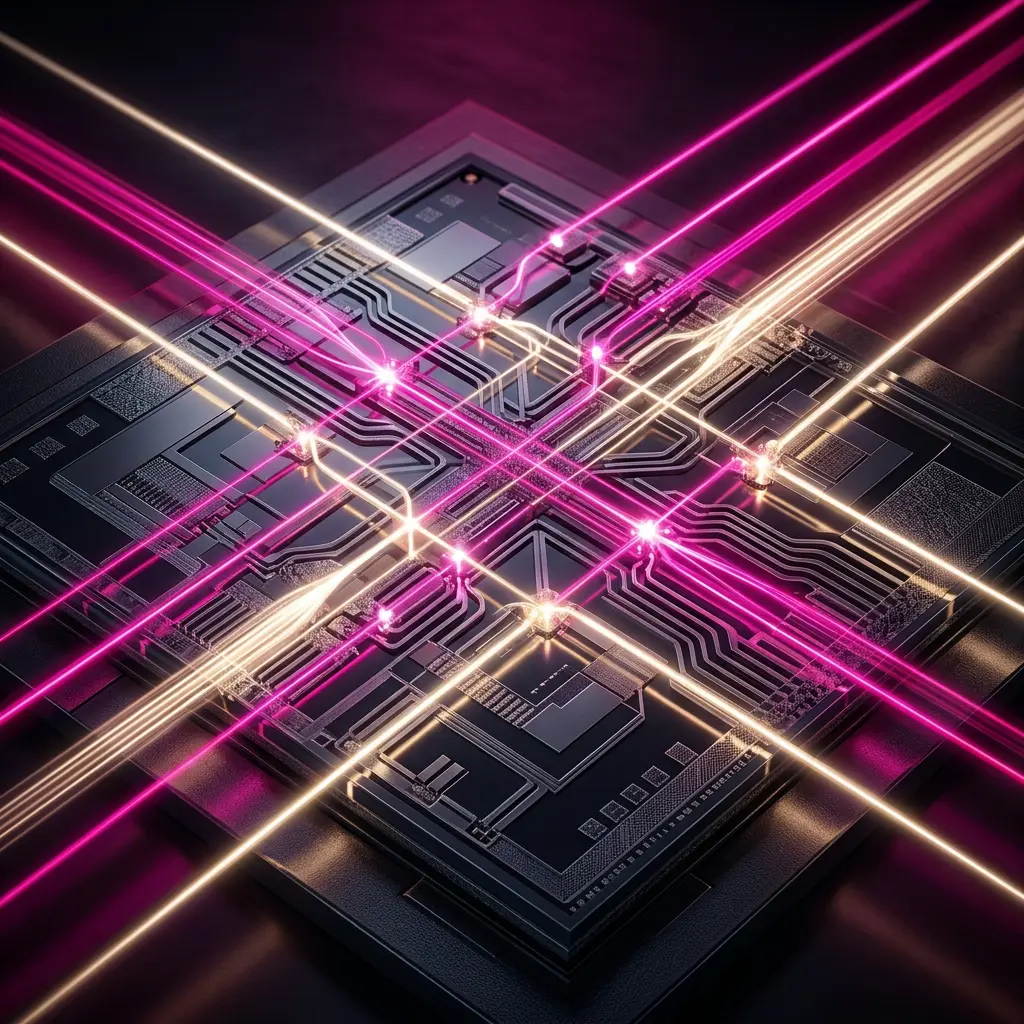
A new fault-tolerant quantum computing method utilising nine quantum error-correcting codes on a trapped-ion quantum computer has been achieved by Edwin Tham of the University of Innsbruck and colleagues. The method delivers a logical error rate up to nine times better than previous work using similar codes on superconducting qubits, employing a quantum low-density parity-check (qLDPC) code encoding four logical qubits into 18 physical qubits. The approach is key for achieving breakeven performance, where qubit lifetimes equal or exceed those of the physical qubits, and features a new optical-metastable-ground (OMG) architecture that enables a streamlined experimental process by removing the need for ion transport or dedicated coolant ions.
Significant error reduction in trapped-ion quantum computation via a low-density parity-check code
Error rates dropped to nine times lower than previously achieved with superconducting qubits, representing a major leap forward in fault-tolerant quantum computing. A quantum low-density parity-check (qLDPC) code enabled this improvement, offering a promising approach for encoding logical qubits with fewer physical qubits than methods like the surface code. Traditional quantum error correction, such as the surface code, requires a substantial overhead in physical qubits to protect a single logical qubit, often necessitating complex 2D layouts and nearest-neighbour connectivity. qLDPC codes, however, leverage sparse parity-check matrices to define error correction rules, allowing for more efficient encoding and potentially reducing the required qubit count. This reduction in physical qubit requirements is crucial as building and controlling large numbers of qubits remains a significant technological challenge. The team’s implementation of a qLDPC code, encoding four logical qubits into eighteen physical qubits, demonstrates a significant step towards more practical quantum computation. qLDPC codes relax the strict connectivity requirements of surface codes, allowing for more efficient hardware utilisation and potentially simplifying the design of quantum processors. The team achieved this breakthrough on a single trapped-ion device without physical reconfiguration, a feat previously considered a significant obstacle to testing multiple error-correction strategies.
A qLDPC code encoding four logical qubits into eighteen physical qubits achieved a logical error rate up to nine times lower than previously reported for a similar superconducting qubit code. This advance was realised on a single trapped-ion device containing forty 133Ba+ ions. Trapped-ion qubits offer several advantages, including long coherence times and high fidelity control, making them well-suited for implementing complex quantum algorithms and error correction schemes. The system’s flexibility was demonstrated through experiments spanning three distinct families of quantum error-correcting codes, including topological and concatenated codes. Topological codes, like the surface code, are known for their high error thresholds but require extensive qubit connectivity. Concatenated codes, on the other hand, build layers of error correction on top of each other to improve reliability. In one instance, the logical qubit lifetime reached 3.95 ±0.68 seconds, exceeding the 3.3 ±0.9 seconds lifetime of the physical qubits themselves. This ‘breakeven’ point, where the logical qubit lifetime surpasses that of the physical qubits, is a critical milestone in quantum error correction, indicating that the code is effectively suppressing errors. However, scaling to the thousands of logical qubits required for practical applications remains a substantial hurdle despite these results. Achieving fault-tolerant quantum computation necessitates not only effective error correction but also the ability to scale up the number of qubits while maintaining high fidelity and coherence.
Rapid evaluation of quantum error correction via reconfigurable qubit connectivity
This advance hinged on a new approach to hardware flexibility, enabling testing of multiple quantum error-correcting codes without physically altering the trapped-ion device. Trapped-ion quantum computers utilise individual, electrically charged atoms (ions) held in place and controlled by electromagnetic fields to perform quantum calculations, functioning like tiny, precisely controlled switches. Each ion represents a qubit, and their quantum states are manipulated using lasers. The system was designed to accommodate diverse qubit connectivity requirements, as different error-correcting codes demand varying patterns of interaction between qubits. The connectivity graph defines which pairs of qubits can directly interact, and different codes often require different connectivity patterns for efficient error correction. For example, some codes may benefit from all-to-all connectivity, while others can function with limited nearest-neighbour interactions.
Scientists could swiftly switch between codes by using this adaptability, streamlining the experimental process and accelerating the pace of discovery. Previous methods often necessitated extensive and time-consuming hardware reconfiguration for each new code tested, creating a significant bottleneck. This reconfiguration typically involved physically moving ions or altering the laser beam paths, which is a complex and error-prone process. Experiments included topological and concatenated codes; the latter used 16 physical qubits with 12 ancillae for error detection and correction. Ancilla qubits are auxiliary qubits used to assist in the error correction process without storing useful quantum information themselves. An optical-metastable-ground architecture was utilised, eliminating the need for ion transport or dedicated coolant ions, which typically limit trapped-ion experiments. Traditional trapped-ion experiments often rely on ion transport to facilitate interactions between qubits, but this can introduce errors and limit the speed of computation. The OMG architecture avoids this by maintaining the ions in a stable ground state, reducing the need for frequent manipulation and improving coherence times.
Demonstrating multiple error correction codes on a single trapped-ion quantum processor
Despite achieving breakeven performance, where logical qubit lifetimes match those of the physical qubits, scaling this multi-code approach presents a considerable challenge. Building quantum computers demands thousands, even millions, of stable qubits to tackle complex problems, while the team successfully encoded only four logical qubits. This limitation raises a vital question: can the benefits of this flexible, yet currently small-scale, system truly translate to larger, more computationally powerful machines. The primary challenge lies in maintaining high fidelity control and coherence as the number of qubits increases. Errors accumulate with each qubit, and even small error rates can quickly overwhelm the system. Furthermore, controlling and entangling many qubits requires precise timing and calibration, which becomes increasingly difficult as the system scales.
This demonstration of nine quantum error-correcting codes on a single trapped-ion device represents a new level of hardware flexibility. This system avoids reconfiguration, accelerating experimentation and code comparison, unlike previous approaches requiring custom physical setups for each code. The ability to implement diverse codes without altering the device showcases a flexible platform for exploring fault tolerance; for example, qLDPC codes offer higher encoding rates than some alternatives but often demand complex hardware. This flexibility is crucial for identifying the most effective error correction strategies for different types of quantum hardware and algorithms. The results pave the way for more efficient and rapid development of fault-tolerant quantum computers, bringing us closer to realising the full potential of this transformative technology.
The researchers successfully demonstrated nine quantum error-correcting codes, including qLDPC codes encoding four logical qubits into 18 physical qubits, on a single trapped-ion quantum computer without hardware reconfiguration. This achievement signifies improved flexibility in quantum computing, allowing for faster experimentation and comparison of different error correction methods. Their qLDPC code exhibited a logical error rate up to nine times better than a previous demonstration using solid-state qubits, and some instances achieved qubit lifetimes comparable to the physical qubits. The team utilised a novel optical-metastable-ground architecture, eliminating the need for ion transport or dedicated coolant ions during experiments.
👉 More information
🗞 Breakeven demonstration of quantum low-density parity-check codes
🧠 ArXiv: https://arxiv.org/abs/2606.06455
See today’s quantum computing news on Quantum Zeitgeist for the latest breakthroughs in qubits, hardware, algorithms, and industry deals.