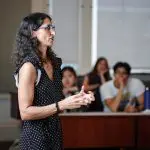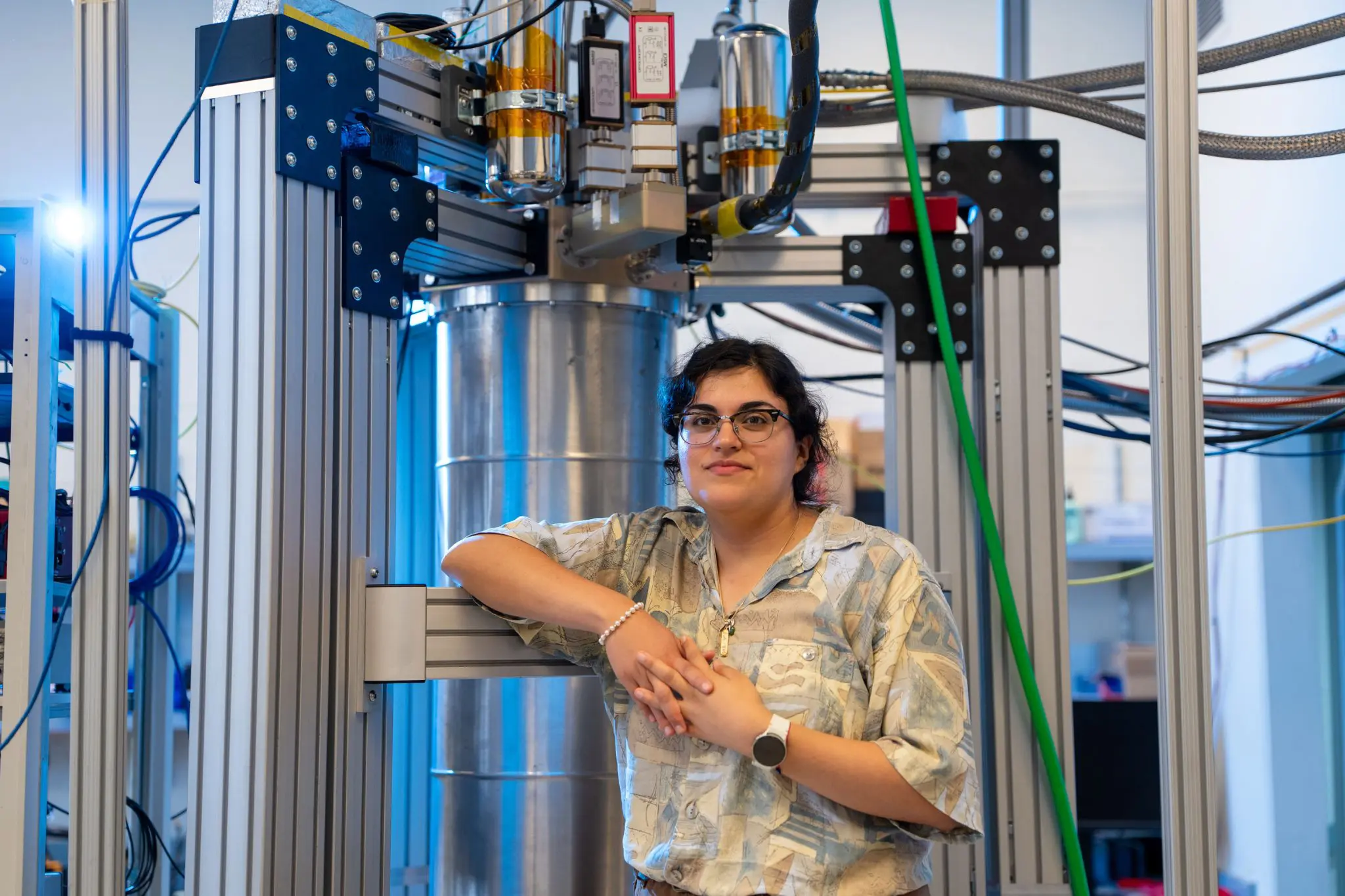
MIT PhD student Faith Reyes has rapidly taken on a guiding role within Ricochet, an international collaboration studying the elusive behavior of neutrinos. Reyes progressed from learning the experiment’s fundamentals to helping guide the work of other scientists, a level of responsibility unusual for a student at her stage. “It felt like my collaborators trusted me, and I had something of value to give to the collaboration,” Reyes says. Beyond her research for Nuclear Science, Reyes fosters interest in physics as a tutor and teaching assistant for first- and second-year undergraduate students at MIT.
Ricochet Experiment Studies Neutrino-Nucleus Scattering in France
The Ricochet experiment, located at the Institut Laue-Langevin in Grenoble, France, focuses on observing coherent elastic neutrino-nucleus scattering, a subtle interaction important for understanding neutrino properties. This process involves neutrinos scattering off atomic nuclei with low energy, and Ricochet aims to capture this phenomenon to refine models of these elusive particles. Reyes’ involvement expanded beyond initial expectations when a planned MIT-based project faced delays, prompting a shift in focus to the French-based experiment and a three-month immersion in detector operations.
At the time, the Ricochet setup comprised two detectors, and Reyes dedicated herself to mastering their functionality through routine maintenance and data acquisition. The Standard Model of particle physics, while remarkably accurate, remains incomplete, and experiments like Ricochet seek to probe its limitations and uncover new physics.
This pursuit extends beyond theoretical advancement, contributing to fundamentally understanding the world in which we live. The collaborative nature of Ricochet necessitated a unique approach to problem-solving, with Reyes developing strategies to streamline data analysis and detector calibration. “It’s sort of like you’re building your own stuff to replace yourself,” she explained, describing how automating tasks allowed her to focus on more complex challenges. This efficiency not only accelerated the research process but also fostered a sense of ownership and confidence in her abilities.
“And luckily, as I began to study it more and more, I found I landed exactly where I wanted to be,” Reyes added, reflecting on her evolving role and growing expertise within the collaboration. She stated, “But now I feel more confident in my position and my prowess as a physicist.”
It felt like my collaborators trusted me, and I had something of value to give to the collaboration.
Faith Reyes Develops Automated Tools for Detector Monitoring
As Ricochet expanded to incorporate eighteen detectors, Faith Reyes developed a software framework automating low-level analysis and detector monitoring previously performed manually. Recognizing the escalating workload, Reyes and a colleague designed the system to streamline repetitive tasks, a project that greatly aided her growth as a physicist. By working closely with the detectors and constructing methods to manage them, she gained detailed insight into the intricacies of the Ricochet setup. This progression was both validating and humbling.
It felt like my collaborators trusted me, and I had something of value to give to the collaboration.
From Student to Leader: Reyes’ Growing Confidence in Physics
Reyes’ time with the Chateaubriand Fellowship in France significantly shaped her approach to scientific collaboration, fostering an appreciation for diverse work cultures beyond the laboratory. She spent nine months total immersed in a new environment following two earlier three-month visits, an experience she describes as influencing her future vision, and also noting, “I fell in love with France and the people,” and “And also, the work culture.” This extended period abroad provided a broader perspective on teamwork and problem-solving, complementing the intensive work within the Ricochet collaboration.
She recalls a period where she initially hesitated to assert her ideas, admitting, “I think I was sometimes not really standing up for myself,” but the support of her colleagues helped her overcome this challenge.
Beyond technical expertise, Reyes emphasizes the interpersonal skills honed during her doctoral work, skills she believes are essential for effective scientific leadership. The Standard Model, she notes, “is extremely accurate and describes most of everything that we see,” but acknowledges the ongoing quest to explore what lies beyond its boundaries.
The Standard Model is extremely accurate and describes most of everything that we see.
Faith Reyes, MIT PhD student
Early Physics Inspiration Fuels Reyes’ Research & Teaching
Before entering higher education, Reyes started a physics club, providing a space for students to conduct experiments and explore the subject outside of formal coursework. This dedication to fostering enthusiasm extends beyond her research into neutrino-nucleus scattering, demonstrating a commitment to broadening participation in the field. The Chateaubriand Fellowship provided Reyes with nine months total in a French research environment, building on two prior three-month visits.
This prolonged exposure to a different work culture significantly shaped her perspective and professional development, influencing her future career aspirations. Reyes is now considering a postdoctoral position after completing her doctorate, a path that would allow her to continue research at another institution and further refine her skills. She notes that the experience abroad also clarified her long-term goals, solidifying her desire to remain actively engaged in physics research.
This sustained engagement with both research and education has cultivated a growing sense of self-assurance in Reyes’ abilities. This confidence, she believes, is one of the most valuable lessons gained during her PhD, and will be crucial as she transitions into the next phase of her career, whether in academia or beyond. Reyes intends to continue contributing to the advancement of physics, driven by a passion ignited early and sustained through both rigorous research and dedicated mentorship.
I’ve learned a lot of lessons.
Faith Reyes


See today’s quantum computing news on Quantum Zeitgeist for the latest breakthroughs in qubits, hardware, algorithms, and industry deals.