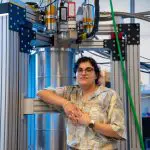
Vassar College alumna Vera C. Rubin’s early passion for astronomy, building a cardboard telescope at age 10 to track meteors, is honored by the newly operational Vera C. Rubin Observatory in Chile. The observatory, the first major, publicly funded U.S. observatory named after a woman, uses the largest digital camera ever built to begin a decade-long survey of the universe.
“Rubin became famous for her discovery of dark matter,” explains Vassar’s Physics and Astronomy Chair Colette Salyk, “an invisible mass that causes galaxies to rotate faster than expected, and something that remains unexplained.” The resulting data, gathered in what Associate Director Sandrine Thomas calls “the greatest astronomical movie of all time,” will help scientists chart the history of the universe and catalog 20 billion stars.
Vera Rubin Observatory Launches 10-Year Legacy Survey of Space and Time
The Vera C. This ambitious undertaking relies on the observatory’s ability to rapidly document changes in the sky, triggering alerts with each new observation and already yielding over 30,000 alerts within the first month of operation.
Associate Director of Summit Operations Sandrine Thomas explained that the telescope’s speed is due to its design; “We can detect very faint objects because we have the ground-based Simonyi Survey Telescope, which is the world’s fastest-slewing large telescope.” These alerts are not merely notifications of celestial events, but prompts for follow-up observations by astronomers worldwide, accelerating the pace of discovery.
The observatory’s location atop Cerro Pachón in Chile is critical to its function, and data collected is not confined to a single location. “It also ships the images to the U.S. facility in California, and then later to France and the U.K., where it does a lot of processing and storage,” Thomas detailed, highlighting the international collaboration underpinning the project.
This distributed processing network is essential for managing the immense volume of data. At least 2 million images are expected by the end of the 10-year survey, and making it accessible to a broad scientific community.
Thomas shared that, “So she would memorize paths of meteors and map their locations.” She was interested more in the questions than the answers, and she really advocated for women in astronomy, and that’s how this whole dream came together. While much of the universe remains unknown, Salyk noted, the Legacy Survey of Space and Time promises to provide insights into the cosmos.
The telescope documents 20 terabytes of data every night for 10 years and provides alerts when there are changes in the sky.
Sandrine Thomas, Associate Director of Summit Operations at the Rubin Observatory
Simonyi Survey Telescope Maps Milky Way with 3D Data
The Simonyi Survey Telescope is generating a three-dimensional map of the Milky Way containing roughly 20 billion stars, a dataset 100 times larger than previous surveys due to its rapid data acquisition rate. This ambitious mapping project, enabled by the telescope’s ability to scan the entire southern sky every three to four nights for a decade, promises to reveal new insights into the galaxy’s evolution and formation.
The resulting catalog will detail the position and motion of each star, providing a level of granularity previously unattainable for such a large sample. Beyond charting stellar positions, the observatory’s data stream is already proving valuable for identifying potential threats from near-Earth asteroids. In its first 30 days of operation, the telescope generated over 30,000 alerts, triggering follow-up observations and analysis by astronomers worldwide, and leading to the publication of more than 40 scientific papers based on its initial findings.
Understanding the composition of the universe remains a central goal of this research, as scientists estimate that only 5 percent of the universe is comprised of matter readily observable and tangible. “95 percent remains a mystery, and so it is really important for us to understand what it is and how it interacts with the rest of the matter,” Thomas said, emphasizing the broader context of the Milky Way mapping effort.
The observatory’s comprehensive data set will contribute to ongoing investigations into dark matter, an invisible mass that influences galactic rotation, and its role in the cosmos. “Don’t shoot for the stars; we know what’s there. Shoot for the space in between because that’s where the real mystery lies,” Thomas added, highlighting the focus on the unseen components of the universe. The data collected will also support studies aimed at reconstructing the history of the universe itself.
Rubin became famous for her groundbreaking discovery of dark matter-an invisible mass that causes galaxies to rotate faster than expected, and something that remains unexplained.
Colette Salyk, Physics and Astronomy Chair at Vassar




See today’s quantum computing news on Quantum Zeitgeist for the latest breakthroughs in qubits, hardware, algorithms, and industry deals.