

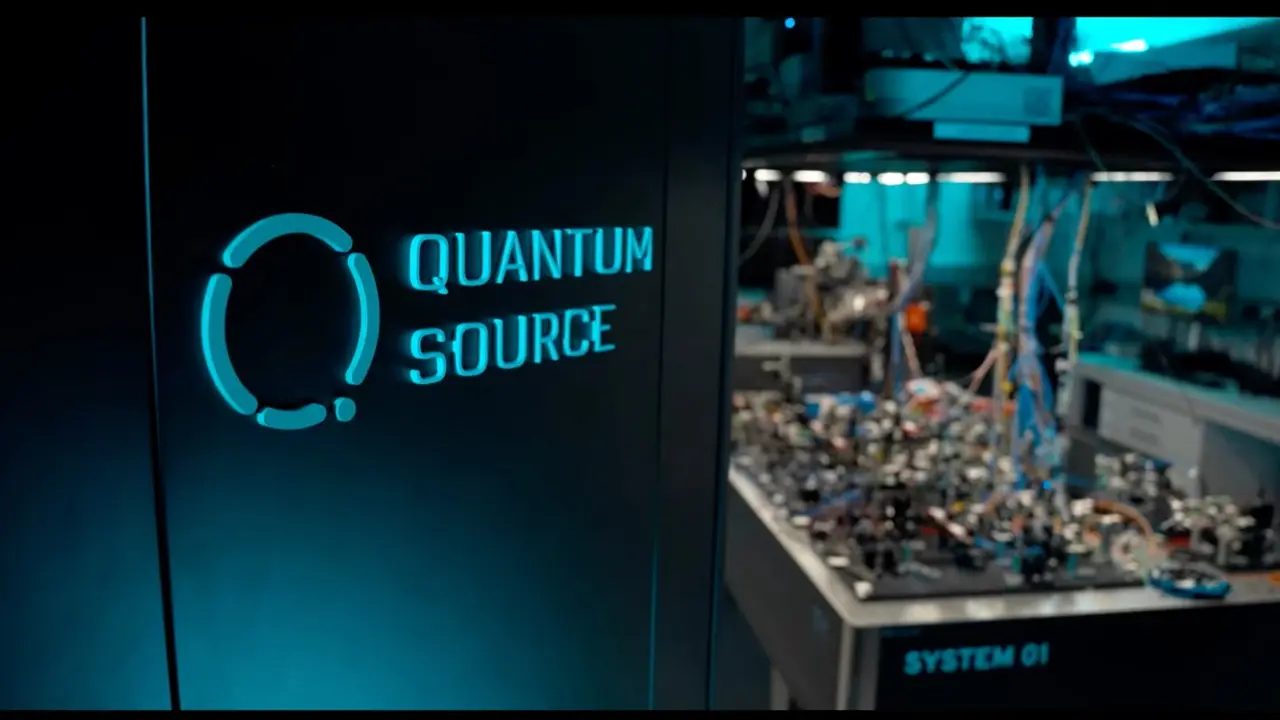
Quantum Source reports demonstrating single-atom trapping near a planar photonic chip, an achievement that advances scalable atom-photon interfaces. The company is addressing a significant gap between the potential of its quantum hardware and its practical application. By using a single-atom memory, Quantum Source increases entanglement rates between quantum processors by eliminating the need for simultaneous photon arrivals. The company states its aim is to overcome barriers that have challenged individual quantum hardware platforms.
Cavity QED Enables Single-Atom Trapping and Photon Generation
A first demonstration of single-atom trapping has occurred near a planar photonic chip, representing a step toward building scalable interfaces between atoms and photons. This achievement uses an evanescent field within an integrated photonic resonator to isolate and control individual atoms, a technique important for developing more robust quantum systems. The ability to precisely position atoms near photonic circuits promises to streamline the creation of complex quantum networks and improve the efficiency of light-matter interactions.
This approach addresses a significant challenge in quantum communication, where coordinating the timing of photons has historically limited the speed and reliability of entanglement distribution. By storing quantum information in the atom itself, the system bypasses the need for precise temporal synchronization, potentially unlocking faster and more stable quantum connections.
Quantum Source is attempting to bridge this gap by focusing on a combined approach, combining the strengths of both photonic and atomic quantum systems. The team is turning complex quantum mechanics into scalable engineering solutions by locking laser frequencies and optimizing interaction fidelity within the optical cavity system, Quantum Source says. This work allows for the precise generation of single photons and cluster states, essential components for implementing quantum error correction.
The company’s research focuses on trapping and cooling single atoms within this cavity system, enabling precise interaction with light. This controlled interaction is key to generating the photons and cluster states needed for quantum error correction, a critical step toward building fault-tolerant quantum computers. The miniaturization of optics and direct mounting of components are further improving system stability and efficiency. Quantum Source was also recently voted by Globes readers as their favorite startup for 2026, reflecting growing recognition of its approach to quantum computing.



See today’s quantum computing news on Quantum Zeitgeist for the latest breakthroughs in qubits, hardware, algorithms, and industry deals.
