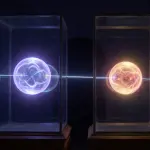
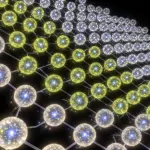
A team led by the US Department of Energy’s SLAC National Accelerator Laboratory has experimentally confirmed altermagnetism, establishing a third distinct magnetic phase beyond the long-recognized ferromagnetism and antiferromagnetism. The research, published in Science, centers on manganese telluride (MnTe) and reveals a unique asymmetric magnetic structure, chirality, within its spins. In the past few years, scientists have observed phenomena that don’t fit neatly into the ferromagnetism-antiferromagnetism dichotomy,” explains lead author Daniel Jost, associate scientist at SLAC. Identifying altermagnetic materials like MnTe could advance technologies including quantum computing and memory devices.
Chirality as Definitive Proof of Altermagnetism
The presence of chirality within manganese telluride (MnTe) provided the conclusive evidence needed to confirm altermagnetism as a distinct magnetic phase, according to research published in Science. Researchers observed an asymmetric, spiral-like structure in the material’s spins, a geometric twist that differentiates it from both ferromagnets and antiferromagnets and solidifies its classification as an altermagnet.
This chiral signature, akin to a screw or spiral staircase, was identified through meticulous experimentation at the European Synchrotron Radiation Facility (ESRF) and represents a critical step in validating theoretical models proposed only a few years ago. The team’s work builds on observations from recent years indicating that certain materials exhibited magnetic behaviors inconsistent with traditional classifications.
Daniel Jost, associate scientist at SLAC and the Stanford Institute for Material and Energy Science, explains that scientists have been “compiling evidence of a third type of magnetism that bridges the qualities of these two classes,” and now believe their results “provide robust experimental confirmation that this third phase – altermagnetism – is real.” The confirmation of altermagnetism in MnTe is particularly significant because the material was previously considered antiferromagnetic, highlighting a shift in understanding of magnetic properties within seemingly well-understood compounds. By 2024, there were some factors that spoke strongly in favor of altermagnetism being real, but there was still a missing piece to the puzzle.
Chirality served as that missing piece, offering a means to distinguish altermagnets from antiferromagnets at a quantum level. While both exhibit alternating spin arrangements, the geometric twists within an altermagnetic lattice create a distinct “handedness” absent in conventional antiferromagnets.
Rachel Nickel, postdoctoral scientist at the ESRF and a co-author on the study, detailed how the team’s technique enabled them to confirm MnTe’s altermagnetic properties. The initial experiment, completed in 2024, was successfully repeated in early 2025, reinforcing the findings. The team’s ability to directly observe this chirality provides “solid experimental ground to say altermagnetism stands in a class of its own,” according to Jost.
The discovery of altermagnetism has implications for spintronics, a field focused on using the spin of electrons to create advanced electronic devices. “If you have a permanent magnet in your pocket and walk by a spintronic device built with ferromagnets, you could start flipping the bits, scrambling the information stored there,” explains Jost.
“Antiferromagnets fix that problem, but they are practically invisible – so you can’t easily read the data stored in them or use them to drive efficient spin currents.” Altermagnets, however, offer a potential solution, possessing the stability of antiferromagnets alongside the ability to generate spin-polarized currents necessary for efficient data extraction and manipulation.
Nickel emphasizes the speed of progress in this area, stating, “Altermagnetism was only proposed a few years ago, and the rapid progress in confirming these models is incredible.” This combination of stability and functionality positions altermagnetic materials like MnTe as promising candidates for applications in quantum technologies, memory devices and AI data centers, potentially enabling more robust and efficient electronic systems.
By 2024, there were some factors that spoke strongly in favor of altermagnetism being real.
Daniel Jost, associate scientist at SLAC and the Stanford Institute for Material and Energy Science
Altermagnetism’s Potential for Advanced Spintronic Devices
The observed chirality within manganese telluride provided definitive evidence supporting the existence of altermagnetism, a characteristic absent in both ferromagnets and antiferromagnets. “Chiral materials scatter left-handed polarized X-ray beams differently than they do right-handed beams,” explained a researcher, detailing how the team distinguished this asymmetry from non-chiral materials which scatter both beams identically. This structural distinction, akin to a spiral staircase, is a curiosity and a key feature enabling potential applications in advanced electronics, particularly within the rapidly evolving field of spintronics.
The team’s 2024 experiment, reinforced by a repeat in early 2025, confirmed the material’s unique magnetic arrangement and solidified the understanding of this newly identified magnetic phase. Spintronic devices aim to use the spin of electrons, rather than their charge, to create faster, more efficient, and robust electronics, but traditional magnetic materials present limitations.
Ferromagnetic materials, while easily manipulated, are susceptible to external magnetic fields, risking data corruption in sensitive applications. Altermagnetism offers a potential solution by combining the advantages of both, providing stability without sacrificing the ability to control spin. “Altermagnets combine the best of both,” stated a researcher, highlighting the material’s potential to overcome the shortcomings of existing technologies. This unique combination stems from the material’s zero net magnetization, ensuring stability, alongside its capacity to generate spin-polarized currents, facilitating efficient data extraction.
This “additional degree of freedom” allows for greater control and manipulation of spin, opening doors to more sophisticated spintronic designs. Researchers from Stanford University, Stanford PULSE Institute, University of Notre Dame, Bavarian Academy of Sciences and Humanities, and Technical University of Munich collaborated with those at SLAC and ESRF to achieve these findings.
The implications extend beyond fundamental physics, promising a new avenue for developing electronics with enhanced performance and reduced energy consumption. The ability to reliably read data from a stable magnetic material, without the interference of external fields, represents a step toward realizing the full potential of spintronics and addressing the growing demands of data-intensive applications. The team’s work demonstrates that altermagnetism is a demonstrable physical phenomenon with tangible implications for future technologies.
This chiral signature gave us the solid experimental ground to say altermagnetism stands in a class of its own.
Daniel Jost, associate scientist at SLAC and the Stanford Institute for Material and Energy Science


See today’s quantum computing news on Quantum Zeitgeist for the latest breakthroughs in qubits, hardware, algorithms, and industry deals.