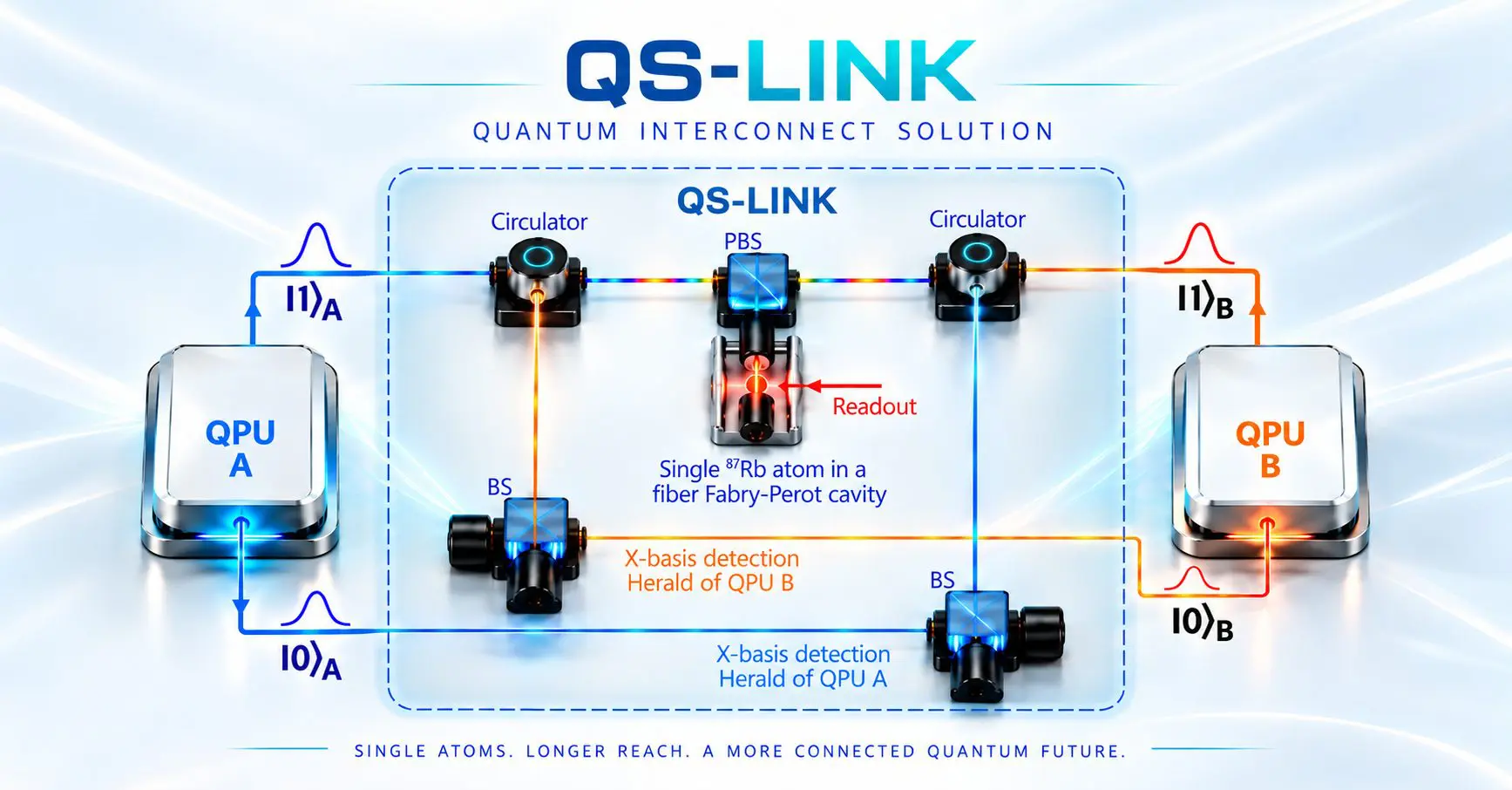
Quantum Source Labs has demonstrated a method to increase entanglement rates between quantum processors by utilizing a single-atom memory, eliminating the need for precisely timed photon arrivals, the company says. This advance addresses a critical hurdle in building more powerful and scalable quantum systems, combining the strengths of both photonics and atom-based qubits on a single chip.
“Photonic quantum computing offers the most scalable path to fault-tolerant quantum computers,” asserts former Israeli Prime Minister Naftali Bennett, a board member at Quantum Source, reflecting growing confidence in the company’s hybrid approach. The Israeli firm recently demonstrated on-demand generation of entangled photon pairs transmitted through over a kilometer of standard optical fiber, a step toward practical quantum communication.
Atom-Photon Integration for Scalable Quantum Interfaces
A first demonstration of single-atom trapping and coupling near a planar photonic chip establishes an important building block for scalable quantum interfaces, circumventing a longstanding challenge in quantum processor entanglement. Quantum Source Labs accomplished this by using the evanescent field of an integrated photonic resonator to hold and interact with single atoms, a technique detailed in recent publications.
The company’s approach centers on deterministic interaction between single atoms and single photons, enabling on-demand single-photon generation and photonic cluster state generation, core components of its ORIGIN cavity-QED engine, according to Quantum Source. This technology underpins both QS-ORBIT, a fault-tolerant photonic quantum computer designed for standard server rooms without cryogenic cooling, and QS-LINK, a photonic quantum interconnect for linking diverse quantum processing units.
According to Quantum Source, this removes much of the feed-forward and switching overhead common in probabilistic photonic schemes, potentially making large-scale, error-corrected photonic quantum computing economically viable. Recent recognition from Globes readers, who voted Quantum Source as their favorite 2026 startup, further highlights the growing interest in the company’s technology and its potential to reshape the quantum field.
Founded in 2021 and headquartered in Tel Aviv, the 67-person firm is backed by investors including Ayal Itzkovitz of Pitango, Seth Winterroth of Eclipse, and Dov Moran of Grove Ventures, as well as Bennett’s involvement on the board.
Deterministic Graph State Generation via Single-Atom Memory
This improvement stems from the implementation of a single-atom memory, effectively decoupling the timing constraints previously imposed on photon exchange. The company detailed how this memory functions within a hybrid architecture, coupling single photons with single atoms on a single platform to achieve deterministic resource-state generation compact enough for deployment in standard server infrastructure, the company says.
This approach enables deterministic generation of graph states, a critical capability for advanced quantum computation, and bypasses the probabilistic nature of many existing photonic schemes. CEO Oded Melamed described this as a blueprint for a fault-tolerant compound photon-atom quantum architecture, aiming to overcome the barriers of both fault tolerance and connectivity that have challenged individual quantum hardware platforms.


See today’s quantum computing news on Quantum Zeitgeist for the latest breakthroughs in qubits, hardware, algorithms, and industry deals.