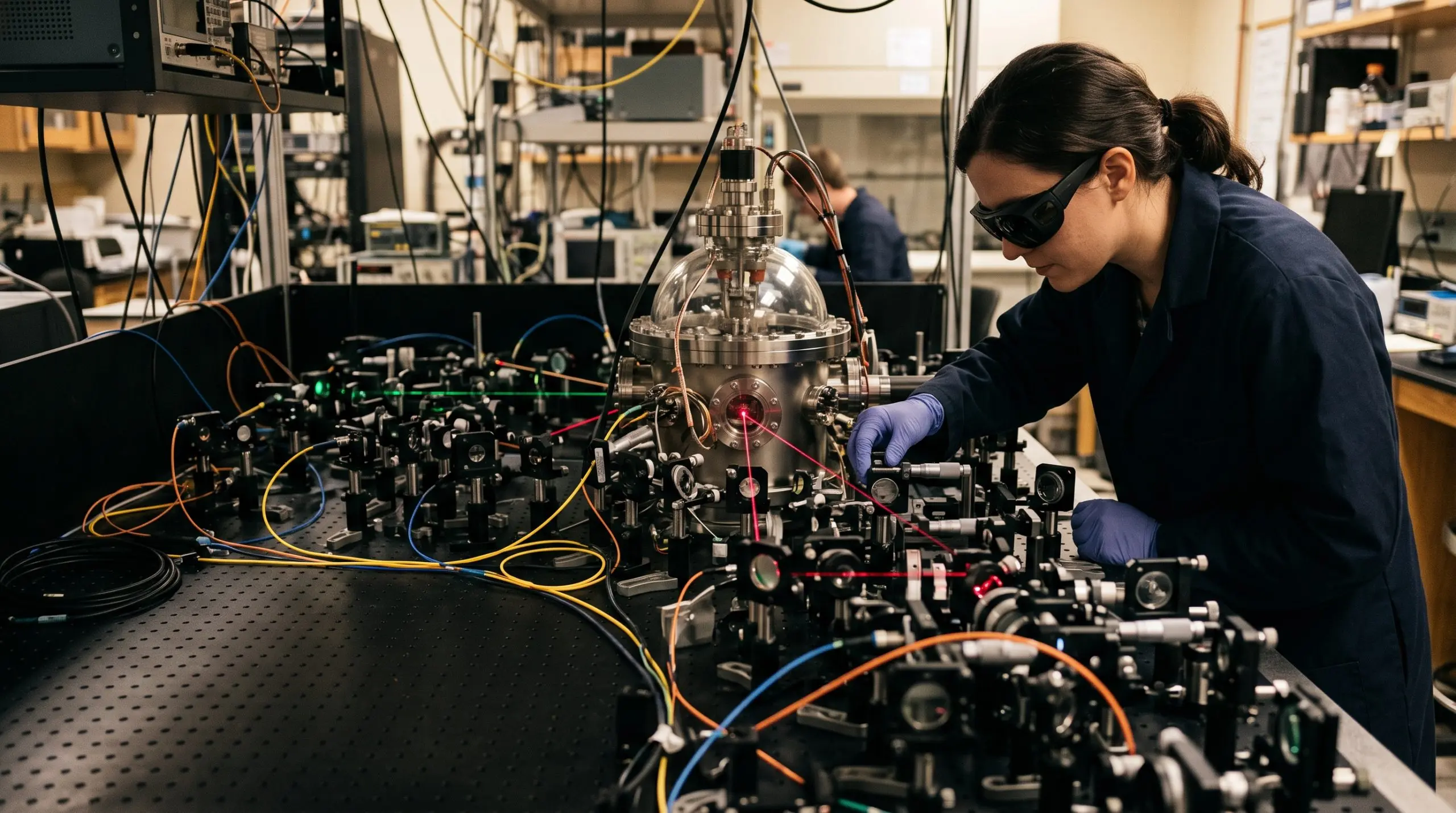
Researchers at the Joint Quantum Institute at University of Maryland have created a “pocket-sized tool” for measuring light frequencies, addressing a long-standing need for portability in physics labs. The team reports demonstrating a new chip-based optical frequency comb that performs as well as older, bulky versions while occupying a fraction of the space.
These frequency combs are important for building atomic clocks, the world’s most precise timekeepers, and enabling a range of other light-based technologies. This advance builds on a decade of research by JQI scientists Grégory Moille and Kartik Srinivasan, and a collaboration led by Miro Erkintalo at the University of Auckland.
Compact Frequency Combs Enable Portable Atomic Clocks
The new chip-based optical frequency comb stabilizes over ten times more microcombs than previous iterations, a performance leap reported by researchers at the Joint Quantum Institute. Grégory Moille, first author on the recent Nature publication detailing the advance, explains that control and stabilization have historically complicated the use of chip-integrated frequency combs, but this new approach offers a viable path forward.
Central to the device’s function are two lasers circulating within a small resonator, generating a “pristine ruler for measuring light” through a process called parametrically driven cavity solitons, initially predicted in 2023. The team demonstrated this capability by successfully monitoring light used in atomic clocks, measuring frequencies oscillating at several hundred trillion times per second to within approximately one hundred thousand oscillations per second of the expected atomic value.
The adaptability of the new frequency comb was further tested using a specialized chip supplied by colleagues at the University of California, Santa Barbara, to produce a low-noise laser reference. This allowed the researchers to generate microwaves with minimal noise, a feature that extends the comb’s utility beyond atomic clocks to applications like radar systems, where improved distance measurements rely on cleaner signals.
Co-authors on the paper include Pradyoth Shandilya, a graduate student, Baltimore County and researchers from the University of Auckland, and the Air Force Research Laboratory. The collaborative effort highlights the interdisciplinary nature of the research and the broad interest in advancing compact frequency comb technology.
Parametric Cavity Solitons Form Novel Frequency Comb
This increased stability stems from a new approach using parametrically driven cavity solitons (PDCSs), a phenomenon predicted in 2023, and dubbed SParCS (self-aligned parametrically-driven cavity soliton) by the team. Unlike traditional combs that rely on a single laser and experience diminished power and definition at the edges, the SParCS method employs two lasers to define the comb’s boundaries, resulting in more precise and powerful teeth across the entire spectrum.
This configuration concentrates power toward the comb’s edges, critical for many practical measurements, and addresses a long-standing challenge in comb technology. The core innovation lies in how these combs establish a fixed relationship between lasers and comb teeth, allowing for the transfer of stability or the detection of fluctuations. By locking a laser to a specific tooth, researchers can effectively anchor the entire comb, providing a stable reference point for measurements at different frequencies.
This capability is particularly valuable for applications requiring high precision, such as atomic timekeeping, where even minute variations in frequency can accumulate over time. “With this new approach, we finally see a viable path for their use in deployable atomic timekeeping, which is one of their most demanding and important applications,” says Moille, highlighting the potential for creating portable and accurate timekeeping devices. The team’s focus has now fully shifted to refining the SParCS technique, a commitment reflected in their resource allocation.
Traditional chip-integrated optical frequency combs have often been hampered by complex control and stabilization requirements, making them difficult to implement in practical devices. The SParCS method, however, allows for compensation of variations during manufacturing, potentially opening the way to mass production and integration into a wider range of products. This ease of use extends to the experimental process itself, streamlining workflows for researchers. “As experimentalists, this new optical frequency comb has simplified much of our work,” Moille explains.
“The system made it so easy that you actually have only one operator at a time doing each application.” The ability to perform complex measurements with a single operator highlights the comb’s potential to democratize access to precision metrology. Beyond atomic clocks, the implications of this technology extend to diverse fields, including lidar systems used in autonomous vehicles and devices that measure light frequencies or distances.
The team’s work builds on years of experience in the field. But the SParCS method offers a fundamentally different way to generate and control optical frequency combs, opening up new possibilities for both fundamental research and practical applications.
Self-Alignment Technique Stabilizes Frequency Line Spacing
The newly developed frequency comb automatically aligns its output frequencies, resolving a longstanding challenge in miniaturized optical technology. Unlike earlier iterations prone to overlapping frequency lines, rendering them unusable like a misprinted ruler, this device achieves a pristine, single set of measurable frequencies through a process called self-alignment. Researchers described the advances behind their frequency comb and its performance on common tasks in an article published Sept.
This self-alignment stems from a combination of a phase-dispersive cavity solitons (PDCS) approach and a previously established stabilization technique. The PDCS method uses two lasers at distinct frequencies to create the comb, positioning them as bookends with additional frequencies forming between, resulting in more precise and powerful comb teeth.
This locking process isn’t merely about achieving alignment. It establishes a fixed relationship between the comb’s teeth and any laser locked to a specific tooth, transferring stability or revealing fluctuations across the entire comb. The precision of this comb extends to determining the zero-frequency offset, a key value representing the comb’s starting point, which is essential for accurate frequency measurements. Traditional methods for finding this offset, recognized with the 2005 Nobel Prize in physics, require specific frequency relationships between comb teeth.
The new design inherently facilitates this requirement, allowing for a more reliable and efficient offset determination. This is particularly important because even slight variations in the fabrication of each resonator can shift the comb’s frequencies, necessitating individual calibration for each device. The adaptability of the comb allows the team to compensate for these variations, reducing the need for extreme precision during manufacturing and potentially enabling mass production.
By precisely pinning down the frequency of comb teeth, researchers can improve the accuracy of frequency measurements and create stable optical frequency sources. They demonstrated this capability by performing the reverse process, linking optical light to microwaves, using the same device. The compact size, a significant departure from bulky laboratory setups, also opens doors for portable atomic clocks and other light-based technologies.
SParCS Comb Enhances Power Distribution & Offset Precision
The ability to accurately pinpoint the frequencies at the edges of an optical frequency comb, critical for precise measurements is significantly enhanced by a new technique developed at the University of Maryland. Unlike traditional combs where power diminishes at the outer frequencies, the SParCS (self-aligned parametrically-driven cavity soliton) method concentrates power toward these edges, simplifying offset determination and accelerating experimental setup.
This improvement addresses a long-standing challenge in comb fabrication where idiosyncrasies in each resonator necessitate individual calibration for accurate frequency readings. This approach creates “bookends” for the comb, ensuring a more uniform distribution of power across all frequencies and bolstering the signal strength at the critical edge teeth.
A comb that does not span an octave, a frequency range where one tooth is approximately twice the frequency of another, requires additional, bulky equipment to find this offset, a requirement the SParCS method circumvents. The team’s verification process focused on ensuring the new comb met or exceeded the performance of existing technology, a benchmark they successfully achieved. The ability to select the initial laser frequencies allows researchers to guarantee the comb spans an octave and that the critical edge teeth are stable and easily measurable, streamlining the process of preparing experiments.
The SParCS approach represents a departure from previous methods that relied on a single “pump” laser and subsequent expansion of frequencies, often resulting in weaker and less defined teeth at the comb’s periphery. The team’s work has already shifted the focus of their laboratory, transitioning from the traditional pumping method to the new SParCS technique.
Beyond simplifying offset determination, the SParCS method offers adaptability for various applications. Researchers envision a future iteration potentially using a single laser feeding both sides of the comb, further streamlining the system. Currently, the team is actively integrating the SParCS combs into other ongoing experiments, using the enhanced precision and ease of use. The resulting combs are described as a “pristine ruler for measuring light”, as visualized in an image showing blue, red and purple curves merging into defined purple lines representing the comb’s precision.



See today’s quantum computing news on Quantum Zeitgeist for the latest breakthroughs in qubits, hardware, algorithms, and industry deals.