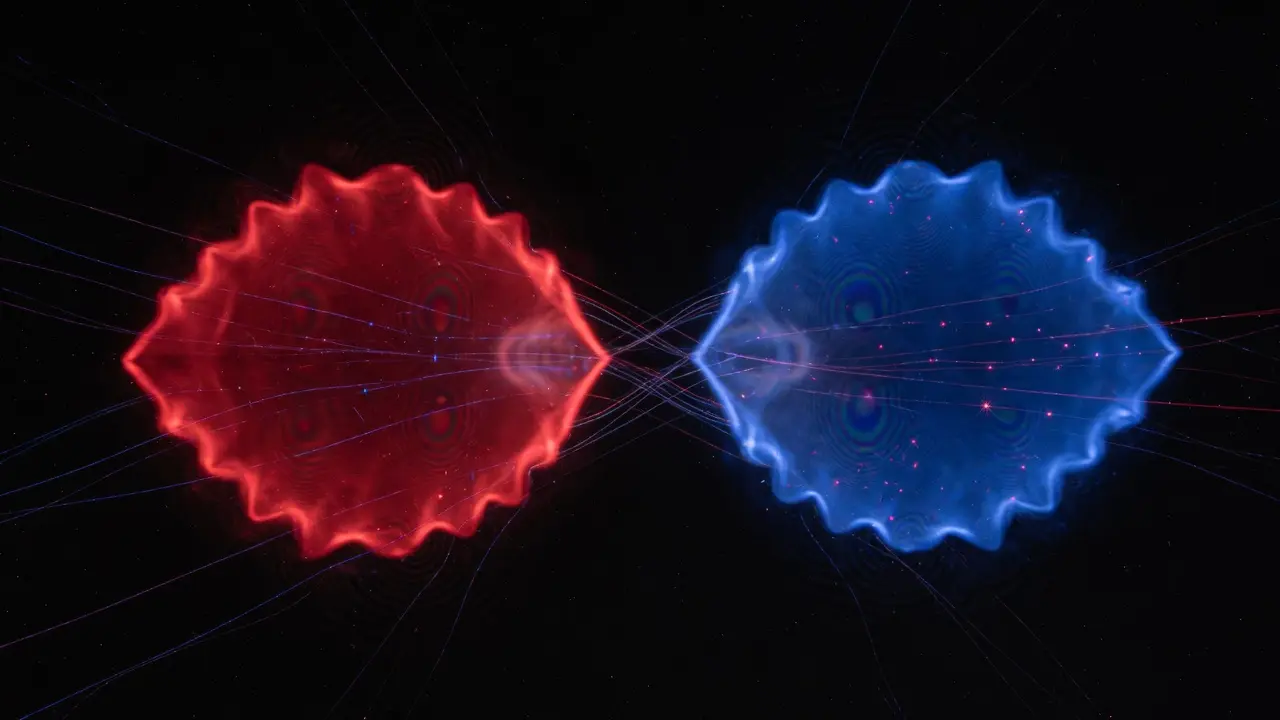
A new framework and algorithm, SOFA, evaluates ‘magic’, a quantum resource distinct from entanglement which measures how far a state deviates from classically simulable ones. Applying this set of tools to both the transverse field Ising model and generic spin chains reveals that magic undergoes a “sudden death” under thermal evolution *after* entanglement disappears; similar conclusions were drawn studying the Kitaev quantum spin liquid where thresholds depend on subregion shape. New methods measure “magic”, a unique form of quantum resource beyond entanglement; it’s key for computers solving problems impossible for conventional machines.
This work demonstrates that ‘magic’ can vanish even after entanglement disappears, revealing how these resources change under conditions such as heating or disruption. Detecting this property directly within materials using neutron scattering is vital, potentially enabling more powerful and reliable quantum systems. The research reveals this ‘magic’ can disappear even after entanglement vanishes. Stabilizer states, highly structured arrangements akin to neatly organised data in rows and columns, easy to read but limited in complexity, help understand these resources.
The team found that under thermal conditions, like heating a material, magic typically disappears *after* entanglement is lost; however, when the system undergoes a sudden change, imagine quickly shaking up a snow globe, the opposite occurs with magic dying first. This differing behaviour raises questions about how best to preserve these fragile quantum properties during computation or transmission of information.
SOFA algorithm reveals magic’s rapid decay across diverse quantum systems
David Awschalom and colleagues developed the Stabilizer-Orbit Frank-Wolfe algorithm (SOFA), enabling calculations up to twelve qubits, a strong leap from previous methods limited by computational complexity. SOFA allowed analysis near critical temperatures where determining ‘magic’ requires evaluating numerous potential stabiliser configurations, resolving a long-standing issue concerning this unique quantum resource distinct from entanglement. Previously impossible due to algorithmic limitations, researchers now demonstrate that it undergoes “sudden death” after entanglement disappears within the transverse field Ising Model.
Applying SOFA revealed similar behaviour in both the transverse field Ising model and generic spin chains; however, thresholds for sudden death depend on subregion shape in the Kitaev quantum spin liquid, highlighting its sensitivity to geometry. The team extended their analysis beyond thermal behaviour to explore quantum quenches, abrupt changes to the governing Hamiltonian, and track how ‘magic’ evolves over time. Simulations using up to 24 sites for generic spin chains, systems where interactions dictate electron behaviour, found magic typically disappearing before entanglement does, a trend contrary to that seen with gradual heating.
This observation held true across 50 randomly generated quenches: in 36 completed within t ≤40 units, magic died first; an additional set of 25 randomised trials yielded similar results, showing magic-first death in 24 instances. Furthermore, even allowing parties to share resources like Bell pairs and ancilla qubits, genuine bipartite magic still undergoes “sudden death” prior to complete loss of entanglement at separations beyond a critical distance *rc*.
Fragile magic’s survival hinges on overcoming decoherence limitations
Identifying when ‘magic’, a quantum resource extending beyond entanglement, vanishes offers pathways for better characterising complex materials and improving computation, but pinpointing its true utility remains elusive. A new framework was developed by the researchers to evaluate this resource; it measures how far a state deviates from those easily simulated on classical computers. Their analysis relies on idealized models lacking imperfections inevitable in real-world systems. This raises an important question: can these fragile magical states survive long enough amidst noise and errors to deliver any practical advantage?
Even if these ‘magical’ states prove too delicate for immediate use in practical quantum devices due to noise and errors, identifying when magic disappears relative to entanglement provides a novel way of characterising complex materials like those used in potential future computers. This work demonstrates that across both thermal processes and abrupt changes to system dynamics (quenches), magic often vanishes before entanglement does, revealing differing behaviours between the two resources. Challenging existing assumptions about preserving fragile quantum states during information processing or transmission, this finding highlights the need for subtle strategies tailored to each property.
This research developed a framework to evaluate “magic,” a quantum resource distinct from entanglement, by measuring how far a state deviates from easily simulated ones. The analysis showed that in models including the transverse field Ising model, spin chains, and Kitaev quantum spin liquid on the honeycomb lattice, magic typically disappears before entanglement under thermal processes and abrupt changes, or quenches, to system dynamics. This suggests differences in how these two quantum properties are affected by decoherence. Researchers also proposed using neutron scattering to experimentally observe volume law of frame-robust magic within certain materials.
👉 More information
🗞 Fate of Quantum Magic
✍️ Liuke Lyu and William Witczak-Krempa (Université de Montréal); Erik S. Sørensen (McMaster University)
🧠 ArXiv: https://arxiv.org/abs/2610.39059


See today’s quantum computing news on Quantum Zeitgeist for the latest breakthroughs in qubits, hardware, algorithms, and industry deals.