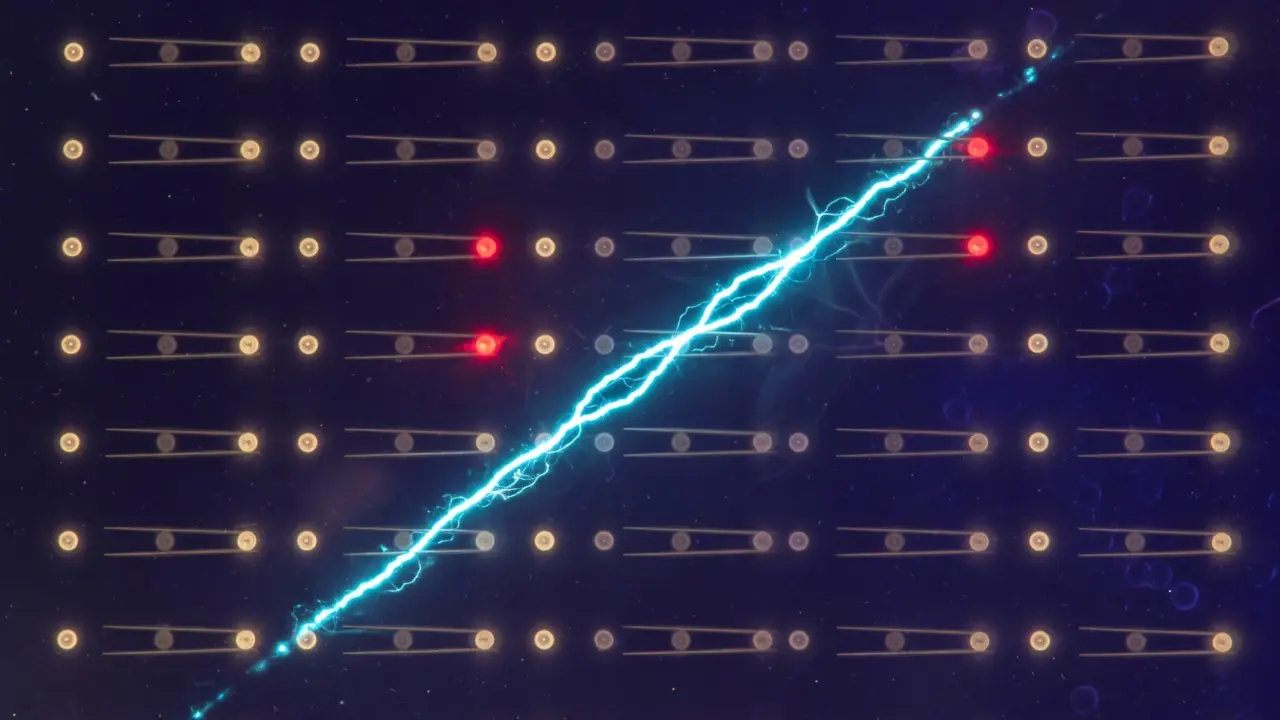
A fundamental limit constrains squeezing, the reduction of quantum noise, in optical systems. Precise analytical expressions describing fully quantized three-wave mixing and parametric amplification have been derived without approximations or fitted parameters. The achievement reorganizes complex calculations into manageable depletion and return profiles; numerical tests confirm errors below one thousandth across dozens of cycles with up to thirty-seven percent pump depletion from an initial population of one hundred thousand.
New mathematical calculations detail how light behaves during three-wave mixing and parametric amplification, processes vital for creating advanced optical technologies. By avoiding approximations common in previous methods, greater accuracy was achieved when predicting system behaviour throughout its operation, including complex phases where energy transfers back and forth. This precise approach allows detailed analysis of quantum noise and correlations within the interaction, providing a strong set of tools for building more robust optical systems.
New mathematical calculations have been developed for understanding light behaviour during three-wave mixing and parametric amplification, processes key for advanced optical technologies like squeezed light sources. Previous methods often relied on approximations; however, precise analytical expressions were derived without such simplifications, allowing accurate prediction of how systems behave throughout operation, even when energy repeatedly transfers between beams of light. This ‘repeated draining and refilling’ of energy is described by depletion-and-back-conversion cycles. The *trilinear Hamiltonian* represents a set of rules governing this energy exchange between different beams, much like recipes determine ingredient combinations.
Depletion Cycle Resummation Simplifies Quantized Nonlinear Optics Calculations
A complex calculation described fully quantized three-wave mixing and parametric amplification by reorganizing the *Heisenberg expansion*, a method tracking changes in quantities over time based on uncertainty principles, imagine ripples spreading across a pond after dropping in a stone. This technique resummed these cycles into simplified profiles representing pump depletion and return, allowing direct calculable expressions without relying on approximations or fitted parameters.
Numerical tests confirmed errors below 10-3 across multiple of these cycles, with even smaller discrepancies, order 10-12, during initial pump depletion stages. The mean pump population, 2 α², dictates sector dimensions in this calculation. The framework provides insights into subtle effects previously obscured by computational limitations; previous methods were limited to approximately 10-3 accuracy over several energy transfer iterations, demonstrating a sharp improvement.
Depletion-and-Back-Conversion Profiles Enable Ultrahigh Precision Three-Wave Mixing Simulations
Error rates dropped sharply as numerical tests now demonstrate errors of order 10-12 throughout pump depletion, a major improvement over prior methods limited to roughly 10-3 across multiple energy transfer cycles. Simplified ‘depletion-and-back-conversion’ profiles accurately describe light behaviour during three-wave mixing and parametric amplification without approximations or fitted parameters; this breakthrough stems from reorganizing complex calculations into these profiles. Analytic expressions for observable dynamics up to fourth-order correlations were derived, accommodating bright squeezed pumps, an important step towards building stronger optical quantum technologies by revealing phenomena previously hidden due to computational limitations.
These analytic formulas allow calculation of first-, second-, and third-order correlations with systematic corrections applied, revealing phenomena crucial for future optical quantum technologies; the framework extends to higher moments as well. This capability enables exploration of interactions beyond current reach and refinement of models based on precise analytical results rather than numerical approximations.
Analytic expressions streamline modelling of squeezed four-photon correlations
Researchers at UNSW Sydney and The University of Queensland has delivered a powerful new set of tools for understanding quantum light interactions, promising accelerated development of advanced optical technologies reliant on precise control over squeezing, reducing inherent uncertainty in light’s properties. Extending this framework to even higher orders remains an open question, hinting at potential scalability challenges as complexity increases; however, demonstrating calculations up to fourth-order correlations is impressive. Acknowledging that extending these calculations presents a challenge shouldn’t diminish the achievement.
By reorganising calculations based on ‘depletion-and-back-conversion cycles’, repeated energy transfer between beams, researchers established a new analytical framework for modelling fully quantized three-wave mixing and parametric amplification, fundamental processes for manipulating light at the quantum level. They derived expressions describing how systems behave without relying on estimations or adjustments to fit experimental data. This approach yields directly calculable results for correlations measuring relationships between photons up to fourth order, accommodating advanced techniques like bright squeezed pumps which enhance weak signals; it provides a solid foundation upon which future work can build.
Researchers developed analytic expressions that accurately describe observable dynamics in quantum three-wave mixing and parametric amplification, processes involving interactions between light waves. Their calculations, based on ‘depletion-and-back-conversion’ profiles, achieved errors below 10-3 even through multiple cycles of energy transfer, and do not require fitted parameters or approximations. The resulting framework allows direct evaluation of photon correlations up to the fourth order using coherent pump inputs, providing precise results for modelling these quantum phenomena. Authors note this approach is extendable to higher moments, though increasing complexity presents a challenge.
👉 More information
🗞 Analytic Solutions To Fully Quantized Parametric Amplification
✍️ Wanli Xing (Affiliation: UNSW Sydney); Timothy C. Ralph (The University of Queensland)
🧠 ArXiv: https://arxiv.org/abs/2610.39387

See today’s quantum computing news on Quantum Zeitgeist for the latest breakthroughs in qubits, hardware, algorithms, and industry deals.