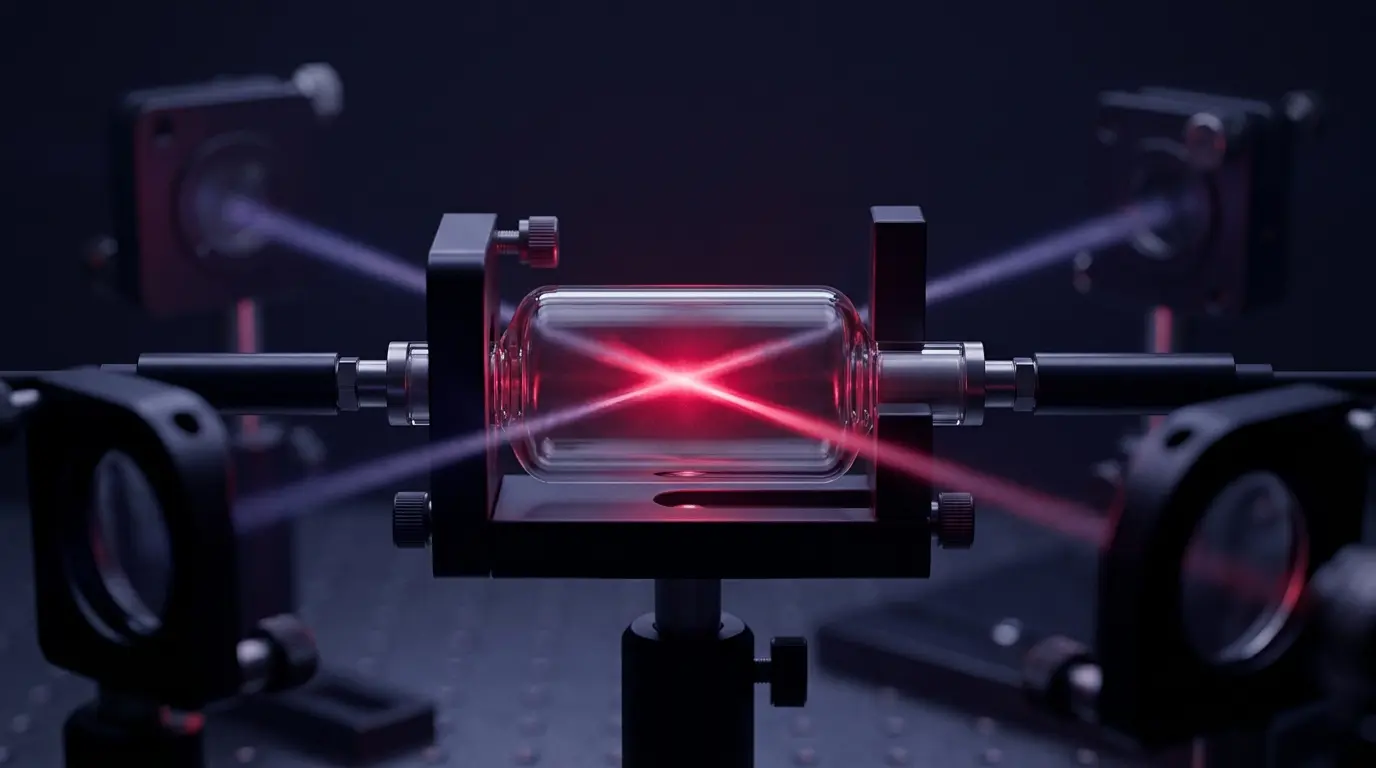
Quantum memories are a critical component for optical quantum information processing, allowing the synchronization of non-deterministic events. In this role quantum memories have been proposed for applications such as quantum repeaters, circuit-based linear optics quantum computing and in cluster state generation for measurement-based quantum computing. Recent work has suggested that integrating memories into quantum computers may reduce physical qubit requirements for fault-tolerant operation by a factor of 100.
The work focuses on optimizing key performance metrics, memory efficiency, fidelity, data storage capacity and storage time, to enable more complex quantum networks. These networks could benefit from multi-tasking components functioning as small linear optics quantum computers, essentially routing information within the system. Researchers believe widespread adoption of quantum memories hinges on achieving wavelength compatibility with existing optical technology and the ability to perform multiple operations simultaneously.
Telecom-Band Spin-State Memory for Quantum Information
A four-level RASE protocol now allows quantum memories to function as both a quantum light source and a quantum memory component, potentially streamlining quantum networks and photonic quantum processors. Improvements to laser frequency stability have directly addressed a limitation of previous designs; background absorption at the memory frequency, which previously restricted efficiency to 22%, has been mitigated through enhanced control of population during spectral preparation.
Quantum Memories in LOQC and Repeater Networks
Quantum memories can extend functionality beyond simple storage, potentially acting as routing elements within quantum networks. These components could perform tasks like mode switching, mode mixing, and entanglement generation, consolidating operations currently distributed across multiple discrete devices and minimizing signal loss. The integration of these capabilities is already being explored in designs for quantum repeaters, combining entanglement generation with storage to improve efficiency. The potential for quantum memories extends to photonic quantum processors, offering a path to reduce complexity and increase information retention during calculations.
Global-scale quantum repeater networks, for example, demand efficiencies exceeding 90%, near-unity fidelity and storage times of at least 100 milliseconds, alongside compatibility with existing fiber telecommunications bands. Meeting these requirements presents a significant challenge, as improvements in one area often come at the expense of another. Recent advances demonstrate progress toward these goals.
One research group achieved 94.6% storage efficiency using rubidium gas ensembles, a result comparable to the performance of delay lines used in commercial LOQC systems. However, these existing systems lack solid-state functionality and telecom compatibility, limiting their storage time and mode capacity. -based crystals offer a promising alternative, possessing an optical transition within the telecom C-band, where photonic components experience minimal loss. The data supporting these findings are available on the ANU data commons.
Performance Metrics for Quantum Memory Applications
Achieving efficiencies exceeding 90% is critical for practical quantum repeater networks, and recent work demonstrates storage efficiency up to 81% in erbium-based quantum memory. They plan to detail the interaction of polarized light with these memories in a forthcoming publication, suggesting ongoing refinement of the system. The demonstrated performance is comparable to, or exceeds, results from other recent quantum memory demonstrations, and the system’s combination of a source and memory simplifies the infrastructure needed for quantum networking tests.
Erbium Crystal Properties Enabling Long Coherence
Erbium crystals exhibit optical transitions with a 150 MHz linewidth, a characteristic enabling extended coherence times when paired with hyperfine splittings ranging from 790 to 1000 MHz. This combination, alongside a 180-second hyperfine lifetime in high magnetic fields, allows for precise spectral preparation of the ensemble into a pure quantum state, a critical step for reliable information storage. To model the storage process accurately, parameters like background absorption and rephasing efficiency were bounded between 0 and 3 dB during data fitting, prioritizing the low-to-mid gain regime where the model remains reliable.
Spectral Preparation of Er:YAG for High Bandwidth
This control stems from the material’s narrow optical inhomogeneous linewidths, 150 MHz, coupled with a long hyperfine lifetime of 180 seconds when subjected to high magnetic fields. These characteristics allow for operation across spectro-temporal degrees of freedom without sacrificing long-term coherence, a trade-off common in other quantum memory materials.
The benefits of this approach extend beyond simply increasing storage time; the large, resolved hyperfine structure within a high magnetic field provides enhanced spectral isolation of quantum memory features. This isolation minimizes loss due to background absorption, a critical factor for efficient quantum information storage and retrieval.
4-Level RASE Protocol for Entangled Light Storage
This refined control is central to the 4-level RASE protocol, a spin-state quantum memory technique that generates two entangled, time-separated optical states, with the second state stored and recalled from an ensemble. The protocol’s ability to create entangled light states positions it to potentially consolidate both quantum light source and quantum memory components within a quantum network or linear optics quantum computer.
The 4-level RASE protocol begins with amplified spontaneous emission, or ASE, generated from an inverted ensemble, entangling this photonic state with the atomic state of erbium ions. This atomic state is then stored on hyperfine levels using a π-pulse and recalled after a programmable delay with a second π-pulse, resulting in rephased amplified spontaneous emission, RASE, time-symmetric with the original ASE.
While earlier 2-level RASE protocols suffered from increased noise, this 4-level version benefits from spectrally resolved control pulses, separating them from the ASE and RASE fields, and allows for hyperfine storage. Initial storage time was limited to due to hyperfine transition inhomogeneity, but researchers extended this to 1.3 seconds by employing hyperfine rephasing pulses. Experiments revealed that the ensemble emits both RASE and an echo of the probe during operation. However, RASE alone is not a read-write quantum memory due to its lack of input and the gain arising from inversion.
Despite this, the 4-level RASE protocol can be adapted into the noiseless photon echo, or NLPE, protocol, a read-write memory, with only minor adjustments to the pulse sequence. Fitting data from a series of experiments, the team determined a spin-state storage time. Further investigations focused on characterizing the gain on the ASE transition, rephasing efficiency and the effect of delay times. The team bounded polarization mode mixing at 1.2%, indicating minimal signal degradation during storage, and observed no evidence of temporal mode mixing, a critical factor for maintaining data integrity.
Magnetic Field and Cryogenic Control of Er Decoherence
Maintaining coherence within erbium crystals requires precise control of the magnetic environment and temperature, as demonstrated by the team’s use of a 6 Tesla magnetic field and cryogenic cooling to 1.5 Kelvin. This combination actively suppresses electron spin flips, a primary source of decoherence and shortened hyperfine lifetimes within the erbium crystal, enabling extended storage times for quantum information. The crystal itself, grown by Scientific Materials, possessed 92% isotopic purity and dimensions specifically cut along its optical extinction axes, optimizing it for these experiments.
👉 More information
🗞 High-Performance Spin-State Memory for Telecom Quantum Information Applications
✍️ James Stuart, Kieran Smith, Morgan Hedges, Rose Ahlefeldt and Matthew Sellars
🧠 DOI: http://link.aps.org/doi/10.1103/bgbx-ph24



See today’s quantum computing news on Quantum Zeitgeist for the latest breakthroughs in qubits, hardware, algorithms, and industry deals.