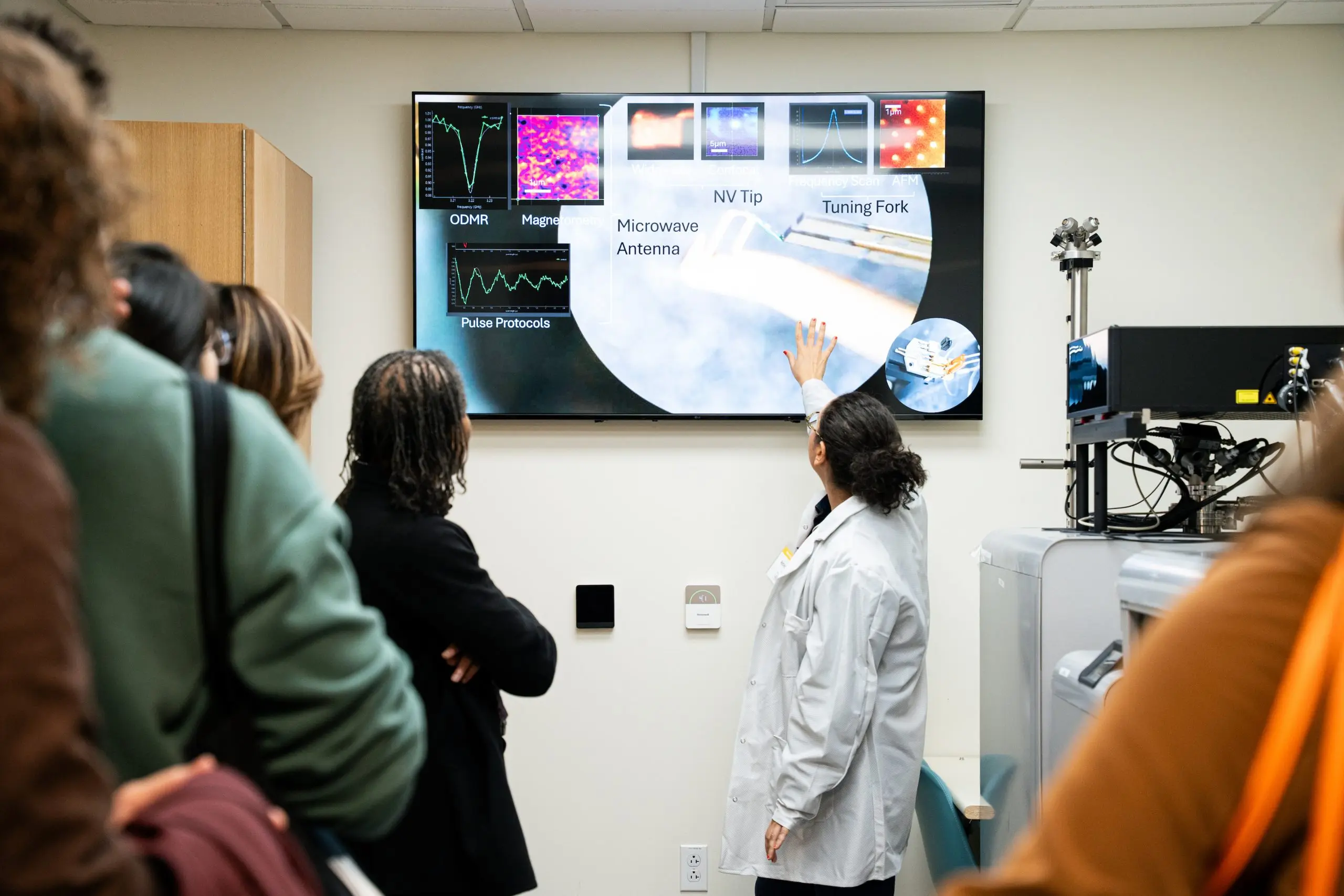
Bryn Mawr College secured the first commissioned commercial scanning nitrogen-vacancy magnetometer (SNVM) in the United States with $1.5 million in National Science Foundation funding. The instrument operates from 1.8 Kelvin to room temperature while applying a vector magnetic field of up to one tesla in any direction and nine teslas in the vertical direction.
Professor of Physics May Cheng explains, “Although these atomic-scale magnetic tornadoes are far too small to see with the naked eye, they may hold the key to future advances in quantum information storage,” as her team prepares to image and control these structures for potential computing applications.
SNVM Microscopy Enables High-Resolution Quantum Material Imaging
The new scanning nitrogen-vacancy magnetometer (SNVM) at Bryn Mawr College achieves tens of nanometer resolution by using an atom-sized quantum defect, known as an NV center, embedded within the tip of a small diamond. This capability allows researchers to map magnetic fields at an extremely fine scale, offering a significant improvement over existing techniques for characterizing quantum materials.
Associate Professor Don Fahey explains that the SNVM’s design focuses on precision, achieving this level of detail through the unique properties of the diamond NV center. The instrument’s ability to resolve features at this scale helps researchers understand the complex magnetic interactions within these materials.
Researchers can now investigate how these materials behave under conditions previously inaccessible with conventional microscopy techniques, potentially revealing new phases and functionalities. The SNVM’s versatility expands the possibilities for materials discovery and characterization, enabling a more comprehensive understanding of their quantum behavior. Complementing the SNVM is a quantum diamond microscope (QDM) that generates widefield magnetic images, though with a coarser resolution.
The QDM employs over a trillion NV centers spread across a millimeter-sized diamond to capture an entire image at once, but its resolution is limited to the wavelength of light, approximately one hundred times less precise than the SNVM. This difference in resolution allows for a tiered approach to materials analysis. The QDM can quickly identify areas of interest, which can then be examined in greater detail using the SNVM.
For more than a decade, researchers have built and used these microscopes in specialized laboratories, but the increased accessibility will undoubtedly foster innovation and collaboration. “Major scientific endeavors truly take a village, and Bryn Mawr’s commitment to research and student opportunities helped turn our Center’s vision into reality,” a representative stated.
Beyond quantum materials, the QDM is also being used to study the magnetic properties of rocks, offering insights into the formation of mountain ranges and the history of Earth’s magnetic field. Traditionally, magnetic measurements of rocks provide an overall picture, obscuring the variations within individual mineral grains. Magnetic microscopy allows researchers to examine these grains more closely, revealing their magnetic properties and orientations, which can preserve signatures of the Earth’s magnetic field from millions of years ago.
Although these atomic-scale magnetic tornadoes are far too small to see with the naked eye, they may hold the key to future advances in quantum information storage
Professor of Physics May Cheng
Quantum Diamond Microscopy Advances Rock Magnetism & Education
The recent installation of a scanning nitrogen-vacancy microscope at Bryn Mawr College, funded by a $1.5 million National Science Foundation grant, is expected to reshape the study of quantum materials. Researchers can now investigate variations within samples at a new scale, potentially revealing new insights into the underlying physics of these materials. Complementing the new scanning NV microscope is a quantum diamond microscope, enabling a tiered approach to materials analysis.
Researchers can rapidly identify areas of interest within a sample using the widefield imaging capabilities of the quantum diamond microscope before focusing on those areas with the higher resolution of the scanning NV microscope. Science Instrument Specialist Rebecca Fishman explains the new NV microscope at the lab’s opening. This combination of instruments also presents a significant educational opportunity, allowing students to engage with quantum sensing technology.
The new microscope will allow researchers to observe these tiny magnetic structures and learn how to control them. The commercial availability of these microscopes, after more than a decade of development within specialized laboratories, is accelerating research across multiple disciplines. The establishment of Bryn Mawr’s Quantum Materials, Sensing and Education Center as a hub of quantum information science research took a big step forward recently with the installation of a scanning NV microscope and the official opening of two new quantum sensing laboratories.
Source: https://www.brynmawr.edu/news/nsf-funded-15m-nv-microscope-new-labs-expand-bryn-mawrs-quantum-center


See today’s quantum computing news on Quantum Zeitgeist for the latest breakthroughs in qubits, hardware, algorithms, and industry deals.