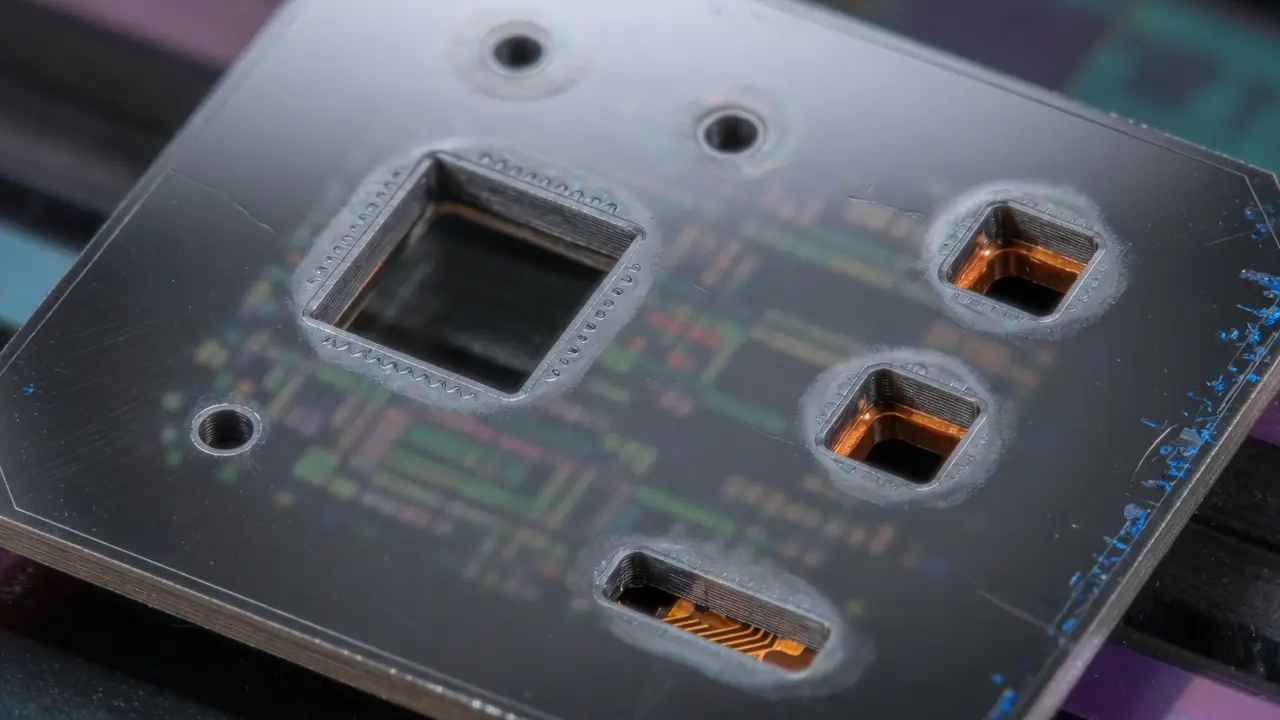
Researchers of China, Lund University, and Fudan University have created a single programmable photonic circuit capable of performing any quantum measurement. This integrated device overcomes limitations of existing quantum processors by enabling arbitrary measurements within a scalable framework, realizing a universal four-dimensional quantum measurement device. The team benchmarked the processor by performing measurement tomography on 100 randomly selected measurements, achieving an average fidelity of 97.7 percent. This work establishes a fully programmable quantum measurement processor, providing a key component for advancing photonic quantum information processing.
Photonic Circuit Enables Universal Quantum Measurements
A single programmable photonic circuit for universal quantum measurements. Programmable photonic quantum processors face a critical challenge. Despite significant advances in quantum state preparation and manipulation, measurements remain limited to projective techniques. Here, the researchers demonstrate a programmable measurement processor that overcomes this limitation by enabling arbitrary quantum measurements within a scalable circuit framework. Their large-scale integrated photonic architecture achieves precise coherent control of ancillary quantum systems, realizing a universal four-dimensional quantum measurement device.
This integrated system, detailed in recent work, moves beyond the constraints of traditional “projective” measurements, which are limited to observing a quantum system in a pre-defined basis. Instead, the circuit enables arbitrary quantum measurements within a scalable framework, offering a significant step toward more versatile quantum processors. The core of this advance lies in the precise control achieved over ancillary quantum systems within the photonic architecture, integrating over 700 components including 96 thermo-optic phase shifters.
These shifters provide the programmability necessary to implement any four-dimensional quantum measurement on path-encoded states, a feat previously requiring multiple specialized devices. 7 percent. This level of precision is critical for ensuring the reliability of quantum computations and communications. The design of the circuit relies on cascading modules, with the number of modules scaling with the dimensionality of the measurement. For a four-dimensional system, the architecture uses cascaded modules, allowing for the decomposition of any measurement into a series of simpler operations.
The researchers adapted this approach, previously demonstrated in bulk optics, to an integrated photonic platform, enabling individual control of the system-ancilla interaction and thus a programmable measurement device. Beyond simply achieving high fidelity, the processor demonstrably outperforms the limits of projective measurements in three key quantum information tasks.
State estimation benefited from a 10.6 percent increase in fidelity, while randomness generation yielded 37 percent more randomness, highlighting the operational quality of the new device. These improvements are not incremental; they represent a fundamental shift in the capabilities of quantum measurement. The team’s work also addresses the challenge of generating certifiable randomness, an important component for secure communication protocols.
By employing entropy accumulation theorems and finite-size effects treatment, they achieved a lower bound of 2.979 bits of randomness per round, significantly surpassing the limits achievable with projective measurements. The implications of this technology extend beyond the specific tasks demonstrated in the study.
The ability to perform arbitrary measurements is essential for implementing complex quantum algorithms and realizing the full potential of photonic quantum computers. “Any d-dimensional quantum measurement can be decomposed into extremal measurements that have at most rank-1 operators,” the researchers write, explaining the scalability of their approach. The circuit’s design also allows for optimization in detector placement, relocating detectors to simplify the system without sacrificing performance.
In the final d-1 modules, operators are configured to ensure that detectors for a given measurement can be directly positioned at a specific mode, streamlining the architecture and potentially reducing signal loss. This attention to detail emphasises the team’s commitment to creating a practical and efficient quantum measurement device. The realization of this programmable photonic circuit represents a step toward building more powerful and versatile quantum systems.
Four-Dimensional Quantum Measurement Device Architecture
This large-scale integration represents a shift from discrete optical elements to a single, programmable platform for manipulating quantum information, streamlining the measurement process and reducing experimental overhead. The architecture’s design prioritizes not only functionality but also practical considerations, allowing for optimization in detector placement to simplify the optical layout and minimize signal loss. The team’s implementation of this concept within an integrated photonic framework offers a route toward scalable quantum measurement systems, a key step for realizing more complex quantum algorithms.
Specifically, the device achieved 23 times lower error in state discrimination, 10. The researchers note that constructing a universal d-dimensional measurement device requires roughly two-dimensional unitary operators, which demonstrates the efficiency of their design.
The successful integration of a state preparation circuit alongside the measurement device on a single chip further demonstrates the potential for creating fully integrated quantum processing units. This co-integration simplifies experimental setups and reduces the need for external control systems.
Measurement Tomography Benchmarks 97.7% Fidelity
The newly demonstrated processor achieved an average fidelity of 97.7% when benchmarked through the reconstruction of 100 distinct four-dimensional quantum measurements selected at random, a figure indicating high precision in its operation. This level of accuracy surpasses the capabilities of theoretical limits imposed on projective measurements, establishing a new standard for quantum measurement devices.
These gains were realized through optimization of on-chip phase errors for each specific measurement, a calibration procedure that further enhances fidelity and consistency. The team’s results, detailed in the paper, demonstrate that the implemented measurement device outperforms projective measurements across these three key areas, showing its high operational quality and potential for advanced quantum information processing.
Analysis of the reconstructed measurements revealed that even with a maximum of 16 outcomes, the fidelity remained high at an average of 97.0%, indicating the scalability of the approach. The fidelity of the device was evaluated by mapping the experimental and ideal measurements to quantum states, a method previously described in published research. The resulting data confirms the processor’s ability to consistently achieve high-quality measurements across a range of conditions, solidifying its position as a key component in the advancement of photonic quantum information processing.
Performance Surpasses Projective Measurements in Key Tasks
The system’s architecture actively controls ancillary quantum systems, a critical element for synthesizing measurement outcomes beyond those achievable with traditional methods. The system generates 37% more randomness in secure randomness generation protocols, enhancing the reliability of cryptographic applications. These improvements are not incremental refinements but represent a qualitative shift in performance, exceeding theoretical limits previously imposed by projective measurements.
The system’s ability to implement any quantum measurement within a scalable circuit framework represents a transition from static, purpose-built measurement devices to a dynamic, software-defined resource. The team’s work also addresses a critical bottleneck in quantum information processing: the limited programmability of measurement devices. Previously, achieving full programmability required multiple specialized devices, each tailored to a specific measurement type. This new processor consolidates those functionalities onto a single platform, streamlining the process and reducing complexity.
The system’s performance in randomness generation is particularly noteworthy, achieving a lower bound of 2. This enhanced randomness is secured through a rigorous finite-size effects treatment and the application of the entropy accumulation theorem, ensuring its reliability in cryptographic applications.
The researchers further detail how their system allows for the rapid development of advanced measurement strategies, including self-learning and adaptive quantum measurement protocols. This adaptability is important for optimizing performance and tailoring measurements to specific tasks, opening up new avenues for quantum algorithm design. The ability to implement high-quality quantum measurements on a single device, based on scalable integrated photonic technology, demonstrates a pathway toward realizing more complex and powerful quantum information processing systems.
By enabling general quantum measurements with high quality, the processor facilitates more sophisticated quantum algorithms and applications. The researchers emphasize that their approach is an incremental improvement and a fundamental shift in how quantum measurements are performed, moving from static devices to a dynamic, software-defined resource.
This transition is essential for building a full-stack integrated photonic quantum processor, a key goal in the pursuit of practical quantum computing. The team’s findings, detailed in their publication, demonstrate a clear path toward realizing this vision, with ongoing research focused on exploring advanced measurement strategies and further optimizing the performance of the system.
👉 More information
🗞 Single programmable photonic circuit for universal quantum measurements
✍️ Wen-Zhe Yan et al.
🧠 DOI: http://link.aps.org/doi/10.1103/8×23-v9n2



See today’s quantum computing news on Quantum Zeitgeist for the latest breakthroughs in qubits, hardware, algorithms, and industry deals.