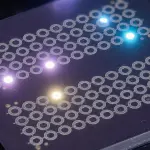
Researchers at the University of California, Los Angeles, have developed a new spectroscopy technique to map the energy level structure of double quantum dots, addressing a longstanding challenge in understanding these potential building blocks for quantum computing. The work directly observes the shift from atom-like energy levels in isolated quantum dots to molecular-like bonding states as the dots are brought closer together, demonstrating a clear visual link between these quantum behaviors.
This method allows for the characterization of energy levels as a function of level detuning, interdot tunnel coupling and magnetic field, and may extend to other quantum systems, such as strong spin-orbit materials. The team’s findings offer new access to the detuning dependent singlet-triplet splitting in the two-electron regime.
Silicon Quantum Dot Energy Levels via Spectroscopy
Researchers directly observed a shift in energy levels as the quantum dots moved from acting as individual entities to forming bonding and anti-bonding states with increased interaction, a visual confirmation of fundamental quantum mechanics at the nanoscale. This observation provides a direct link between the behavior of single particles and the more complex interactions seen in molecules. The method, detailed in recent work, maps the energy level structure of a double quantum dot while varying level detuning, interdot tunnel coupling, and applied magnetic field.
Early methods of probing quantum dot excited states required strong connections to external circuits, potentially disrupting the delicate quantum states needed for qubit operation; this new approach minimizes that interference by nearly isolating the quantum dot from its surroundings. Pulsed-gate spectroscopy, while useful for single quantum dots, lacked the ability to examine these interactions in a coupled system until now.
The spectroscopy technique provides a comprehensive view of the double quantum dot energy levels, extending beyond single-electron studies to include the effects of the Pauli exclusion principle in the two-electron regime. Measurements reveal how energy levels change as a function of detuning, a parameter that controls the relative energy of electrons in each dot. This detailed understanding is important for achieving high fidelity quantum control of spin qubits, which rely on precise manipulation of these energy levels.
The technique’s ability to map energy levels across a broad parameter space addresses a long-standing challenge in quantum dot research. Previous approaches, such as microwave spectroscopy, were limited to narrow ranges near energy level crossings, hindering a complete understanding of the system.
By visualizing the energy level spectrum as a function of multiple parameters, researchers gain access to information previously inaccessible. The team’s work demonstrates the technique by examining the one- and two-electron regimes. But the underlying principles may extend to other materials, including those with strong spin-orbit interactions or those coupled to superconductors.
At zero detuning, the ground states of the left and right quantum dots are degenerate, a condition that allows for the observation of the transition from isolated to coupled behavior. The resulting spectra provide a detailed picture of the energy landscape, essential for optimizing the performance of silicon-based spin qubits.
Transition from Atomic to Molecular States in DQDs
A new spectroscopy technique now makes it possible to visualize the shift from isolated quantum dot behavior to molecular-like states, revealing how energy levels change as interdot tunnel coupling increases. Researchers achieved this by modulating the electrochemical potential of a double quantum dot (DQD) using a repeating square pulse, allowing electrons to tunnel into and out of the structure. The technique relies on precise control of level detuning, defined as the difference in electrochemical potential between the left and right quantum dots, and the interdot tunnel coupling, which governs electron exchange.
The team’s approach allows for the mapping of energy level spectra in both one- and two-electron regimes, providing a comprehensive view of the DQD’s energy landscape. By tuning the total electrochemical potential through a virtualized gate, they were able to control the conditions within the DQD, shifting between localized atomic states and delocalized molecular states.
During the high phase of the applied pulse, electrons tunnel into the ground state, dependent on whether the system is in the atomic regime, where |ε| is much greater than the interdot tunnel coupling, or the molecular regime, where |ε| is much less than the interdot tunnel coupling. This precise control is critical for observing the subtle changes in energy levels as the system transitions between these states.
Further analysis revealed details of excited state behavior, specifically the energy gap between singlet and triplet states in the two-electron regime. Measurements near the (1,1)-(0,2) interdot transition showed that as level detuning increases, the (1,1) states move up in energy and cross the singlet and triplet states. The energy gap between these singlet and triplet states, denoted as , is an important parameter for controlling spin qubits, and this technique provides a direct method for its measurement.
The team demonstrated this by acquiring a high-resolution spectrum at zero magnetic field, referencing the detuning axis to the (2,0)-(1,1) interdot charge transition. This spectroscopy method extends beyond simply characterizing the energy level structure; it provides a means to directly extract various energy gaps in more complex systems. The researchers suggest the technique could be applied to strong spin-orbit materials or quantum dots with proximity effects.
Resolving Zeeman Splitting of Valley States
Silicon quantum dots offer multiple avenues for building spin qubits by exploiting orbital, spin and valley-based quantum properties, but fully characterizing their energy levels across a range of conditions has proven difficult. Recent work demonstrates the ability to resolve Zeeman splitting within both ground and excited valley states when a magnetic field is applied, an important step toward controlling these qubits with greater precision.
The observed Zeeman splitting, a consequence of the interaction between electron spin and the magnetic field, was quantified by measuring spectra at 1 Tesla, revealing an additional energy level arising from the splitting of valley states in the lowest orbital. Fitting the observed splitting yielded an electronic g-factor of 1.98 ± 0.12, a value consistent with theoretical predictions for free electrons, and validating the measurement technique.
This broader applicability allows for the direct extraction of various energy gaps, potentially accelerating the development of more complex quantum devices. The researchers demonstrated that as interdot tunnel coupling increases, localized orbitals hybridize, forming bonding and anti-bonding states indicated by avoided crossings with a splitting of . This transition from atom-like to molecular-like behavior was directly observed, providing a visual link between isolated particle behavior and the emergence of collective quantum phenomena.
Singlet-Triplet Splitting in the Two-Electron Regime
The ability to resolve singlet-triplet splitting in silicon quantum dots offers a new benchmark for understanding electron behavior within these structures, with measured values of 69 ± 4 microelectronvolts observed. The research team extracted a comprehensive set of energy gaps, summarizing values for orbital and valley splittings across various charge configurations, including of 89 ± 5 microelectronvolts for the (0,1) and (1,0) states and 64 ± 4 microelectronvolts for the (1,1) state. These detailed measurements provide a more complete understanding of the quantum dot’s energy landscape than previously accessible.
Pulsed-Gate Spectroscopy Method for DQD Analysis
Pulsed-gate spectroscopy overcomes limitations of earlier techniques by probing nearly isolated quantum dots, a critical feature for maintaining qubit coherence where previous transport spectroscopy demanded strong reservoir coupling. This method relies on detecting the charge associated with tunneling electrons, allowing for examination of energy levels without the decoherence risks inherent in strong coupling to external circuits. The technique expands upon recent approaches like microwave spectroscopy and detuning axis pulsed spectroscopy, which were confined to narrow parameter ranges near energy level crossings, by providing a broader view of the quantum dot’s energy landscape.
Interdot detuning, similarly controlled by a virtual gate, is defined as ε = , allowing for precise manipulation of the DQD’s energy levels. Initial experiments focused on the one-electron regime at zero magnetic field to map orbital and valley degrees of freedom, establishing a baseline for understanding the system’s behavior before introducing more complex conditions.
Prior to applying a Δ pulse, the DQD is initialized in either the (1,0) or (0,1) charge state, ensuring a consistent starting point for measurements. Spectroscopic analysis in the two-electron regime revealed ground and excited states of the (2,0), (1,1), and (0,2) charge configurations, with the detuning axis ε measured relative to the lower (2,0)/(1,1) triple point. The team employed pulse durations of τ = 0.3, 1 µs, while maintaining a tunneling timescale of ~ 50 µs, optimizing the measurement for sensitivity and accuracy.
A Δ pulse can inject an electron into the right QD when the system begins in the (1,0) configuration, revealing the valley and orbital excited states of that dot. At larger positive ε, the DQD resides in the (0,1) configuration. The spectrum shows the ground state in the (1,1) charge configuration, where two electrons occupy the lower-valley states of each dot.
The researchers observed that at negative ε, the (2,0) configuration hosts a singlet ground state and a triplet excited state, separated by . The spectroscopy of this (2,0) excited state is achieved via electron injection into the DQD prepared in the (1,0) charge configuration, demonstrating the technique’s versatility in probing different energy levels and configurations.
Extending Spectroscopy to Hybrid Quantum Systems
This approach relies on tunneling and sensitive charge detection, suggesting potential application to other systems, including those designed to host Majorana zero modes. The work’s potential extends beyond silicon quantum dots, offering a pathway to directly extract energy gaps in a broader class of materials such as strong spin-orbit materials or proximitized quantum dots. The researchers envision broad applicability of this measurement approach to characterize the energy level structure of quantum dots and provide insights into less mature materials systems.


See today’s quantum computing news on Quantum Zeitgeist for the latest breakthroughs in qubits, hardware, algorithms, and industry deals.