Organization with neural-network prediction was investigated in a two-site electron, phonon model. A comparison of piecewise-constant, B-spline, feed-forward, and recurrent control parameterizations optimised to increase accumulated electronic double occupation revealed that all methods increased double occupation when used on the dissipation-free model at zero Hubbard interaction; the B-spline raised the mean total double occupation by approximately 30%. Alongside control optimisation, a separate recurrent network learned to predict next-step double occupation and phonon observables from their preceding values and applied field. These results offer a computational proof of concept for shaping local electronic correlations.
B-Spline Control Yields Sharply Enhanced Electron Pairing via Lattice Vibration Manipulation
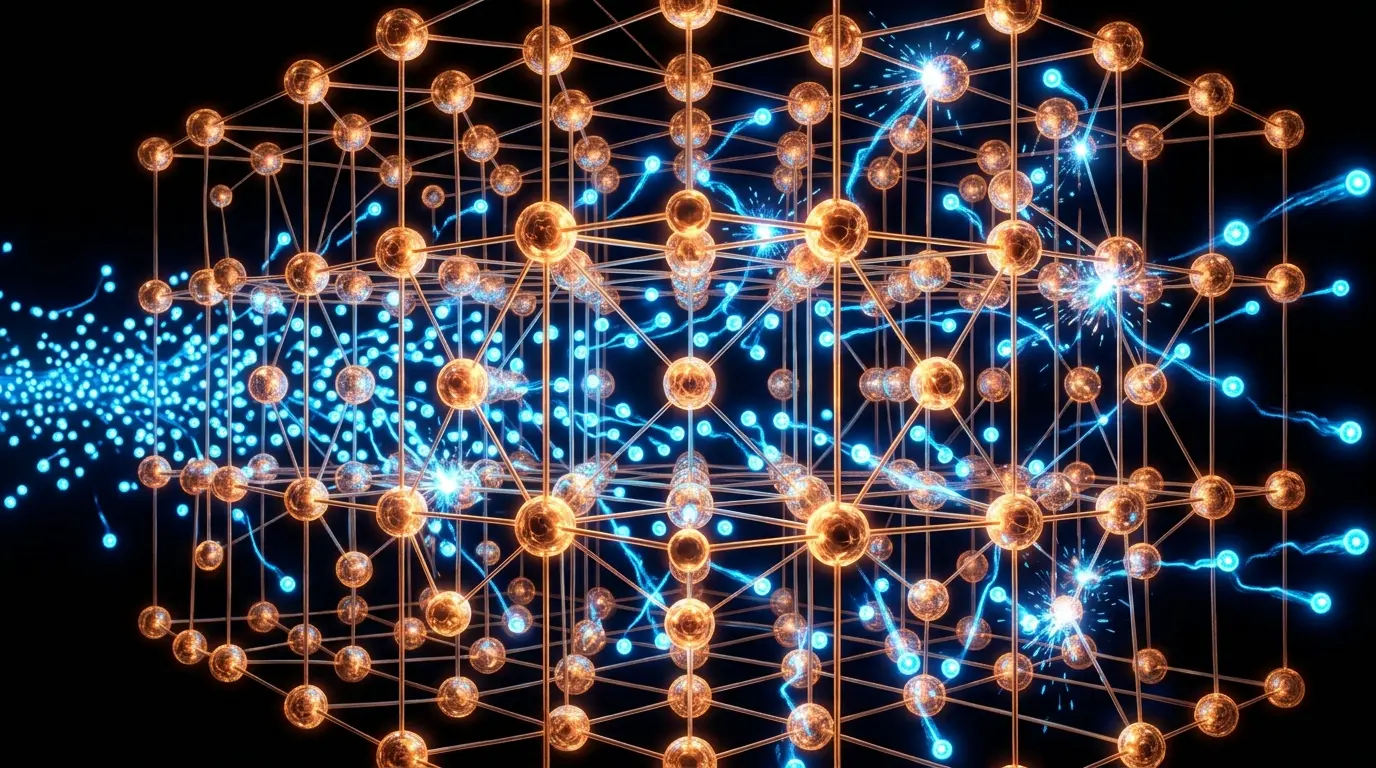
A 30% increase in mean total double electron occupation was achieved by the team at the Max Planck Institute for the Science of Light using B-spline methodology. Previously, gains of this magnitude were unattainable without either complex calculations or custom hardware. This enhancement demonstrates control over how electrons pair within materials through manipulation of lattice vibrations with precisely shaped light pulses, a feat previously requiring direct alteration of material characteristics such as temperature and pressure.
All tested methods, piecewise-constant fields, B-splines, feed-forward networks, and recurrent neural networks, increased electron double occupancy within their two-site model system. The researchers also achieved approximately a 30% increase via B-spline methodology and trained a separate recurrent network to predict future states. This predictor accurately forecast both phonon behaviour and levels of double occupancy based on previous values and applied driving fields. Pulse shaping sharply boosted time-averaged double occupation compared to standard monochromatic drives, confirmed by evaluating control beyond initial training parameters.
Machine learning designs vibrational control of electron behaviour in solids
This work provides computational proof-of-concept for controlling electronic behaviour through light-induced lattice vibrations, a promising route towards designing materials with tailored properties. However, the team acknowledges its reliance on an extremely simplified two-site model, raising an important question: can these techniques scale to realistically complex systems where electrons interact strongly and energy is not perfectly conserved. Despite this simplification, a deliberate choice to prove initial viability, valuable insight into controlling material’s electronic behaviour with light emerges; machine learning assists in designing complex ‘driving fields’, or tailored pulses of energy used to manipulate electrons within solids.
This research demonstrated control over electron pairing within a two-site model by manipulating lattice vibrations using precisely shaped light pulses, increasing accumulated electronic double occupation by approximately 30% with B-spline methodology. This means that researchers were able to influence how electrons behave inside materials through the application of specific vibrational patterns. Alongside optimizing these controls, they trained a recurrent neural network to predict future phonon and electron behavior based on applied driving fields.
👉 More information
🗞 Learning to control and predict light-driven electron-phonon dynamics
✍️ Matteo Puviani (Affiliation: Max Planck Institute for the Science of Light)
🧠 ArXiv: https://arxiv.org/abs/2611.16780


See today’s quantum computing news on Quantum Zeitgeist for the latest breakthroughs in qubits, hardware, algorithms, and industry deals.