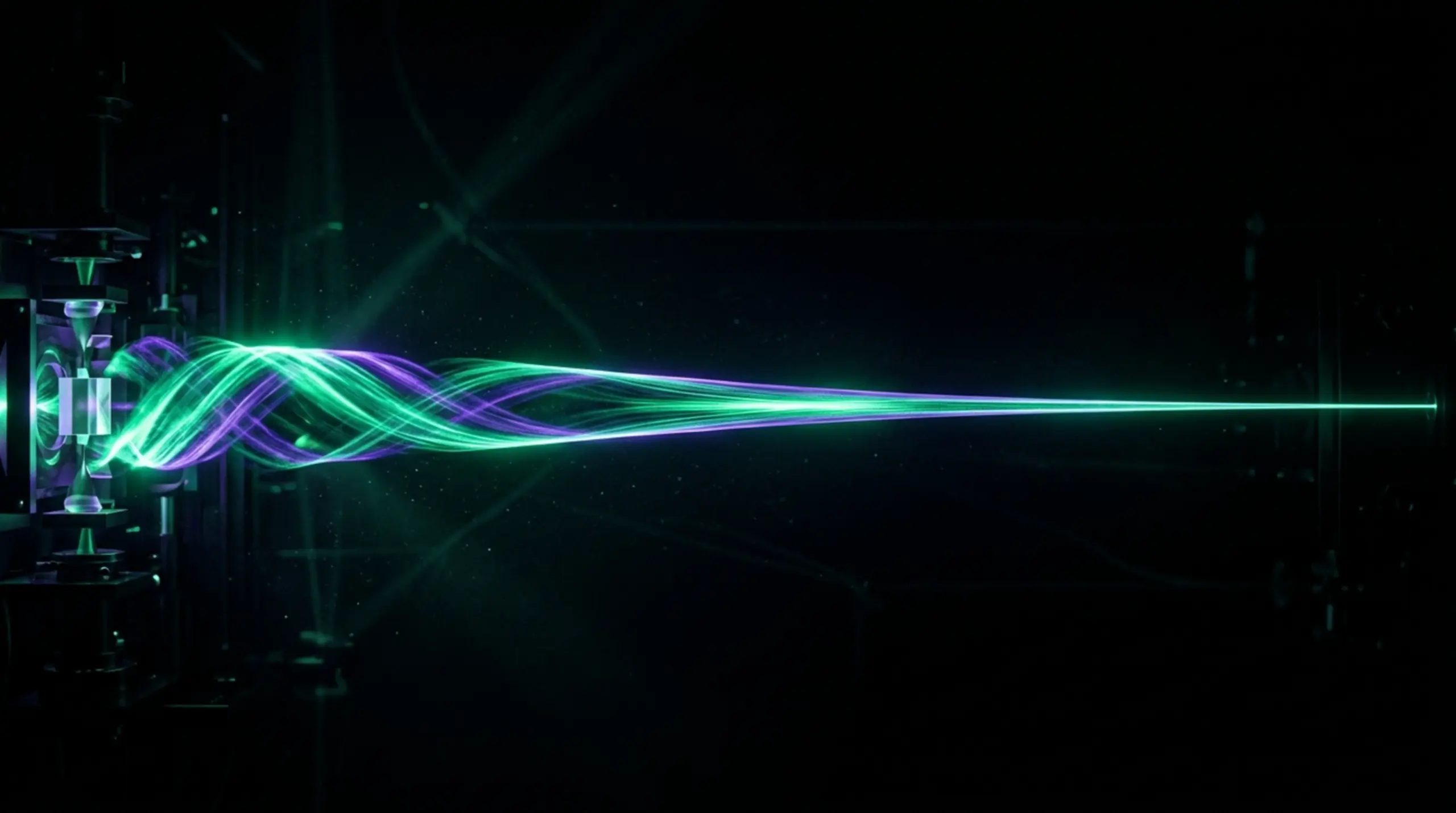
Physics defines the boundaries of information processing, while information processing shapes their understanding of physical reality, according to a new guide to higher-order quantum operations. The work details how short coherence times and thermal fluctuations in devices using trapped ions or superconducting systems present key obstacles to realizing practical quantum technologies. Researchers establish a framework for understanding both the static and dynamic properties of quantum features, coherence, entanglement and their transmission. This approach aims to unify the description of quantum information processing across space and time within a single formalism.
Physics Limits Information: The Fundamental Interplay
Higher-order quantum operations (HOQOs) provide a means of characterizing non-Markovian quantum dynamics, tools essential for modern quantum physics research and offering a distinct perspective from traditional approaches. This interplay is particularly important when considering the inherent fragility of quantum systems, which complicates the efficient and reliable encoding, processing, transmission, and reading of quantum information.
The researchers note that requiring this holds for all instances is a much stronger requirement than only demanding it for a fixed one. The framework’s ability to describe correlated quantum processes while respecting causality makes it fundamental to understanding temporal quantum processes and their applications in quantum information science.
Spatial vs. Temporal Quantum Properties & Their Challenges
Traditional quantum theory often treats space and time asymmetrically, a distinction that impacts how quantum systems are described and manipulated. While state preparations are generally deterministic, measurement outcomes are inherently probabilistic, creating a fundamental difference in how these processes are modeled. Averaging measurement outcomes across multiple parts of a quantum state accurately describes local statistics, but similar temporal averaging often fails due to the invasive nature of measurement itself.
This disparity presents challenges in fully characterizing and controlling quantum dynamics. Higher-order quantum operations (HOQOs) offer a solution through their operational approach to quantum theory.
Higher-Order Quantum Operations Defined & Their Role
Higher-order quantum operations, or HOQOs, redefine quantum processing by acting on quantum operations themselves, rather than solely on quantum states. This distinction is important for optimizing complex circuits. These operations transform existing operations into new ones, enabling a level of control beyond standard quantum gates. This approach positions operations as inputs, mirroring the role of initial states in conventional quantum information processing. The mathematical description of these HOQOs centers on the concept of a superchannel, a mapping that transforms preparation procedures into output states over time.
A superchannel remains linear in the preparation map, acting only on the system’s space, and represents the first non-trivial example of a HOQO, differing from standard quantum channels which map states to other states. Throughout this framework, input operations are visually distinguished, and can themselves be HOQOs, creating a recursive potential for complex transformations.
HOQOs as Linear Maps for Quantum Objects
By framing all quantum objects as linear maps, the research establishes a unified mathematical language for describing diverse elements like state preparations and measurements, placing them on equal footing within the hierarchy of higher-order quantum operations. This conceptualization extends beyond standard quantum theory, allowing for a natural generalization of analysis to HOQOs, which themselves are linear maps acting on expanded spaces. The work demonstrates that both quantum measurement and quantum dynamics can be expressed as linear maps operating on quantum states, solidifying this consistent representation.
HOQOs Enable Temporal Feed-Forward & Circuit Optimization
Higher-order quantum operations (HOQOs) are now used to improve error correction in quantum computers by enabling information to be fed forward in time, a critical step for addressing correlations in both space and time. “For quantum computing, the framework has proven valuable in circuit optimization,” the work states, indicating a direct impact on reducing the resources needed for quantum calculations. This ability to optimize circuits, coupled with the capacity to simulate complex dynamics, positions HOQOs as a powerful tool for advancing the field of quantum information processing.
HOQOs Model Multi-Round Quantum Communication Protocols
Higher-order quantum operations (HOQOs) provide a framework for analyzing transformations of quantum channels. This extends beyond simply optimizing circuits. The approach models multi-round games and protocols where shared correlations and communication are possible, with explicit applications in analyzing quantum computation complexity with indefinite causal structures. Quantum cryptography, computational complexity, and distributed quantum computation all benefit from this modeling capability.
The conceptual link between HOQOs and quantum channels with memory is particularly strong, mirroring the process tensor formalism used to study quantum non-Markovianity. Examples include local operations and classical communication (LOCC) channels in the resource theory of entanglement.
HOQOs Verify Spatiotemporal Causal Structures
Quantum circuits can be reshaped through pre- and post-processing, transforming operations into more desirable forms for applications ranging from secure communication to complex computation. Beyond these applications, operational procedures can now verify spatiotemporal structures, specifically the causal connections and ordering between laboratories separated by distance and time. An axiomatic approach to HOQOs defines them as valid transformations of quantum operations, offering flexibility beyond constructive methods that encode causal ordering based on underlying circuit spatiotemporal relations.
Quantifying Non-Markovianity & Causal Non-Separability with HOQOs
Higher-order quantum operations, or HOQOs, allow for unambiguous quantification of spatiotemporal resources like non-Markovianity and causal non-separability, extending the understanding of spatial correlations already well-established in quantum states. The ability to quantify these dynamic elements is important given that nearly all complex physical scenarios involve interplay between static and dynamic properties, as seen in areas from open quantum dynamics to quantum circuit architecture.
HOQOs: Unifying Diverse Quantum Research Fields
The recurring discovery of HOQOs across seemingly disconnected fields highlights their importance as a natural descriptor for quantum information processing in both space and time. While these operations often encode spatiotemporal structures of an envisaged scenario, as is the case for multitime quantum processes, they can also describe more general causally indefinite processes.
From this perspective, the framework of HOQOs is suitable for analyzing causality and foundational questions thereof in quantum theory. Within this framework, all quantum objects become operations that can be considered as linear maps. State preparations map probability distributions to quantum states, measurements transform states into outcome probabilities, and channels convert input states to output states.
👉 More information
🗞 A Guide to Higher-Order Quantum Operations
✍️ Philip Taranto, Simon Milz, Mio Murao, Marco Túlio Quintino and Kavan Modi
🧠 DOI: http://link.aps.org/doi/10.1103/92c4-g7qs
See today’s quantum computing news on Quantum Zeitgeist for the latest breakthroughs in qubits, hardware, algorithms, and industry deals.