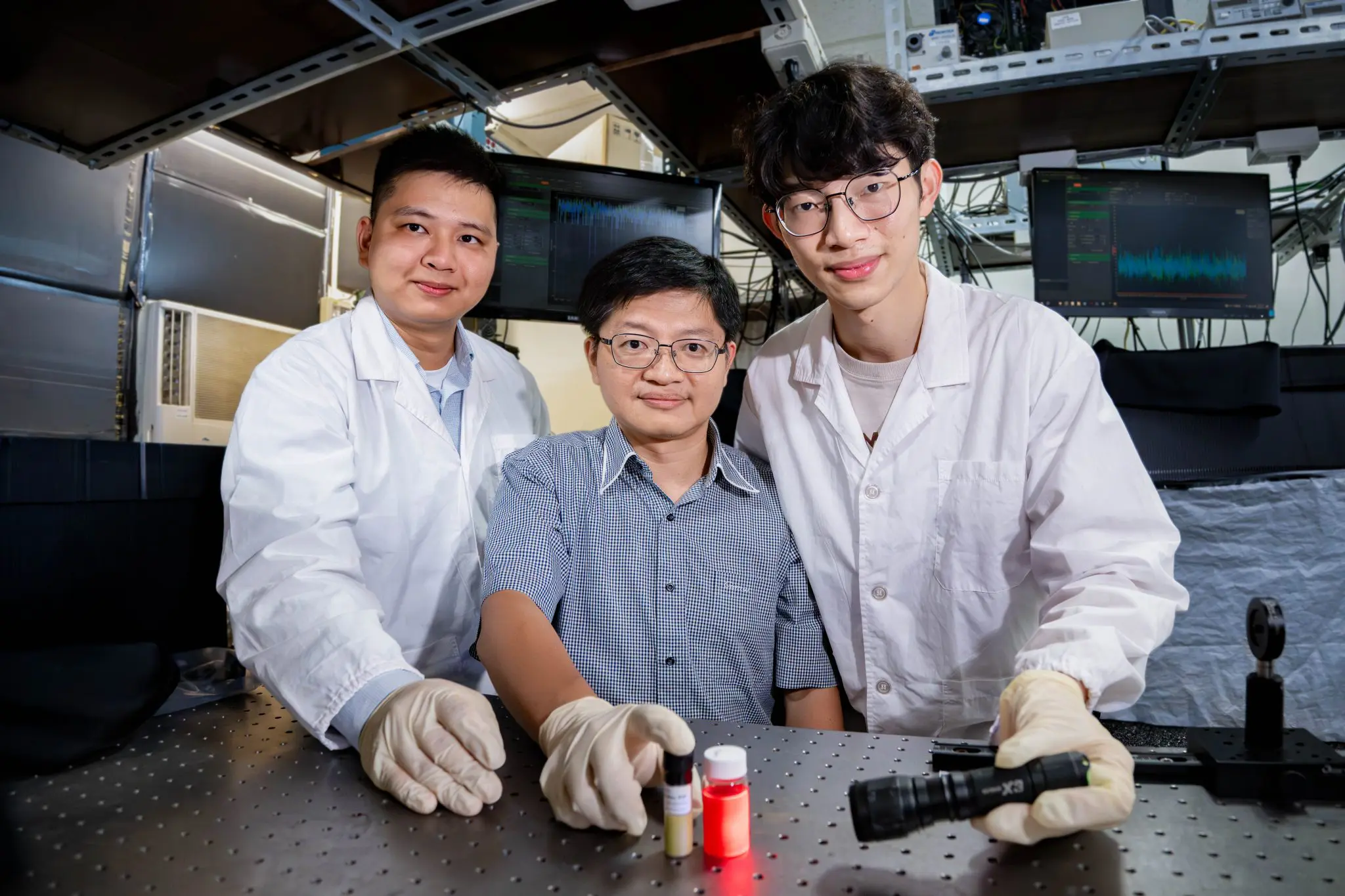
Researchers at National Tsing Hua University (NTHU) have achieved a new benchmark in quantum photonics, developing a single-photon source that emits over 2.3 billion photons per second. This device, detailed in a recent publication in Science Advances, combines ultrafast and stable light emission at room temperature, addressing a critical challenge for practical quantum communication and integrated photonic chips. The innovation centers on integrating 100 nanometer silver nanocubes with perovskite quantum dots to create a plasmonic nanocavity, overcoming material incompatibility issues that previously hindered performance. “The brightness of a single-photon source directly determines the rate at which quantum information can be transmitted,” explained Professor Hao-Wu Lin of the Science and Engineering department at NTHU, highlighting the potential for significantly accelerated quantum communication speeds.
A new approach to single-photon emission has yielded a device capable of emitting over 2.3 billion photons per second, establishing a new benchmark in brightness for potential quantum communication networks. This innovation addresses a critical need for brighter, faster, and more reliable single-photon sources, essential components for realizing practical quantum technologies. The core of the advancement lies in the creation of a nanocavity formed by 100 nanometer silver nanocubes and a silver film, separated by a mere 10 nanometers, approximately one ten-thousandth the diameter of a human hair. This structure facilitates strong light-matter interaction, dramatically enhancing the performance of the embedded perovskite quantum dots. A significant hurdle was ensuring the quantum dots’ survival within the polar solvents necessary for dispersing the silver nanocubes; conventional perovskite materials rapidly degrade under such conditions.
Doctoral student Tzu-Hao Liao, responsible for quantum dot synthesis, explained the team employed “specially designed zwitterionic ligands to encapsulate the quantum dots, effectively providing a protective molecular coating,” maintaining a remarkably high photoluminescence quantum yield of 95%. This careful encapsulation enabled the quantum dots to thrive within the plasmonic environment, resulting in a substantial boost in emission. Co-author Dr. Yung-Tang Chuang, who led the photophysical analysis, detailed how coupling the quantum dots to the nanocavity generated a strong Purcell effect, increasing the emission rate by a factor of 435 and reducing the emission lifetime to less than 12 picoseconds. The overall emission intensity improved by approximately 250 times compared to uncoupled quantum dots.
Professor Hao-Wu Lin noted that this rapid emission also eliminated a common problem: “The emission process becomes so fast that the quantum dots have little opportunity to enter non-emissive states,” effectively preventing the issue that plagues many single-photon sources. The device’s stable operation at room temperature further simplifies potential applications and reduces costs, suggesting wider adoption of this technology is possible.




See today’s quantum computing news on Quantum Zeitgeist for the latest breakthroughs in qubits, hardware, algorithms, and industry deals.