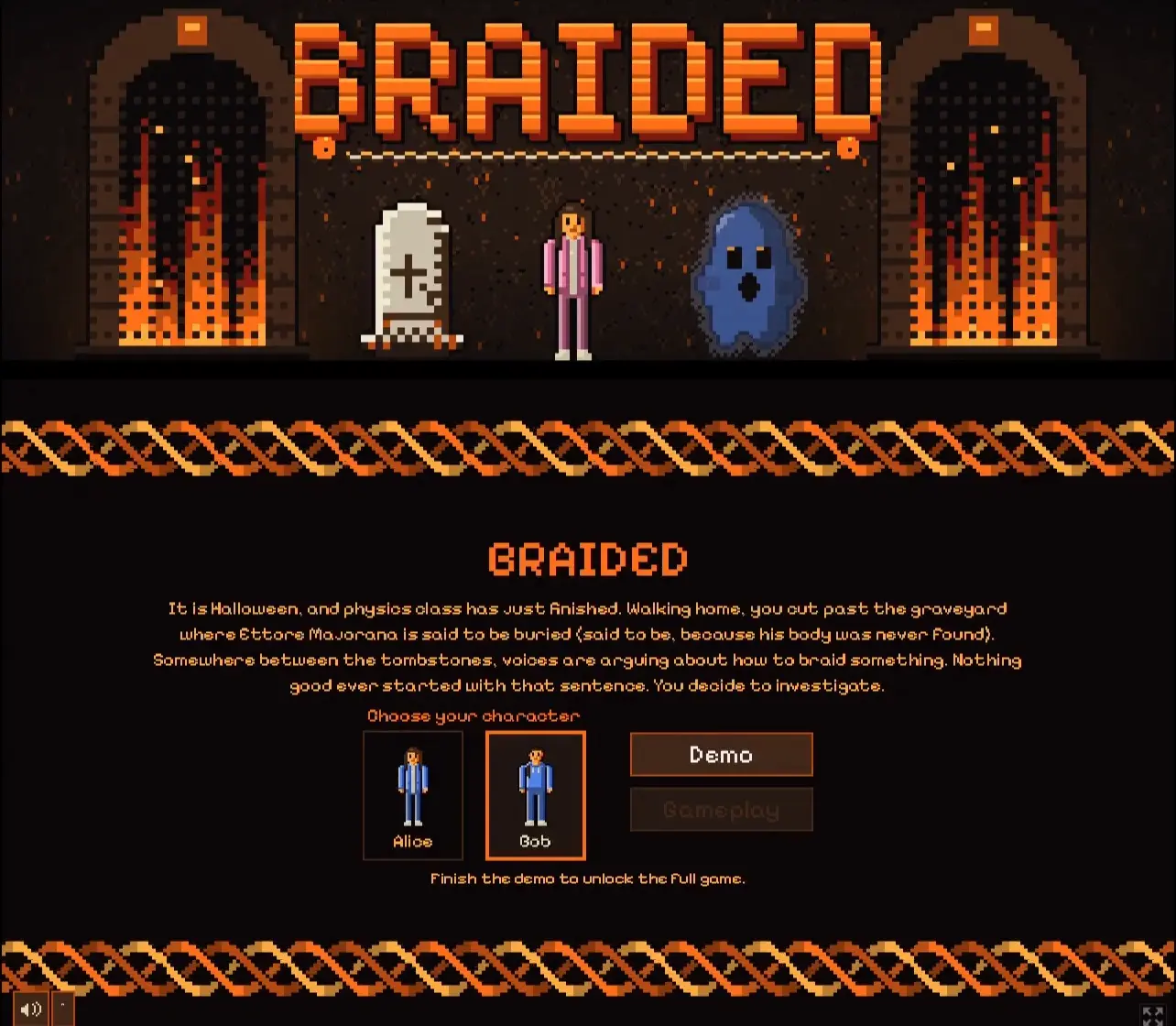
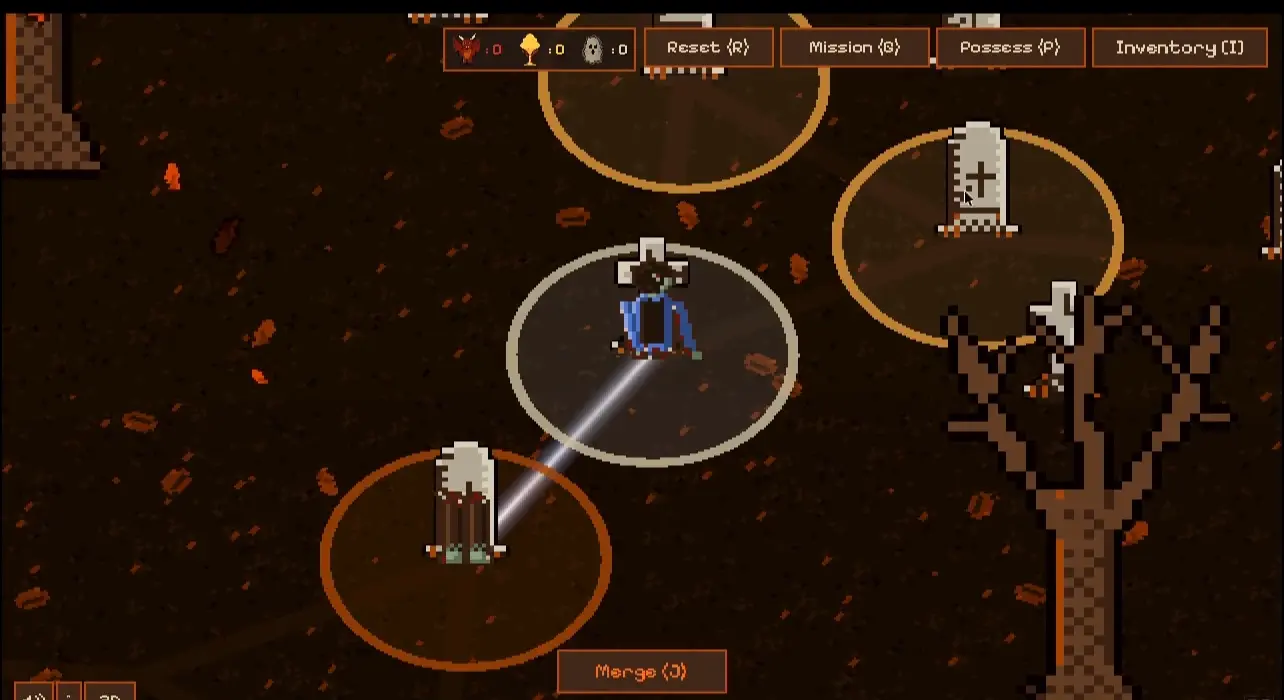
Moth Quantum is offering players a uniquely unsettling Halloween experience with its new demo, Braided, built on its Atlas platform. Unlike conventional games, Braided casts players as a zombie split into two halves, a top and a bottom, connected by a line that is both a visual and gameplay mechanic driven by quantum entanglement.
These two halves are specifically designated as “Majoranas,” named after Ettore Majorana, the physicist who first described these exotic quantum particles in 1937, and their fate hinges on a principle called braiding. The game unfolds in a cemetery said to be Majorana’s resting place, challenging players to merge their fractured selves by manipulating their paths through a quantum landscape where the outcome of a combination is written not in code, but in the history of their movements.
Majorana Particles Define “Braided’s” Unique Quantum Gameplay
Hinging on the behaviour of exotic particles predicted by theoretical physicist Ettore Majorana in 1937, Majorana fermions and their unusual properties when combined, the core gameplay of Braided is structured around these technical details. Unlike conventional particles with defined states, Majoranas can exhibit two outcomes when paired. They either annihilate each other or coalesce into a standard fermion, a principle directly translated into the game’s central mechanic of character restoration.
This binary outcome dictates whether the player, fractured into two halves, successfully reintegrates or ceases to exist within the game’s quantum environment. Moth Quantum implemented these quantum behaviours using Matching Codes, a family of quantum error correcting codes that naturally describe Majoranas and allow for their manipulation within a two-dimensional space.
The company’s Majorana Lattice engine, built on the Atlas platform, facilitates the creation of quantum software where these particles appear and move, enabling the unique gameplay of Braided, the company says. Normally, running such software requires a quantum computer and significant processing time; however, Moth Quantum’s approach allows for real-time interaction within the game environment, according to the company. This is a departure from typical quantum software development, where results often require minutes to compute.
The game’s narrative grounds these abstract quantum concepts in a specific setting: a cemetery believed to be the final resting place of Ettore Majorana himself. As players navigate this environment, they embody a zombie split into two Majorana halves, connected by a visual line that remembers the path they walked. The game’s puzzles require players to manipulate these halves, using the laws of the simulated quantum universe to achieve reunification. The unpredictable nature of Majorana particle interaction is central to Braided’s design.
This means players cannot simply predict the outcome of merging their two halves. They must experiment and understand the underlying quantum rules to succeed. The souls inhabiting the graveyard are also represented as fermions, further embedding the quantum physics into the game’s world. Braided is a creative exploration of its potential for novel game mechanics. Moth Quantum’s approach allows anyone to create quantum software for a 2D universe of exotic particles, opening possibilities beyond traditional game development, the firm reports.
The company encourages players to explore the Atlas platform and experiment with the Majorana Lattice engine, supporting a community of quantum game developers. The game’s release coincides with the Global Quantum Game Jam, where many participants used the Atlas platform for their own projects, all inspired by the theme of “braiding”. The game’s design philosophy prioritizes player agency and discovery.
Matching Codes & Majorana Lattice Enable Quantum Game Emulation
These codes allow for the creation and manipulation of Majoranas in a two-dimensional environment. Moth Quantum’s implementation of these codes is encapsulated in the Majorana Lattice engine, a tool designed to empower users to build quantum software without immediate access to quantum hardware. This engine uses the unique properties of error correction to achieve playable speeds. While error correction typically aims to protect quantum computations from hardware imperfections, the process itself can be efficiently emulated on conventional computers.
Moth Quantum determined that emulation was sufficient for Braided, allowing the game to run smoothly and provide a real-time experience within its quantum universe. Moth Quantum actively encouraged this external development, providing access to the Majorana Lattice engine and other quantum tools.
This collaborative approach extends beyond the game jam, as the company intends the Atlas platform to be a broader creative outlet for exploring quantum software development, the company states. The ability to create a 2D universe of exotic particles through the Majorana Lattice engine represents a shift in accessibility for quantum software creation.




See today’s quantum computing news on Quantum Zeitgeist for the latest breakthroughs in qubits, hardware, algorithms, and industry deals.