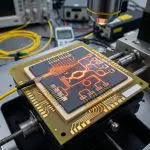
He turned a fragile superconducting circuit into a computer, and the quantum age followed.
Who John Martinis is
John Martinis is an American experimental physicist whose career has tracked the rise of the quantum computer almost note for note. Born in 1958, he has built some of the most coherent superconducting qubits in the world and led the team that announced the first claimed demonstration of quantum supremacy.
Martinis has been a professor of physics at the University of California, Santa Barbara since 2004, and he later co-founded the quantum hardware startup Qolab. In 2025 he shared the Nobel Prize in Physics for foundational experiments on quantum behavior in electrical circuits. His work sits at the practical heart of how a real machine stores and manipulates a fragile unit of quantum information.
Few researchers have moved so fluidly between deep physics and engineering at scale. John Martinis helped prove that quantum mechanics governs circuits you can hold in your hand, then spent decades turning that fact into hardware that computes. That dual identity, part physicist and part builder, defines almost everything he has done.
Early life and education
Martinis earned his bachelor’s degree in physics in 1980 and his doctorate in 1987, both from the University of California, Berkeley. His doctoral adviser was John Clarke, who would later become one of his Nobel co-laureates. The pairing shaped the questions Martinis would chase for the rest of his career.
A doctoral question that became a career
For his PhD, Martinis studied the quantum behavior of a macroscopic variable, the phase difference across a Josephson tunnel junction. That sounds abstract, yet it asks something profound: can a whole electrical circuit, built from countless particles, act like a single quantum object. The answer he and his colleagues found would echo for forty years.
After Berkeley, John Martinis took a postdoctoral position at the CEA research center near Paris before moving to the National Institute of Standards and Technology in Boulder, Colorado. At NIST he worked in the electromagnetic technology division on superconducting quantum interference device amplifiers. That precision-measurement training gave him an unusually rigorous feel for noise, error, and what it really takes to make a quantum signal survive.
The years at a national metrology lab left a permanent mark on his approach. Martinis came to see quantum devices through the eyes of someone who measures things for a living, where every stray signal and every fraction of error matters. That discipline would later separate his qubits from flashier but less reliable competitors.
The physics that won a Nobel Prize
In 1984 and 1985, Martinis, working with Michel Devoret and John Clarke, demonstrated that quantum mechanics can govern a macroscopic electrical circuit. Using superconductors and a Josephson junction, they showed that the circuit could tunnel through an energy barrier and occupy discrete, quantized energy levels, exactly as a single quantum particle would. It was startling evidence that quantum rules do not stop at the atomic scale.
Why a tunneling circuit mattered
These experiments established that a superconducting circuit could be treated as an artificial atom, with controllable quantum states. That insight is the direct ancestor of the modern superconducting qubit, the building block now used by Google, IBM, and superconducting-hardware companies including the one Chad Rigetti founded. Without it, the dominant hardware path in quantum computing would not exist in its current form.
The result was also philosophically bold for its time. Many physicists assumed the strange rules of quantum mechanics would wash out in anything bigger than a single atom, blurred into ordinary classical behavior. By showing a hand-sized circuit tunneling like a single particle, the team pushed the boundary of where quantum effects can live, and that boundary has been expanding ever since.
In October 2025, the Royal Swedish Academy of Sciences awarded the Nobel Prize in Physics to John Martinis, John Clarke, and Michel Devoret for this body of work. The prize recognized experiments that were decades old yet had only grown in importance. What began as a curiosity about big objects behaving quantumly had become the foundation of an industry.
There is a poignant symmetry in the award. John Martinis shared the prize with John Clarke, the very adviser who had guided his doctoral work at Berkeley in the 1980s. The teacher and the student were recognized together for experiments they had performed side by side, a rare and satisfying arc in the history of physics.

Building the superconducting qubit
Long before quantum computing was fashionable, John Martinis was learning to make superconducting circuits behave themselves. At NIST and then at UC Santa Barbara, his group developed high-coherence qubits and the careful measurement techniques needed to read them out without destroying the quantum state. Coherence time, the span over which a qubit keeps its information, became one of his signature obsessions.
His engineering instinct set his work apart. John Martinis treated a qubit not as a physics demonstration but as a component that had to be fabricated reliably, controlled precisely, and scaled up. That attitude, rooted in his metrology years, pushed the field toward chips with many qubits rather than isolated showpieces.
From single qubits to working processors
Making one excellent qubit is hard, but wiring many of them together is harder still. Martinis focused on the unglamorous problems of control electronics, readout fidelity, and crosstalk between neighboring qubits. Solving those engineering bottlenecks is what let his teams move from a handful of qubits to processors with dozens.
By the early 2010s the Martinis group at UC Santa Barbara was producing among the best superconducting qubits anywhere. Those results attracted serious industrial attention, and they explain why a search company would soon want to hire an entire academic team. The qubit had matured from a laboratory marvel into a manufacturable device.
Leading Google to quantum supremacy
In 2014, Google announced it had hired John Martinis and his UC Santa Barbara team in a major deal to build a superconducting quantum computer. Martinis became the head of Google’s quantum hardware effort while keeping his UC Santa Barbara professorship. The mandate was ambitious: demonstrate that a quantum processor could outrun the best classical supercomputers on some task.
The Sycamore processor and a 200-second claim
In 2019 the team published a paper in Nature describing Sycamore, a processor with 53 working qubits. They reported that Sycamore completed a specialized sampling computation in about 200 seconds, a task they estimated would take a leading classical supercomputer roughly 10,000 years. It was framed as the first experimental demonstration of quantum supremacy, the point at which a quantum machine does something no classical machine practically can.
The milestone was a landmark, and it remains one of the defining moments in the field. The phrase quantum supremacy had been coined years earlier by the theorist John Preskill, and Sycamore was the first concrete claim to it. Reaching it required everything John Martinis had built across his career, from coherent qubits to careful calibration and error characterization. You can read the deeper story of that threshold in our explainer on what quantum supremacy means.
The achievement also drew on the broader sweep of progress in the field. It built on decades of incremental advances in superconducting hardware, much of it documented in the longer history of quantum computing. Sycamore did not appear from nowhere; it was the visible peak of a long, patient climb.
The IBM rebuttal and an honest milestone
Google’s claim did not go unchallenged, and the debate that followed was healthy for the field. IBM researchers argued that the 10,000-year figure was too generous to classical hardware. With clever use of a supercomputer’s vast disk storage and optimized algorithms, IBM contended the same problem could be solved in roughly 2.5 days, not millennia.
The disagreement did not erase the achievement so much as sharpen it. Sycamore still solved its task far faster than the classical comparison, even under IBM’s more favorable assumptions. The episode underlined a lasting lesson: claims of quantum advantage must be measured against the best possible classical methods, not convenient ones.
John Martinis himself has spoken carefully about the result in the years since. The honest framing is that Sycamore crossed a meaningful threshold while leaving plenty of room for classical computing to fight back. That tension between quantum promise and classical ingenuity still drives the research today.
A debate that strengthened the field
The exchange between Google and IBM set a useful precedent for how to argue about quantum advantage. It forced researchers to publish their assumptions, share their methods, and invite scrutiny rather than rest on a headline. In that sense the dispute did more good than harm, raising the standard of evidence everyone would be held to.
Leaving Google and founding Qolab
After the supremacy milestone, John Martinis was reassigned to an advisory role with reduced leadership over the team he had built. He resigned from Google in April 2020, later attributing the split to differences in personality and research style with the project’s longtime leadership. He felt he had lost direct control of the hardware effort he cared about most.
A startup aimed at useful machines
John Martinis did not step away from quantum computing. He returned to his UC Santa Barbara research and, in 2022, co-founded Qolab with Alan Ho, a former Google colleague who serves as chief executive, and Robert McDermott, a physics professor at the University of Wisconsin, Madison. As co-founder and chief technology officer, he set out to build superconducting quantum computers that are genuinely useful, not just record-setting.
Qolab’s bet is on manufacturing. Martinis has argued that reaching a million physical qubits will require wafer-scale semiconductor techniques and devices designed for inherently low noise, which would ease the heavy burden placed on error correction. It is a characteristically practical vision from a physicist who always cared how the chip gets made.
The strategy reflects a hard-won belief about where the bottleneck really lies. Rather than chase ever cleverer software fixes for noisy hardware, John Martinis wants to make the hardware quieter at the source. Better physical qubits, he argues, would lighten the load on every layer above them and bring practical machines closer.
The Nobel has widened his reach beyond the lab. In March 2026 the White House named John Martinis to the President’s Council of Advisors on Science and Technology, and in July 2026 Qolab announced a 54.2 million dollar Series B round led by UC Investments to push its wafer-scale manufacturing programme forward. Both suggest the practical, manufacturing-first agenda he has argued for is now being funded and heard at a national level.
Why John Martinis matters in quantum computing
John Martinis matters because he closed the gap between a beautiful idea and a working machine. His 1980s experiments proved that quantum mechanics rules macroscopic circuits, and his later engineering turned that proof into qubits good enough to challenge the world’s supercomputers. Few people have carried a single thread of physics so far into the real world.
His influence reaches across the industry that now races to build fault-tolerant quantum computers. The superconducting qubit at the core of so many efforts traces directly to his lineage of work, and his insistence on coherence, calibration, and manufacturability still sets the standard. The 2025 Nobel Prize confirmed what the field already knew about the importance of his foundational discoveries.
John Martinis also embodies a useful kind of scientific honesty. He pursued a bold milestone, weathered a public technical debate about it, and kept building toward machines that solve real problems. That combination of ambition and rigor is exactly what the next decade of quantum computing will demand.
For anyone trying to understand how quantum computers became real, his career is a compact map. Where Richard Feynman imagined a machine that computes with quantum mechanics, Martinis is among those who made one work. It runs from a curious doctoral experiment through the first superconducting qubits, the most talked-about milestone in the field, and a fresh startup chasing genuinely useful machines. That arc is still unfolding, and his influence on it shows no sign of fading.
Frequently asked questions
Who is John Martinis?
What did John Martinis win the Nobel Prize for?
What is quantum supremacy and what was his role?
What was the Sycamore processor?
Why did IBM challenge the supremacy claim?
Why did John Martinis leave Google?
What is Qolab?
What are superconducting qubits?
Where did John Martinis work before Google?


See today’s quantum computing news on Quantum Zeitgeist for the latest breakthroughs in qubits, hardware, algorithms, and industry deals.