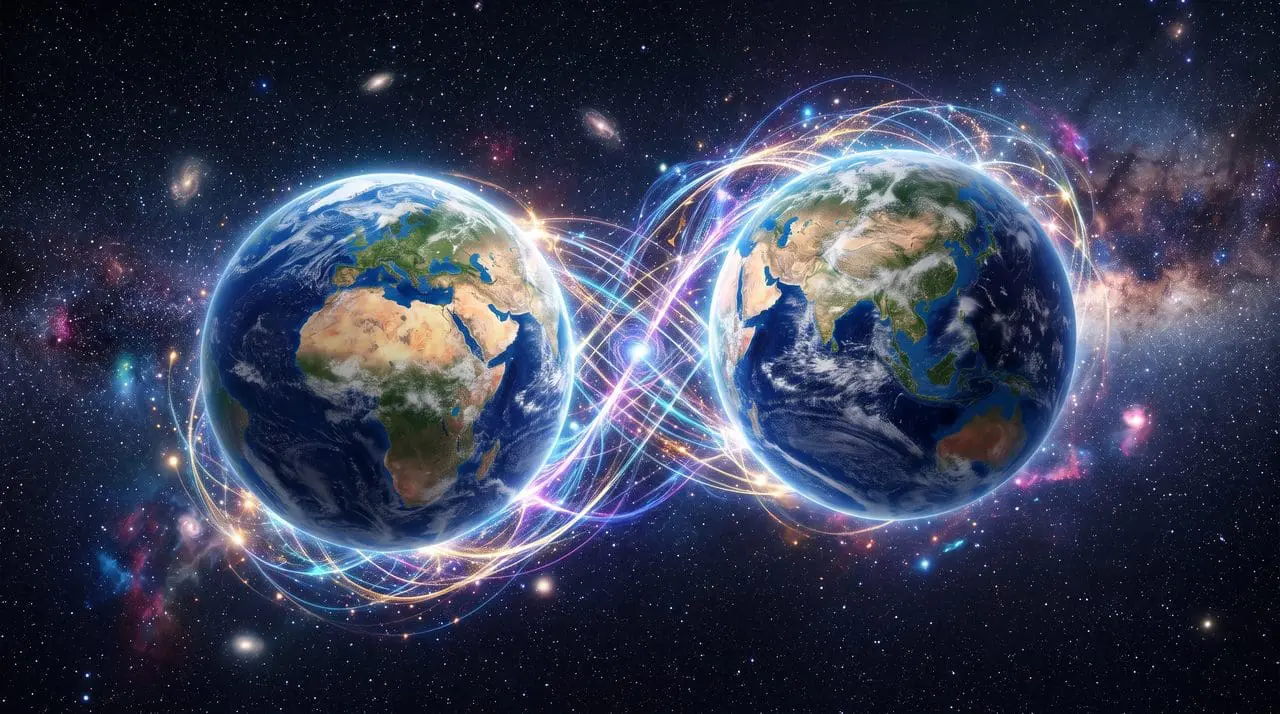
Angelo Gelmini Rodriguez of the University of Geneva and colleagues from Aalto University and PSL University have demonstrated two record-setting quantum memory experiments. In a laboratory setup using 25.3 km of fibre spools, the team stored entanglement across 16,340 temporal modes while storing photons for 125 microseconds. They also distributed entanglement over 5.66 km of metropolitan fibre, storing 8,235 temporal modes for 63 microseconds. Together, these achievements significantly advance high-capacity quantum communication using broadband rare-earth quantum memories.
Angelo Gelmini Rodriguez and colleagues achieved a record 16,340 temporal modes of entanglement storage, dramatically increasing the capacity of quantum memories by enabling many more photonic modes to be stored simultaneously. The system employed a rare-earth-ion ensemble within a specially designed quantum memory, allowing efficient storage of quantum information while maintaining high bandwidth.
The researchers further validated the approach by distributing entanglement across 5.66 km of metropolitan fibre, storing photons for up to 63 microseconds and demonstrating the technology’s suitability for real-world quantum networks. The experimental results and quantitative analysis show how high-capacity, long-lived quantum memories could support future long-distance quantum communication.
Extended quantum memory entanglement facilitates high bandwidth fibre optic communication
A substantial leap beyond the previous record of 1,650 stored temporal modes, the researchers demonstrated storage across 16,340 temporal modes, substantially increasing the multiplexing capacity of quantum memories. This breakthrough unlocks the potential for sharply increased data transmission rates in quantum communication networks. Maintaining quantum coherence and efficiently managing the broadened bandwidth required for multiplexing previously presented challenges to storing entanglement across such many modes. Mikael Afzelius and colleagues at the University of Geneva successfully demonstrated entanglement between a telecommunication photon and a stored photon, utilising a 171Yb3+:Y2SiO$5 crystal; its unique properties enable the simultaneous storage of multiple photonic modes.
A 25.3km fibre optic cable carried the photon, while a 979nm photon was stored within a quantum memory for 125 microseconds, successfully generating entanglement. The 171Yb3+:Y2SiO5$ crystal exhibited a 250MHz bandwidth and a photon storage lifetime of 76.6 microseconds, parameters crucial for efficient multimode storage.
Quantifying the effective temporal mode capacity with Schmidt decomposition demonstrated storage across 16340 temporal modes, and the system was further deployed within Geneva’s fibre network, distributing entanglement over 5.66km while storing 8235 modes for 63 microseconds. Despite these advances, the demonstrated coherence lifetime of 307 microseconds remains shorter than the material’s potential 1 millisecond optical coherence time, suggesting a remaining gap before fully realised, practical long-distance quantum communication is achieved.
Metropolitan quantum networks enabled by long-lived rare-earth storage
Storing entanglement across thousands of temporal modes represents a step towards building practical quantum repeaters, devices essential for extending the range of secure quantum communication. A significant gap persists between demonstrated coherence lifetimes and the theoretical limits of the material itself, indicating that further optimisation is needed to unlock the full potential of the Yttrium orthosilicate crystal. Validating the potential of this approach for real-world networks, successful distribution of this entanglement occurred over 5.66km of metropolitan fibre, storing photons for up to 63 microseconds. Precisely controlling the absorption properties of a yttrium orthosilicate crystal doped with ytterbium ions was achieved by Mikael Afzelius and colleagues; these devices are essential for extending the distance of secure quantum communication, overcoming the inherent limitations of signal loss in fibre optic cables. Information was successfully stored within a rare-earth-ion ensemble, specifically a yttrium orthosilicate crystal, for a useful duration, though theoretical performance benchmarks remain unmet.
Storing entanglement across 16340 temporal modes demonstrates a pathway towards building quantum repeaters for long-distance communication. This achievement matters because it allows for greater data capacity and more efficient use of quantum memories, essential for overcoming signal loss in fibre optic cables.
Researchers successfully distributed entanglement over 5.66km of fibre in Geneva, storing photons for up to 63 microseconds, and they are working to extend coherence lifetimes closer to the theoretical maximum of 1 millisecond. The team quantified the effective temporal mode capacity using Schmidt decomposition to validate the performance of their ytterbium-doped yttrium orthosilicate crystal.
👉 More information
🗞 Entanglement distribution and quantum storage of more than 8000 modes over a metropolitan network
✍️ Angelo Gelmini Rodriguez, Louis Nicolas, Théo Sanchez Mejia, Pavel Sekatski, Nicolas Brunner, Towsif Taher, Rob Thew, Philippe Goldner and Mikael Afzelius
🧠 ArXiv: https://arxiv.org/abs/2608.13177


See today’s quantum computing news on Quantum Zeitgeist for the latest breakthroughs in qubits, hardware, algorithms, and industry deals.