The Caltech theorist who named two eras of the field, coining quantum supremacy and the term NISQ, and who helped turn quantum error correction into a working science.
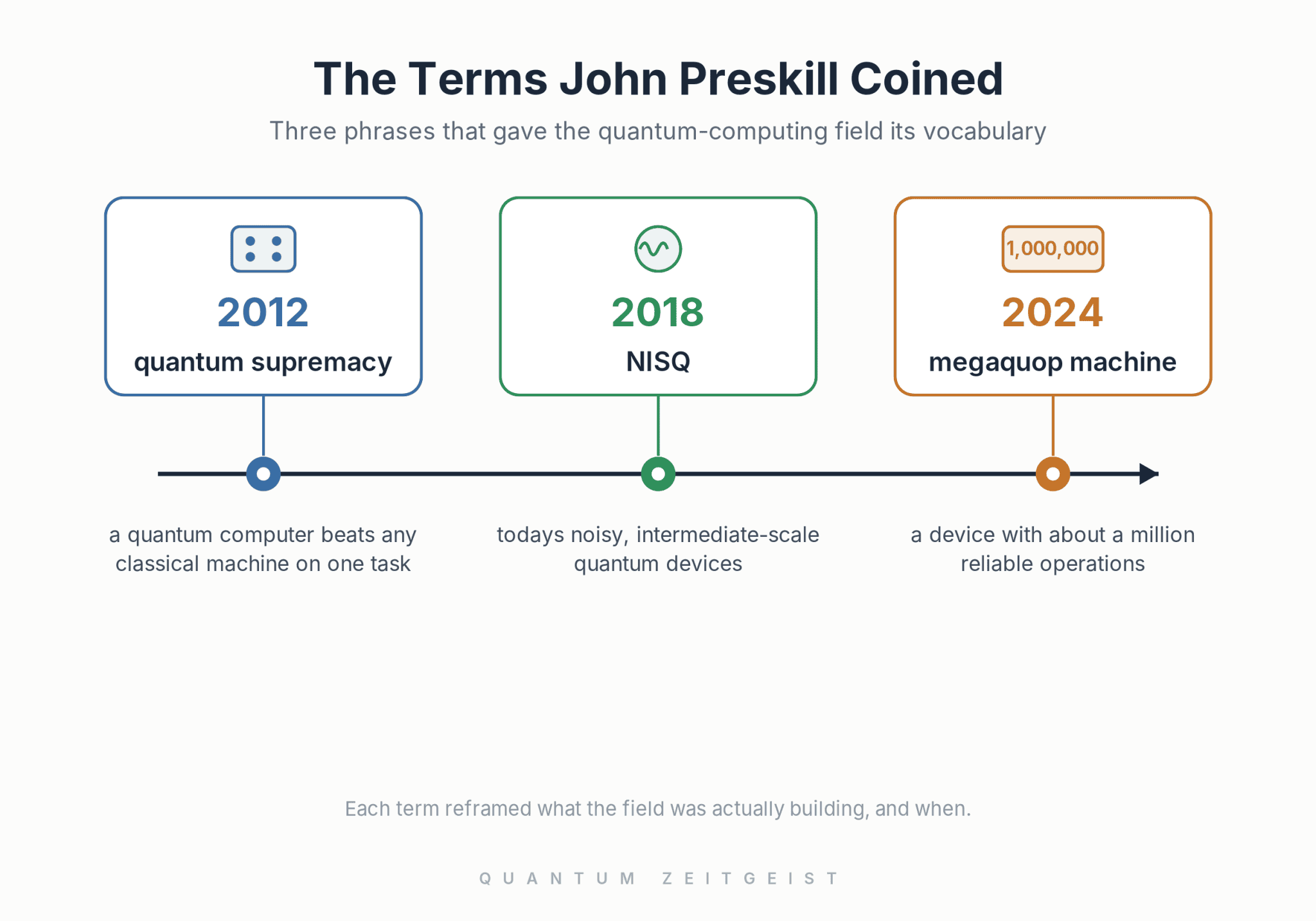
✓ Coined “quantum supremacy” (2012), “NISQ” (2018), and the “megaquop machine” (2024), shaping how the field names its own progress.
✓ Directs Caltech’s Institute for Quantum Information and Matter and holds the Richard P. Feynman Professorship of Theoretical Physics.
✓ Trained Daniel Gottesman, inventor of the stabilizer formalism behind most modern quantum error-correcting codes.
✓ Showed, with Pastawski, Yoshida, and Harlow, that quantum error-correcting codes can model how spacetime itself is organized in holographic theories of gravity.
✓ Appointed in December 2022 to the White House’s National Quantum Initiative Advisory Committee, the federal body that advises the President on quantum policy.
✓ Won the 2024 John Stewart Bell Prize for contributions to quantum information science.
The physicist who named the field
John Preskill is the American theoretical physicist who has done more than almost anyone to give quantum computing its language. From his base at Caltech he coined both quantum supremacy and the term NISQ, two phrases that now organise how researchers, companies, and journalists talk about progress.
Naming things well is an underrated power in science, because a sharp term can focus a whole community on the right question. Preskill has supplied that clarity twice, and in doing so he has shaped the goals the field sets for itself.
Behind the vocabulary sits a serious body of work on quantum information, error correction, and the deep physics of how information behaves. He is a theorist whose ideas reach from black holes to the design of practical quantum machines.
From particle physics to quantum information
John Preskill did not begin his career in quantum computing at all. His early research was in particle physics and cosmology, including influential work on magnetic monopoles and the physics of the very early universe.
A change of direction
In the 1990s he turned toward the emerging science of quantum information, drawn by the realisation that the strange features of quantum mechanics could be exploited for computation. The move proved perfectly timed, as the field was about to take off.
He brought to it the rigour of a particle theorist and a gift for seeing the big structural questions. That blend let him help build quantum information theory into a serious discipline rather than a collection of clever tricks.
Education and the road into quantum information
Preskill earned his PhD in physics from Harvard University in 1980, working under Steven Weinberg, the Nobel laureate who helped unify the electromagnetic and weak forces into a single theory. He stayed at Harvard for three more years, first as a Junior Fellow in the Society of Fellows and then on the faculty as an assistant and associate professor, before joining Caltech as an associate professor of theoretical physics in 1983.
The monopole problem and cosmic inflation
As a graduate student, Preskill turned his attention to magnetic monopoles, hypothetical particles that would carry an isolated north or south magnetic pole rather than the paired poles found in every ordinary magnet. He showed that Grand Unified Theories, which attempt to merge the strong, weak, and electromagnetic forces into one framework, predict that the hot early universe should have produced enormous numbers of these monopoles.
The trouble was that no one had ever observed a single one, a mismatch that became known as the monopole problem. That gap between prediction and observation was one of the puzzles that Alan Guth’s theory of cosmic inflation was built to resolve, since a brief burst of extremely rapid expansion would dilute any monopoles down to a density far below what telescopes could ever detect. The episode put Preskill’s name in cosmology years before quantum computing existed as a distinct field of study.
A theorist before quantum information existed as a discipline
Through the 1980s he continued to work on cosmic strings and other topological defects left behind by the early universe’s cooling, on nonperturbative effects in quantum field theory, and on the physics of black holes. Caltech promoted him to full professor in 1990, named him the John D. MacArthur Professor in 2002, and gave him his current title, the Richard P. Feynman Professor of Theoretical Physics, in 2010, a chair named for the Caltech physicist whose 1980s proposal that quantum systems be simulated by quantum machines helped set the field in motion.
His shift toward quantum information came in the mid-1990s, prompted by two breakthroughs elsewhere in the field: Peter Shor’s discovery of a quantum algorithm for factoring large numbers in 1994, and the first quantum error-correcting codes the following year. Together they showed that a quantum computer was not just a mathematical curiosity but could in principle be shielded from noise well enough to run a long, useful calculation. Preskill redirected his research toward that possibility and never really left it, carrying the same rigor he had once applied to monopoles and black holes into the study of qubits.
Coining quantum supremacy
In 2012 Preskill introduced the phrase quantum supremacy to describe the moment a quantum computer performs a task beyond the reach of any classical machine. The term gave the field a clear, dramatic milestone to aim at and argue about.
When Google reported reaching that milestone in 2019, the debate that followed used Preskill’s framing throughout. The word focused attention on a precise scientific claim, even as researchers disagreed about exactly when and whether it had been met. The argument has only sharpened since, from Google’s later move to a verifiable quantum advantage to D-Wave’s contested claim of supremacy on a useful problem, each weighed against the bar Preskill set.
He has been careful to stress that supremacy is a scientific benchmark, not a promise of useful applications. That nuance, often lost in headlines, is central to how he thinks the milestone should be understood.
The NISQ era
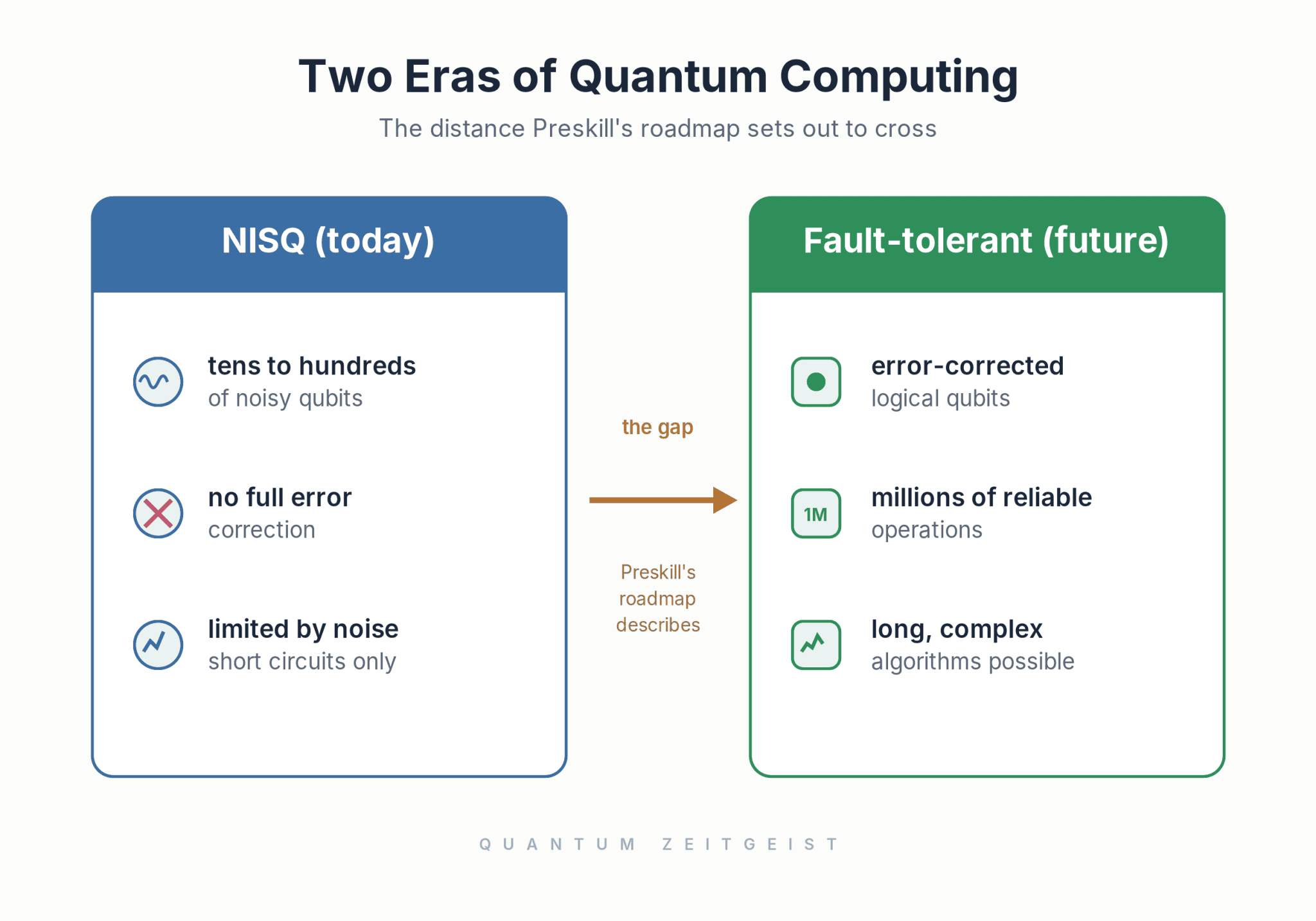
In 2018 Preskill coined a second defining term, NISQ, short for noisy intermediate-scale quantum. It names the present era of devices that have tens to hundreds of qubits but lack full error correction, so noise still limits what they can do.
A realistic label for today’s machines
The NISQ idea cut through hype by describing honestly what current hardware can and cannot achieve. It acknowledged real progress while making clear that fault-tolerant, large-scale quantum computing still lay further ahead.
The term has become standard across academia and industry, shaping research agendas and investor expectations alike. Few pieces of jargon have so quickly become indispensable to an entire field.
Quantum error correction and fault tolerance
Much of Preskill’s deepest work concerns quantum error correction, the set of techniques that protect fragile quantum information from noise. Without it, decoherence caused by the surrounding environment would wash out any long computation.
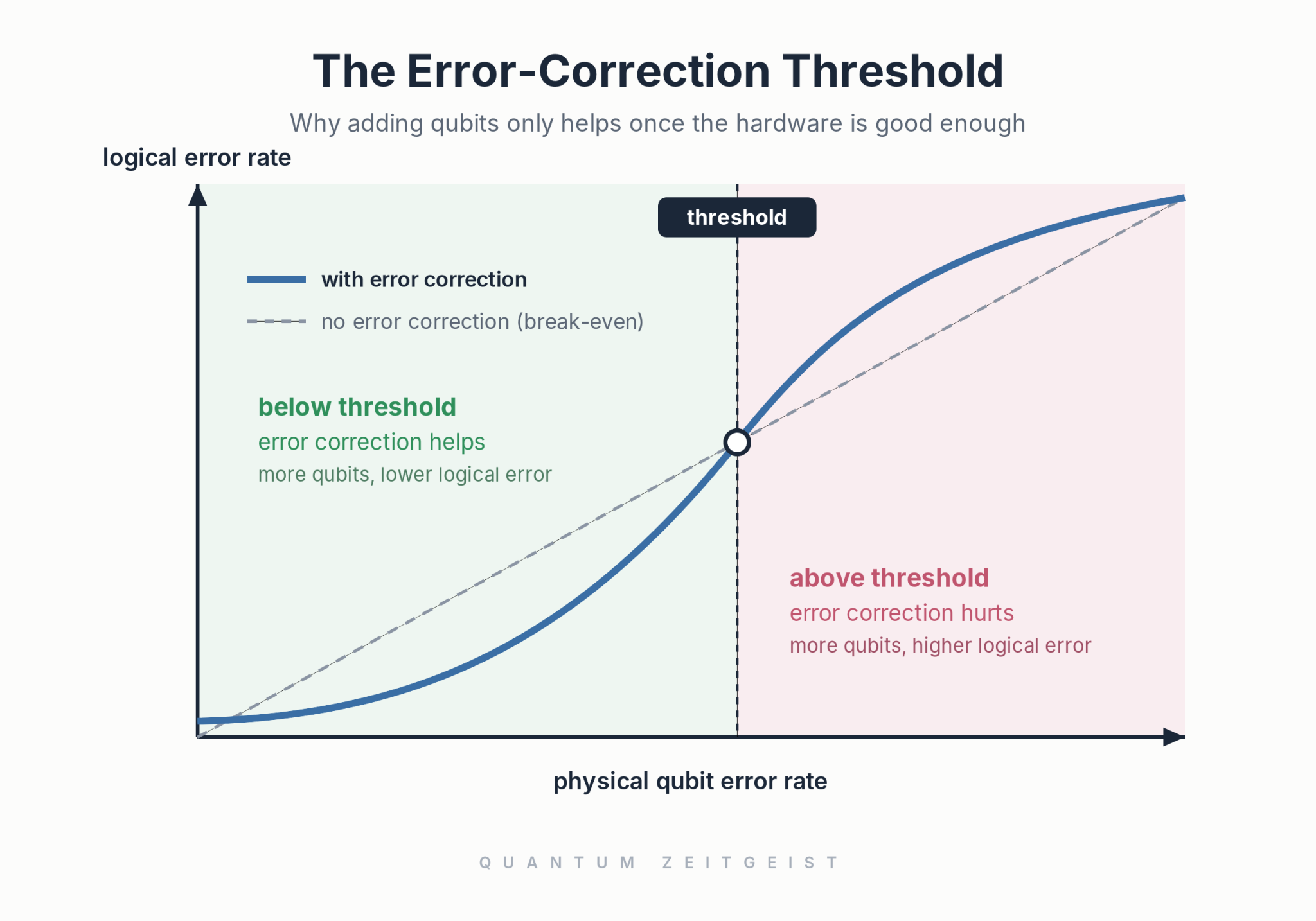
He helped develop the theory of fault tolerance, which shows how a reliable quantum computer can be built from imperfect parts. These results are the reason the field believes large-scale quantum computing is possible in principle, not just in dreams.
A bridge between physics and information
Preskill has also explored the surprising links between quantum information and fundamental physics, including how ideas from error correction illuminate black holes and spacetime. His 1997 bet with Stephen Hawking on the black hole information paradox, which he won, came from exactly this territory.
This two-way traffic, using physics to improve computing and computing to probe physics, is characteristic of his thinking. It has helped make quantum information one of the most intellectually fertile areas of modern science.
Where quantum information meets gravity
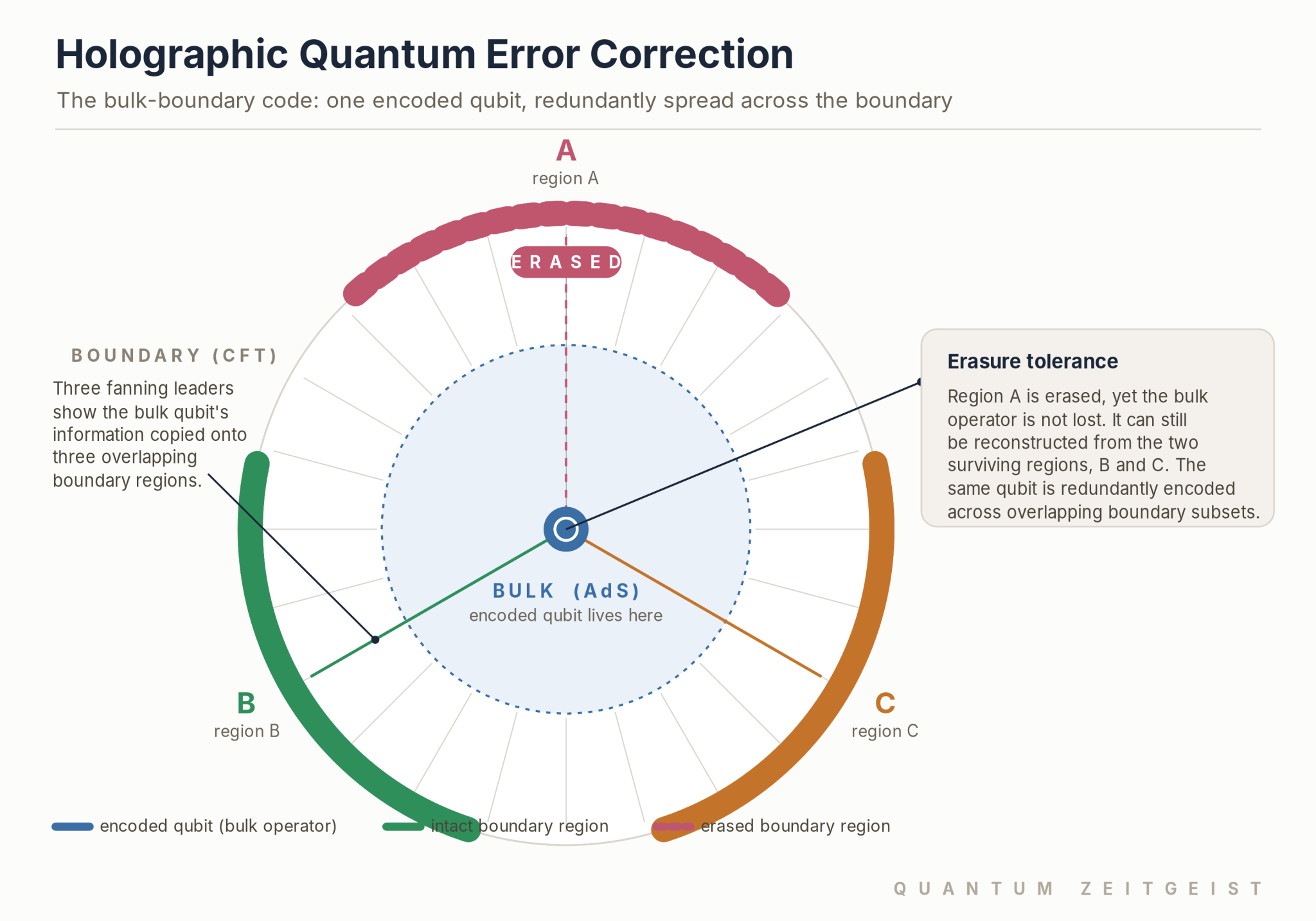
Some of Preskill’s most striking recent work connects quantum computing and the physics of spacetime. He and his collaborators showed that the mathematics of quantum error-correcting codes mirrors the way information is organised in certain theories of gravity.
Error correction as a model of spacetime
The idea is that the geometry of space in a so-called holographic theory behaves like a code that protects information against erasure. This surprising dictionary lets insights from quantum computing illuminate questions about black holes, and the reverse.
For Preskill, this is the natural continuation of his old wager with Hawking, now pursued with the precise tools of quantum information. It treats the universe itself as a kind of error-correcting machine, an image that has reshaped how many physicists think.
The work shows why he resists drawing a hard line between pure physics and computing. In his hands the two fields are a single conversation, each lending the other its sharpest questions.
A teacher, an adviser, and a public voice
Beyond his research, John Preskill is one of the field’s most influential teachers and communicators. His lecture notes on quantum computation have educated a generation of students and are read worldwide, far beyond the Caltech classrooms where they began.
As director of the Institute for Quantum Information and Matter at Caltech, he has built a leading centre where physics and computer science meet. He has also worked with industry, serving as an Amazon Scholar at the AWS Center for Quantum Computing from 2020 to 2026 and then joining Oratomic, the neutral-atom quantum computing company spun out of Caltech and Harvard, as a senior scientist in 2026.
Lowering the barrier to entry
Preskill is a prominent voice online as well, explaining quantum ideas to a broad audience with unusual clarity and candour. He is as willing to flag what remains unknown as to celebrate what has been achieved, which is part of why people trust him.
That openness has helped the field grow beyond a small circle of specialists. By naming its milestones, teaching its methods, and advising those building real machines, he has lowered the barrier for newcomers entering quantum science.
Mentor to a generation of quantum scientists
Over four decades at Caltech, Preskill has supervised dozens of doctoral students, and several of them became leading figures in quantum information science in their own right. The best known is Daniel Gottesman, who completed his Caltech PhD under Preskill in 1997 and went on to develop the stabilizer formalism, a mathematical framework that still underlies most practical quantum error-correcting codes, including the surface code used by today’s leading hardware makers.
Other researchers who passed through his group include Graeme Smith, known for showing that two quantum communication channels can sometimes carry more information together than the sum of their separate capacities, a strange effect with no classical counterpart, and Nicole Yunger Halpern, a quantum thermodynamicist who later wrote a popular book explaining her field to a general audience. Both extended, in different directions, the same tradition of taking abstract quantum theory and asking exactly how much it can actually do.
A partnership with Patrick Hayden on black holes
Preskill also worked closely for years with Patrick Hayden, who joined Caltech as a postdoctoral scholar after completing his own doctorate at Oxford under Artur Ekert, rather than as one of Preskill’s formal graduate students. Their collaboration produced the Hayden-Preskill result, a calculation of how quickly information about matter falling into a black hole re-emerges scrambled into its Hawking radiation.
The result is still cited widely in discussions linking quantum information theory to the physics of gravity, and it treats a black hole almost as if it were an extremely fast, extremely scrambling quantum computer. Taken together with his formal doctoral students, it shows how deliberately Preskill built a research group that crosses the usual boundary between computer science and fundamental physics, training people who could speak both languages fluently.
That legacy continues today. Preskill’s students and postdoctoral researchers have gone on to found their own research groups at other universities, meaning that the intellectual lineage he began now stretches across much of the field’s leading institutions, from Perimeter Institute to Stanford to NIST.
Quantum Frontiers and a public voice online
Preskill is a frequent and prominent contributor to Quantum Frontiers, the blog run by Caltech’s Institute for Quantum Information and Matter since 2012. His posts there cover quantum computing, quantum gravity, and the everyday culture of doing physics, written for a general readership rather than only for specialists in his own field.
The blog gives him a venue that a journal paper cannot, a place to explain why a new result matters, or does not, in plain language soon after it happens. That kind of fast, accessible commentary has become an important part of how the wider public and even other scientists first make sense of a fast-moving field.
An active voice on social media
He is also an active presence on social media, posting as @preskill on X, where he explains new quantum computing results and pushes back on overhyped claims in something close to real time. That mix of research authority and plain-spoken commentary has made him one of the field’s most trusted public voices, on a subject where hype and substance are not always easy to tell apart for outsiders.
Naming the megaquop machine
His habit of coining useful terms has continued well past NISQ. In December 2024 he proposed the idea of a megaquop machine, a quantum computer capable of roughly a million reliable logical operations, as a concrete milestone for the era that follows today’s noisy devices.
The term gives researchers and companies a specific number to build toward, in much the same spirit as quantum supremacy and NISQ before it. It is a reminder that Preskill’s influence on the field’s vocabulary did not end in the 2010s, and that he keeps supplying the field with language for whatever comes next, whether that is a milestone already reached or one still years away.
Beyond NISQ, toward useful machines
Having named the NISQ era, Preskill has also thought carefully about what should come after it. He frames the central challenge as crossing from noisy prototypes to fault-tolerant machines that can run long computations reliably.
He has argued that the most valuable early applications may be in simulating quantum systems themselves, such as molecules and materials, where a quantum computer is matched naturally to the problem. That view steers researchers away from overpromising on tasks where classical methods remain strong.
At the same time he urges patience about timelines, noting that genuinely transformative applications may take many years of hardware progress. His measured optimism has become a reference point for how to talk about the field’s future without hype.
This forward-looking realism is the same instinct that produced the NISQ label in the first place. It keeps expectations tied to what the physics and engineering can actually deliver.
He has been equally clear that the path runs through better hardware and better error correction together, not one without the other. Reducing error rates and increasing qubit counts are, in his telling, two halves of the same engineering problem.
That framing has helped funders and founders alike judge progress by the right yardsticks rather than by headline qubit numbers alone. It is a quieter contribution than naming an era, but arguably just as influential.
A voice in national quantum policy
Preskill’s influence reaches beyond the lab and the lecture hall into science policy. In December 2022 he was appointed by the President to the National Quantum Initiative Advisory Committee, the federal body created under the National Quantum Initiative Act to guide the White House and the National Science and Technology Council on the direction of American quantum research.
The committee weighs both the scientific opportunities and the economic and security stakes of quantum technology, giving Preskill a direct role in shaping how the United States invests in the field he helped define. The appointment placed one of quantum computing’s founding theorists squarely inside the national conversation about where the technology should go next.
That conversation increasingly involves billions of dollars in public funding rather than only academic papers, as governments around the world commit large sums to quantum research and compete for talent and manufacturing capacity. Advisory committees like this one are where the technical judgment of scientists such as Preskill meets the political and budgetary decisions that determine how quickly, and in what direction, the technology actually develops.
It is a fitting role for someone who has spent much of his career insisting on honest, carefully hedged claims about what quantum computers can and cannot yet do. The same instinct that produced NISQ, a term designed to puncture hype rather than add to it, is well suited to a seat advising policymakers who must decide how much of the excitement around quantum computing to take at face value.
Honors, lectureships, and a career of recognition
Long before the 2024 Bell Prize, Preskill’s standing in physics was already well established. He was elected a Fellow of the American Physical Society in 1991 and a member of the National Academy of Sciences in 2014, two of the most selective marks of recognition available in American science.
He has also delivered many of physics’ most prestigious named lectures, including the Lorentz Chair at Leiden, the Rouse Ball Lecture at Cambridge, the Loeb Lectures at Harvard, and the American Mathematical Society’s Josiah Willard Gibbs Lecture, an itinerary that reads like a tour of the world’s leading physics departments. Invitations of that kind are typically reserved for researchers whose work has already reshaped how a subject is taught, not only how it is studied.
Recognition as a teacher as well as a researcher
Caltech students have twice voted him their Associated Students of Caltech Teaching Award, a sign that his gift for explanation reaches the classroom as much as it does his public writing and his research papers. Few physicists manage to be recognised at this level for teaching, communication, and original research all at once.
In 2025 the Quantum World Congress added its Academic Pioneer in Quantum award to that list, recognising decades of work that helped build the field from a handful of speculative papers in the 1990s into a global research effort involving governments, universities, and some of the world’s largest technology companies. Taken together, the honors trace a career recognised at almost every stage, from a young theorist solving cosmological puzzles about magnetic monopoles to an elder statesman shaping how nations plan their quantum future.
Why John Preskill matters in quantum computing
John Preskill matters because he has given quantum computing both its conceptual milestones and much of its theoretical backbone. The terms quantum supremacy and NISQ frame how the entire field measures itself, and his work on error correction sustains its long-term promise.
He has also modelled a rare combination of depth and honesty, celebrating real progress while refusing to oversell it. In a field prone to hype, that steadiness has made him a trusted reference point for scientists and the public alike.
Recognised with the 2024 John Stewart Bell Prize and a long list of honours, Preskill remains at the centre of the conversation he helped start. As fault-tolerant machines come into view, the questions he sharpened are the ones the industry is racing to answer.
His influence is unusual in that it runs through vocabulary as much as through theorems, shaping how thousands of people frame the problem before they write a line of code. Few scientists get to name the eras of their own field, and fewer still do it twice.
For students entering quantum science today, John Preskill is both a foundational reference and a living guide to where the work is headed. That combination of authority and accessibility is rare, and it is a large part of why his profile looms so large over the discipline.
Frequently asked questions
Who is John Preskill?
What does quantum supremacy mean?
What is NISQ?
Did John Preskill really coin quantum supremacy?
What is John Preskill known for in research?
What was the Preskill and Hawking bet?
Where does John Preskill work?
Why does John Preskill matter to quantum computing?
Has John Preskill won major awards?
Where did John Preskill get his PhD?
Who are some of John Preskill’s notable students?
What is Quantum Frontiers?
What is the megaquop machine?
Has John Preskill advised the United States government on quantum policy?
What other honors has John Preskill received?



See today’s quantum computing news on Quantum Zeitgeist for the latest breakthroughs in qubits, hardware, algorithms, and industry deals.